• BFA25 Review: Nova Scotia Vol 2 edited by Neil Williamson and Andrew J Wilson [2024]

    This is the first review from my challenge to read the 2025 British Fantasy Award Best Anthology category.

    Nova Scotia 2 Cover Art

    An anthology, to me, is a little bit like a selection box—mostly treats you’ve never tried before. There might be an author or two you’ve read previously, but for the most part, they’re new experiences. And I can say that’s true of this anthology.

    Jon Courtenay Grimwood and Ken MacLeod are authors I’ve read and enjoyed before. The others—apart from Grant Morrison—were unknown to me.

    The editors, Neil Williamson and Andrew J. Wilson, in their introduction to this collection of new speculative fiction from Scotland, ask and answer the question: What is speculative fiction?

    “It’s writing that challenges consensus reality. Speculative fiction includes science fiction, fantasy, horror, and all the variants and subgenres of these imaginative approaches to storytelling. What does it have to do with Scotland? Everything!”

    They also explain how they see the contributors’ connection to Scotland:

    “The contributors are all Scots. They’re Scottish in the broadest sense: some were native-born while others have chosen to make their home here; some are Highlanders and islanders, others urbanites; and this gives us an extraordinary range of perspectives. We wanted this collection to be inclusive, not exclusive, and we wanted not only the tight focus of introspection, but also the ability to see ourselves, as Burns had it, as others see us.”

    Did every story give me a sense of connection to Scotland? Not quite. There were definitely some stories that didn’t evoke that feeling, despite the editorial postscript often trying to explain the link. That sense of connection swings from strong to weak, and in a couple of cases, I felt their inclusion was tentative at best.

    The opening story by Ken MacLeod threw me slightly. It resurrects two folk singers from an earlier story (Newton’s Wake)—I’ve no idea how significant they were, as I’ve never met them before. Ken places them on a future Mars where AIs have not been a gift to humanity. But what niggled me was the use of “Joint Chiefs” in a military context. It felt like an odd Americanism in a story that should centre Scotland.

    Not understanding the importance of political and protest songs to Scotland reflects my own ignorance. And opening with what ends up being a very clever story, with multiple layers, set me up for the whiplash that followed.

    The whiplash effect comes from jumping between strong voices—at least at the beginning. There’s a TV star whose family traditions lie in curses, a homecoming that could lead to confrontation, a detective who gets too nosy about a specialist investigation team, and a good old-fashioned locked-room murder.

    A story that’s exceptional but felt out of place is Lise and Otto by Pippa Goldschmidt. It describes the rise of the Nazis but doesn’t, as hinted in the introduction, lean into the idea of “as others see us.”

    Another story I enjoyed was Broderie Écossaise by Eris Young. Again, it lacked a grounding in Scotland, though I’m glad I read such a clever story about embroidery and desire.

    We slip into body horror with Grimaldo the Weeping, as Ali Maloney explores the power of stories—and how often they’re closer to reality than we’d like.

    Junior by Lindz McLeod floored me. You’ll see why when you read it.

    There were also a few skips—sorry, Grant, I just couldn’t get into it.

    There’s environmental exploration in a couple of stories, volunteering that goes wrong, and the cutest—but saddest—dodo story.

    I need Doug Johnstone to write another story set in the world of Under the Hagstone—ideally with the same characters.

    There were more skips, and a few misses, but overall I’d say there’s enough variety and story strength to justify reading this all the way through—skipping where appropriate.

    Anthology Details

    • Title: Nova Scotia Vol 2: New Speculative Fiction from Scotland
    • Editors: Neil Williamson, Andrew J. Wilson
    • Publisher: Luna Press Publishing
    • Publication Date: July 30, 2024
    • ISBN: 978-1915556431
    • Format: Paperback
  • SR Review: Creation Lake by Rachel Kushner [2024]

    Second (or Spoiler) Read Reviews are written for readers who already know about a book or don’t mind a spoiler or three. Expect plot reveals and in-depth discussion of the book’s events.

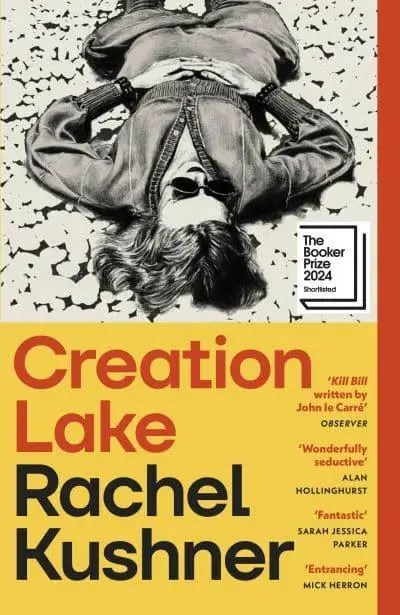
    Cover of Creation Lake by Rachel  Kushner

    WARNING. SPOILERS FROM THIS POINT ON 

    My interest in reading Creation Lake was sparked by a mistaken categorisation of it as science fiction. It’s not. It is, however, science-infused fiction.

    That’s one of the things that kept me going—the main character and first-person narrator’s paraphrasing of various emails focused on Neanderthals and Homo sapiens, which were also supposed to contain hidden messages about the intentions of an activist group she was sent to spy on.

    I should have put it down when the email summaries stopped; without them, it lost its magic. It felt like there was a moment when the author realised she needed to do something with all these vibes and start planning for an ending.

    I can see why it made it to The Booker Prize 2024 shortlist. It lingers. It lingers. I imagine it would spark a great book club discussion.

    The character repeatedly tells us she’s an agent provocateur—and not a good one. In the end, the incident she’s meant to instigate would have happened without her, which makes it all feel a little pointless. Actually, that’s unfair. She does whip up the crowd, forcing the target to be in the wrong place at the right time.

    There’s no grand conspiracy. There’s commentary on wealthy people playing saviour to those their peers have oppressed and ignored. There’s also a lot of information imparted about evolution.

    It’s like a weird fever dream of a secret agent’s summer holiday—one that both we and the author eventually wake up from. It’s one I feel I’d rather not have had.

  • Challenge: Award Reading x 2

    Based on my last post on DNF’ing, this is probably unwise, but I’ve been thinking about setting myself the challenge of reading a shortlist or at least a category from an award’s shortlist.

    This idea was fuelled by the FOMO from seeing all the discussions around this year’s ARTHUR C. CLARKE AWARD

    Out of this year’s shortlist, I’ve read two, DNF’d two, heard very interesting things about one I’ve not read, and not heard a lot about the other unread one:

    • Annie Bot by Sierra Greer – see a spoiler-filled thoughts here
    • Private Rites by Julia Armfield – To Be Read
    • The Ministry of Time by Kaliane Bradley – DNF’d
    • Extremophile by Ian Green – DNF’d
    • Service Model by Adrian Tchaikovsky – Read
    • Thirteen Ways to Kill Lulabelle Rock by Maud Woolf – To Be Read

    Whilst this was all bubbling away in my brain, another two award shortlists were announced:

    1. British Fantasy Awards 2025
    2. World Fantasy Awards 2025

    I floated the idea on Bluesky of reading and reviewing the BFA Best Anthology category, and I’ve publically committed to doing that before the announcement at the end of October, which will be done as part of the World Fantasy Convention.

    Infographic of the shortlisted titles:

Nova Scotia 2, edited by Neil Williamson and Andrew J Wilson – Luna Press Publishing
I Want That Twink Obliterated!, edited by Trip Galey, C.L. McCartney, and Robert Berg – Bona Books
Fight Like A Girl 2, edited by Roz Clarke and Joanne Hall – Wizard’s Tower Press
Heartwood: A Mythago Wood Anthology, edited by Dan Coxon- PS Publishing
The Year’s Best African Speculative Fiction (2023), edited by Oghenechovwe Donald Ekpeki and Chinaza Eziaghighala – Caezik SF & Fantasy
Bury Your Gays – An Anthology of Tragic Queer Horror, edited Sofia Ajram – Ghoulish Books
Jurors: Kristen Platt, Steven French, Ariana Weldon, Stuart Conover, Jacqui Greaves

    The only thing is that I don’t think I’ve reviewed an anthology before, so I asked the experts. Runalong Womble gave me a great template:

    • How is the theme developed or explored throughout the anthology?
    • Does the mix of stories work effectively together?
    • Which stories stood out to you, and why?

    Thanks Womble.

    The World Fantasy Awards also take place during the World Fantasy Convention, and as I am planning on attending, I thought I’d also read and review of one of the WFA shortlists. This time, I’m going for the novellas:

    • Crypt of the Moon Spider by Nathan Ballingrud (Tor Nightfire/Titan Books)
    • In the Shadow of Their Dying by Michael F. Fletcher and Anna Smith Spark (Grimdark Magazine)
    • Yoke of Stars by R. B. Lemberg (Tachyon Publications)
    • The Woods All Black by Lee Mandelo (Tordotcom)
    • The Butcher of the Forest by Premee Mohamed (Tordotcom/Titan Books UK)

    That’ll keep me busy from now until October.

    I say busy. I do plan on completing the Clarke Award reading of Private Rites by Julia Armfield and Thirteen Ways to Kill Lulabelle Rock by Maud Woolf. And the TBR pile is overflowing, and I need to get it down.

    Are you planning on reading any shortlists from these two awards? If so, which ones?

  • Thoughts: Embracing the DNF

    This week, I have DNF’d (Did Not Finish), aka started but not finished the following books:

    • The Ministry of Time by Kaliane Bradley [2024]
    • Floating Hotel by Grace Curtis [2024]
    • Extremophile by Ian Green [2024]

    And in May, I DNF’d:

    • The Employees: A Workplace Novel of the 22nd Century by Olga Ravn [2018]
    • Under the Eye of the Big Bird by Hiromi Kawakami [2016/2025]

    And before that, I was struggling with the following:

    • Red Sonja: Consumed by Gail Simone [2024]

    That one actually put me in a reading slump. 

    Are they ‘bad’ books? Definitely not. They’ve got mainly positive reviews. A Womble, for example, enjoyed The Ministry of Time and Extremophile. Most of them are award-shortlisted, so someone has definitely advocated for them. 

    Do they work for my brain? No. At least, they didn’t work for me when I picked them up. And part of my brain won’t let go of them. Why didn’t I like them? Why did other people enjoy what I did not?

    It’s those kinds of spirals that cause a short circuit.

    joked on Bluesky that the theme for the rest of 2025 is: 

    DNF With Gay Abandon.

    I am considering getting it printed on a t-shirt.

    A T-Shirt with a logo of a book in the middle. Above that is 'DNF' and below is, 'With Gay Abandon'
    T-Shirt Idea

    What I don’t want to do is put myself in the position of another reading slump. They are brutal. I am giving myself permission to DNF for the silliest of reasons without guilt.

    It might be the book, or it might be me, but I’m going to try not to read too much into it if you don’t? 

    Though I don’t understand how anyone made sense of Under the Eye of the Big Bird… 

    I’m leaving this post here before I get myself in trouble.

    But before I do, I’ve avoided a slump. I’m reading Creation Lake by Rachel Kushner [2024], and the narration is doing the right things for my brain. 

  • FR Review of The Stars Too Fondly by Emily Hamilton [2024]

    First Read Reviews (FR Reviews) are written for readers who want to know whether a book is worth picking up and what it might be about. There may be mild spoilers, but no in-depth discussion of the book’s events.

    The publishers describe The Stars Too Fondly as:

    “Part space odyssey, part Sapphic romcom, and all spaceship-stealing fun, Emily Hamilton’s breathtaking debut is a wild tale of galaxy-spanning friendship, improbable love, and wonder as vast as the universe itself.”

    After finishing it last night, I mostly agree.

    Hamilton weaves a well-constructed story of strange energy, making the best of bad circumstances, and unsustainable love.

    I can’t remember why I bought it—maybe I just needed more fun, space-based sci-fi. I read it now because June was Pride Month, and I was hoping for some queer joy. That’s exactly what Emily Hamilton delivered.

    Four friends want to know what happened to the missing crew of a spaceship, so they break into a compound to find out. In the process, they set off a series of events that lead them to examine the fabric of the universe in a completely unique way.

    At its core, The Stars Too Fondly is a slow-burn sapphic romance. It’s essential not only to understanding the main character but also to a foundational element of the plot. The story couldn’t have happened without it.

    As this is a First Read Review, I won’t overexplain the story. I found it compelling and touching—it made me cry—but it also had a strong sci-fi heart. The science drives the events until… well, you’ll see.

    Hamilton keeps it playful, especially in the interplay between the long-term friends and the not-so-subtle flirting of the wannabe lovers. The characters come to understand the impact of being on an unplanned space odyssey, and Hamilton manages the tension so it never spills over into melodrama.

    I do have a couple of notes of caution. First, in the setup, you’ll need to suspend disbelief that an advanced spacecraft could remain untouched in a hangar for twenty-one years. Second, the story is stripped back, which is part of its appeal—you, as the reader, are as trapped as the characters. Some may find this overly simplistic or frustrating. But as I said, it’s all about the romance and finding out whether they will or won’t. No spoilers, but I cried again.

    The spice level was unexpected, given the timing and circumstances in which it occurred. And the resolution to one of the plotlines felt underplayed, considering all it took to get there.

    But Hamilton clearly planned her plot. You can see the threads come together, and that makes her a writer to watch.

    Overall, I had a great time. If you’re looking for queer joy in space with solid science fiction adventure behind it, I highly recommend this book.