Sunday Summary mainly functions as my personal record of book-related topics that have captured my interest over the past week. It also acts as a public memory prompt and bookmarking system.
Keeping Everything Tracked
I sought Bluesky’s advice on tracking books, as I am feeling a mix of lost, confused, or overwhelmed due to all the options.
Do you keep a list of books you want to read/buy? How long is that list? Could you make it ten or less and keep it that long on a constant basis?
The following discussion prompted me to compile a spreadsheet of all my pre-orders, clearly showing that I have enough pre-orders to keep me occupied until June.
Tufty McTavish reminded me of the power of tags in the Story Graph and why it’s good to invest time in adding them.
I’m also going to try more immediate (the next week or two) reading lists to see if that cuts through the ever-growing physical TBR.
Newsy Things
Introducing a new bona new quarterly literary magazine:
FANTABULOSA!
Pushing the boundaries of bold, authentic, QUEER storytelling. Bringing you stories of the uncanny, the dangerous and the fantastical.
& thanks to our brilliant #WrathMonth backers, we’re fully funded for 2026 🤘
The UK’s largest book chain, Waterstones, had a pre-order sale on releases for 2026 this week. Did I fall into the trap and order some books? Yes. Did I also get a bit too invested in what is coming out in 2026? Also, yes.
I placed orders for various new releases and paperback reprints.
Thanks to the spreadsheet mentioned above I now know when to look out for post.
And the offer wasn’t all the books coming out in 2026, but I now expect to stay busy with new releases from January to June.
But the reason for mentioning it was that I had to sift through many books to decide on those I chose.
Which is probably why I felt the urge to look at all the books coming out this week… there are a few.
Womble from Runalong The Shelves has been doing a weekly “Wombling Along” and highlighting reviews and other articles that caught their attention over the past week.
Sunday Summary is mostly going to be my personal log of books and bookish things that have caught my attention — and may also serve as a public memory prompt/bookmarking system.
Halloween is Not Far Away
And this means that both the British Fantasy Awards and the World Fantasy Awards are soon to be announced.
The British Fantasy Awardswill be presented on Saturday 1st November, in the evening, at the World Fantasy Convention in Brighton.
And
The World Fantasy Awards will be presented on Sunday 2nd November, in the afternoon following the banquet, also at the World Fantasy Convention in Brighton.
I’ve just realised I have three weeks to finish reading my selected shortlists from each!
I’m confident I’ll manage the novellas — I’ve read three and have two to go. I’m about halfway through the anthology reading. I’m planning to read the novels as a group and continue reviewing the anthologies individually.
I am reading them in the order in which they are presented in the shortlists, and as a reminder, here they are:
British Fantasy Awards 2025: Best Anthology
Nova Scotia 2, edited by Neil Williamson and Andrew J Wilson – Luna Press Publishing
Fight Like A Girl 2, edited by Roz Clarke and Joanne Hall – Wizard’s Tower Press
Heartwood: A Mythago Wood Anthology, edited by Dan Coxon- PS Publishing
The Year’s Best African Speculative Fiction (2023), edited by Oghenechovwe Donald Ekpeki and Chinaza Eziaghighala – Caezik SF & Fantasy
Bury Your Gays – An Anthology of Tragic Queer Horror, edited Sofia Ajram – Ghoulish Books
World Fantasy Awards 2025: Best Novella
Crypt of the Moon Spider by Nathan Ballingrud (Tor Nightfire/Titan Books)
In the Shadow of Their Dying by Michael F. Fletcher and Anna Smith Spark (Grimdark Magazine)
Yoke of Stars by R. B. Lemberg (Tachyon Publications)
The Woods All Black by Lee Mandelo (Tordotcom)
The Butcher of the Forest by Premee Mohamed (Tordotcom/Titan Books UK)
I’m taking longer to read Heartwood than I expected. The themes explore similar emotional and mythic territory, though from completely different angles. Despite their varied perspectives, they overlap in meaningful ways, which is slowing my reading pace. That might also be due to the weight of the stories — they demand attention.
I think it’s going to be my winner. Not because the other anthologies aren’t excellent, but because this is a unique collection, rooted in a powerful myth.
I thought Crypt of the Moon Spider was going to be my novella winner before reading Yoke of Stars, and now I’m not so sure. Let’s see what the two tree-related stories do for me, as Ryhope Wood has entrances everywhere.
Back to anthologies — they’ve put me in the mood to read more. I’ve already started The Crawling Moon: Queer Tales of Inescapable Dread, and I’ll have read Heartwood: A Mythago Wood Anthology. So, after the winner has been announced, do I read the other nominees in the World Fantasy Awards Best Anthology category? They are:
Heartwood: A Mythago Wood Anthology, ed. Dan Coxon (Drugstore Indian Press)
Discontinue If Death Ensues: Tales from the Tipping Point eds. Carol Gyzander & Anna Taborska (Flame Tree Press)
Northern Nights ed. Michael Kelly (Undertow Publications)
The Dagon Collection, ed. Nate Pedersen (PS Publishing)
The Crawling Moon: Queer Tales of Inescapable Dread ed. Dave Ring (Neon Hemlock Press)
Newsy Things
Ebooks – Now Available from Bookshop.org
There is more in the press release, but these are the highlights:
For the first time ever, UK indies will be able to sell ebooks to their customers
The launch marks Bookshop.org’s fifth anniversary
Bookshops will make 100% profit on every ebook they sell
A much-awaited alternative to Amazon to buy ebooks, at no extra cost
Bookshop.org to launch audiobook sales next year
I use an iPhone and a Boox Palma (which uses Google Play), and I’ve bought a couple of books to test it out. The whole process was slick and easy—especially with Apple Pay.
The app offers lots of control over the reading experience, but there are two things you should know. By default, it:
looks terrible
overrides the publisher’s settings
But don’t worry—there’s an easy fix if you have the patience. Try turning on the publisher settings or fiddling with the options until you get it looking the way you want. The initial appearance actually encourages you to change it, and once you do, the text looks stunning.
So don’t let that put you off. It’s great to have more big-company options for buying ebooks, and I’m sure they’ll improve the app to make it a better out-of-the-box experience.
Kickstarter #1: I want to see Welsh Heroes Return
They are Still Here (Maen Nhw Yma O Hyd) will be an anthology of contemporary fantasy tales of resistance and resilience. The threats will be very modern, but the resolution will contain a hint or more of the fantastic.
This one is live but the all or nothing deadline is:
Thursday, November 6, 2025 at 9:47 AM GMT (UK local time)
This one is coming in 2026. I loved A Market of Dreams and Destiny, and while I’m waiting on a sequel —which Trip has just confirmed is written and likely out in 2027—I’m excited to get a new novel‑length work in 2026 to fill the gap!
The Fall of the House of Valenziaga is a high-stakes, science-fantasy family epic. If you love lushly imagined settings, strange magics and impossible sciences, and queer characters that are both smart and sexy, you’ll live for this latest tale from Trip Galey!
The Ignytes seek to celebrate the vibrancy and diversity of the current and future landscapes of science fiction, fantasy, and horror by recognizing incredible feats in storytelling and outstanding efforts toward inclusivity of the genre.
Hot off the presss is the winners to this year’s awards:
OUTSTANDING NOVEL: ADULT – For novel-length work (40,000+ words) intended for an adult audience Winner:The Sentence – Gautam Bhatia
OUTSTANDING NOVEL: YOUNG ADULT – For novel-length (40,000+ words) works intended for the young adult audience Winner:Heir – Sabaa Tahir
OUTSTANDING MIDDLE GRADE – For works intended for the middle grade audience Winner:The Last Rhee Witch – Jenna Lee-Yun
OUTSTANDING NOVELLA – For speculative works ranging from 17,500–39,999 words Winner:Lost Ark Dreaming – Suyi Okungbowa Davies
OUTSTANDING NOVELETTE – For speculative works ranging from 7,500–17,499 words Winner:We Who Will Not Die – Shingai Njeri Kagunda
OUTSTANDING SHORT STORY – For speculative works ranging from 2,000–7,499 words Winner:We Will Teach You How to Read | We Will Teach You How to Read – Caroline M. Yoachim
OUTSTANDING SPECULATIVE POETRY – For excellence in speculative poetry Winner:Reliving: Post Trauma of the Lekki Tollgate Massacre – Fasasi Ridwan
CRITICS AWARD – For reviews and analysis of the field of speculative literature Winner: Maya Gittelman
OUTSTANDING FICTION PODCAST – For excellence in audio performance and production for speculative fiction Winner: Podcastle
OUTSTANDING ARTIST – For contributions in visual speculative storytelling Winner: Tran Nguyen
OUTSTANDING COMICS TEAM – For comics, graphic novels, and sequential storytelling Winner:Lunar Boy – Jes and Cin Wibowo
OUTSTANDING ANTHOLOGY/COLLECTED WORKS – For excellence in curated speculative fiction collections Winner:Thyme Travellers: An Anthology of Palestinian Speculative Fiction – Sonia Sulaiman
OUTSTANDING CREATIVE NONFICTION – For works related to the field of speculative fiction Winner:Afro-Centered Futurisms in Our Speculative Fiction – Eugen Bacon, ed.
THE EMBER AWARD – For unsung contributions to genre Winner: Sonia Sulaiman
THE COMMUNITY AWARD – For outstanding efforts in service of inclusion and equitable practice in genre Winner: Authors Against Book Bans
Out This Week in the UK – ish
(I need to do better at this as this is a last minute list category)
Big Kiss, Bye-Bye by Claire-Louis Benett via Jeff VanderMeer (but not really as I bought it before I saw this BlueSky post)
I List My Favourites Reads Since 2022
Do you ever get the feeling that you don’t read enough? I had that earlier in the week, so I wrote up a list of my favourites going back to 2022. It turned out to be a longer list than I expected:
Drive Your Plow Over the Bones of the Dead by Olga Tokarczuk trans. Antonia Lloyd-Jones
Auntie Mame by Patrick Dennis trans. by Anne Milano Appel
Babel-17 by Samuel R. Delany
‘salem’s Lot by Stephen King
The Old Woman With the Knife by Gu Byeong-mo trans. Chi-Young Kim –
The Salvagers Trilogy by Alex White
Magic For Liars by Sarah Gailey
Alien: The Cold Forge by Alex White
Siblings by Brigitte Reimann trans. Lucy Jones
Death of a Bookseller by Alice Slater
Broken Light by Joanne Harris
What Abigail Did That Summer (Rivers of London #5.3) by Ben Aaronovitch
The Indranan War by K.B. Wagers
What Moves the Dead (Sworn Soldier #1) by T. Kingfisher
What Feasts at Night (Sworn Soldier #2) by T. Kingfisher
The Living and the Rest by José Eduardo Agualusa
The Bandit Queens by Parini Shroff
A Market of Dreams and Destiny by Trip Galey
The Colony by Audrey Magee
When Among Crows by Veronica Roth
Starling House by Alix E. Harrow
Calypso by Oliver K.
Lake of Darkness by Adam Roberts
The Drowned Woods by Emily Lloyd-Jones
Rubicon by J.S. Dewes
Kitchen by Banana Yoshimoto tr. Megan Backus
The Black Cloud by Fred Hoyle
August Kitko and the Mechas from Space (The Starmetal Symphony #1) by Alex White
The Undetectables (The Undetectables Series #1) by Courtney Smyth –
The Stars Too Fondly by Emily Hamilton
Goodnight Tokyo by Atsuhiro Yoshida tr. Haydn Trowell –
Diavola by Jennifer Marie Thorne –
The Last Hour Between Worlds (The Echo Archives #1) by Melissa Caruso
The Grimoire Grammar School Parent Teacher Association by Caitlin Rozakis
Crypt of the Moon Spider by Nathan Ballingrud
All Systems Red (The Murderbot Diaries #1) by Martha Wells
Artificial Condition (The Murderbot Diaries #2) by Martha Wells
I feel better about myself after seeing this, I’m not gonna lie.
Outro
Well, that turned out to be a much longer post than I expected.
Womble from Runalong The Shelves has been doing a “Wombling Along” post for the last few weeks, highlighting reviews and other articles that caught their attention over the past week.
This is mostly going to be about books and book-ish things that have come to my attention — and possibly serve as my own public bookmarking system.
We all understand that acquiring books to read later and actually reading books are two entirely separate hobbies, don’t we? Good.
Here is a curated selection from my recent acquisitions, starting with ebooks — some of which were irresistible deals priced between £1.99 and 99p:
Victorian Psycho by Virgina Felto
A Ghost Hunter’s Guide to Solving a Murder by F.H. Petford
An Academy for Liars by Alexis Henderson
Coffin Moon by Keith Rosson
Model Home by Rivers Solomon
The Scholar and the Last Faerie Door by H.G. Parry
Artificial Wisdom by Thomas R. Weaver
What Stalks the Deep by T. Kingfisher
How to Defeat a Demon King in Ten Easy Steps by Andrew Rowe
Reignclowd Palace by Phillipa Rice
Cold Eternity by S.A Barnes
And now the physical books…
All of Us Murderers by KJ Charles
Once Was Willem by M. R. Carey
The Healing Season of Pottery by Yeon Somin
The Autumn Springs Retirement Home Massacre by Philip Fracassi
House Of Leaves by Mark Z. Danielewski
To Clutch a Razor (Curse Bearer #2) by Veronica Roth
Carrion Crow by Heather Parry
Play Nice by Rachel Harrison
The Most Unusual Haunting of Edgar Lovejoy by Roan Parrish
The Haunting of William Thorn by Ben Alderson
Automatic Noodle by Annalee Newitz
Have you read any of these, or are there any you’d like to read?
Selected by a panel of 80 literary professionals, the winners were chosen from over 1,300 book submissions representing more than 300 publishers.
For over 30 years, Lambda Literary has championed LGBTQ books and authors. We believe that lesbian, gay, bisexual, transgender, and queer literature is essential to preserving our culture — and that LGBTQ lives are affirmed when our stories are written, published, and read.
Fiction and poetry
Bisexual Fiction:How to Fall in Love in a Time of Unnameable Disaster by Muriel Leung
Gay Fiction:Henry Henry by Allen Bratton
Lesbian Fiction:The Safekeep by Yael van der Wouden
Transgender Fiction:Firebugs by Nino Bulling
Bisexual Poetry:Interrogation Records
Gay Poetry:How to Kill a Goat and Other Monsters by Saúl Hernández
Lesbian Poetry:Song of My Softening by Omotara James
Transgender Poetry:Girl Work by Zefyr Lisowski
LGBTQ+ Poetry:Cowboy Park by Eduardo Martínez-Leyva
LGBTQ+ Speculative Fiction:Metal From Heaven by August Clarke
Nonfiction and memoir
Bisexual Nonfiction:You’re Embarrassing Yourself by Desiree Akhavan
Gay Memoir/Biography:Radiant: The Life and Line of Keith Haring by Brad Gooch
Lesbian Memoir/Biography:My Withered Legs and Other Essays by Sandra Gail Lambert
Transgender Nonfiction:Pretty by KB Brookins
LGBTQ+ Nonfiction:The Other Olympians by Michael Waters
I do want to share the LGBTQ+ Speculative Fiction one:
Metal From Heaven by August Clarke (Erewhon)
The Palace of Eros by Caro De Robertis (Primero Sueño)
Markless by C.G. Malburi (Levine Querido)
The Sunforge by Sascha Stronach (Saga)
Bury Your Gays by Chuck Tingle (Tor)
The good news for UK readers like myself is that Solaris will be publshing Metal From Heaven at the end of the month — and should be available in any good (or even not-so-good) bookstore.
Good News About Two Lovely People
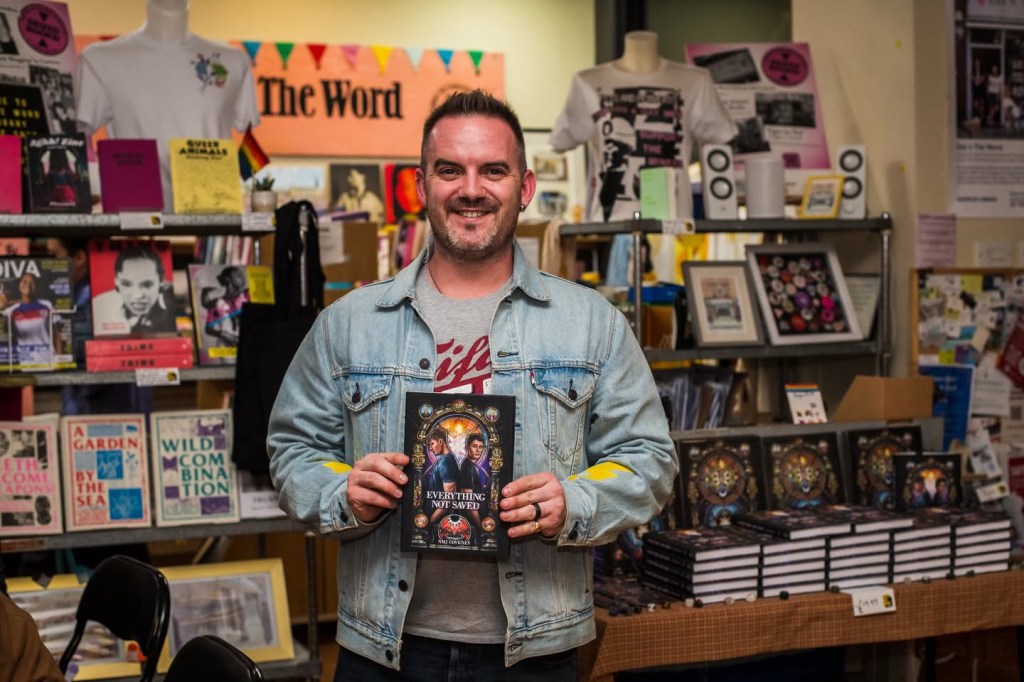
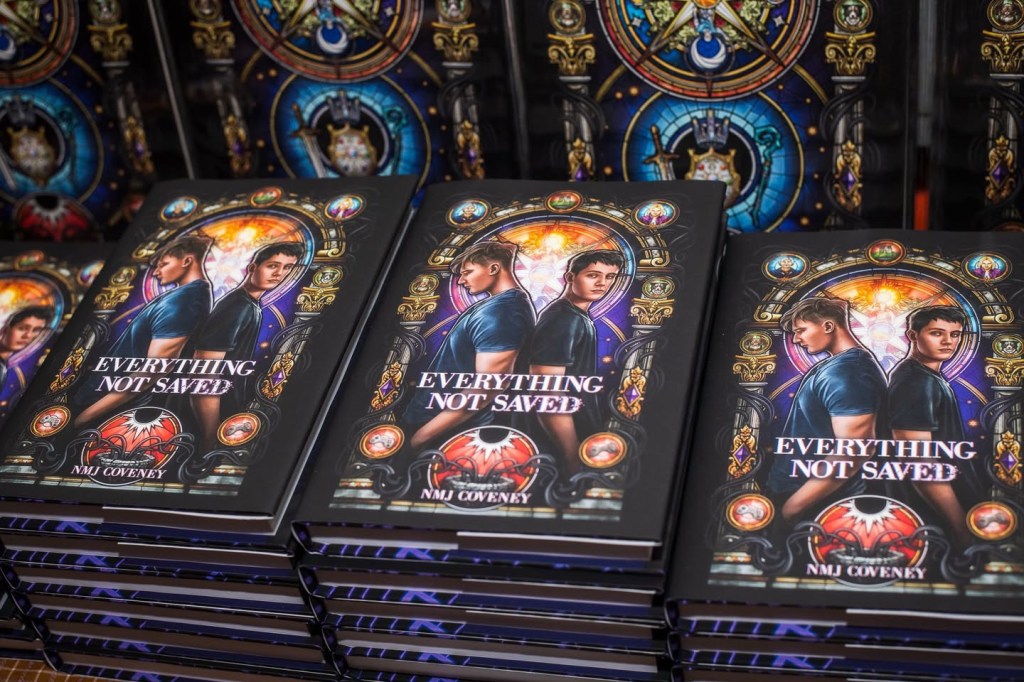
ONE: Let’s start with a book that’s been years in the making—one I had the privilege of beta reading twice. Both times, it made me cry.
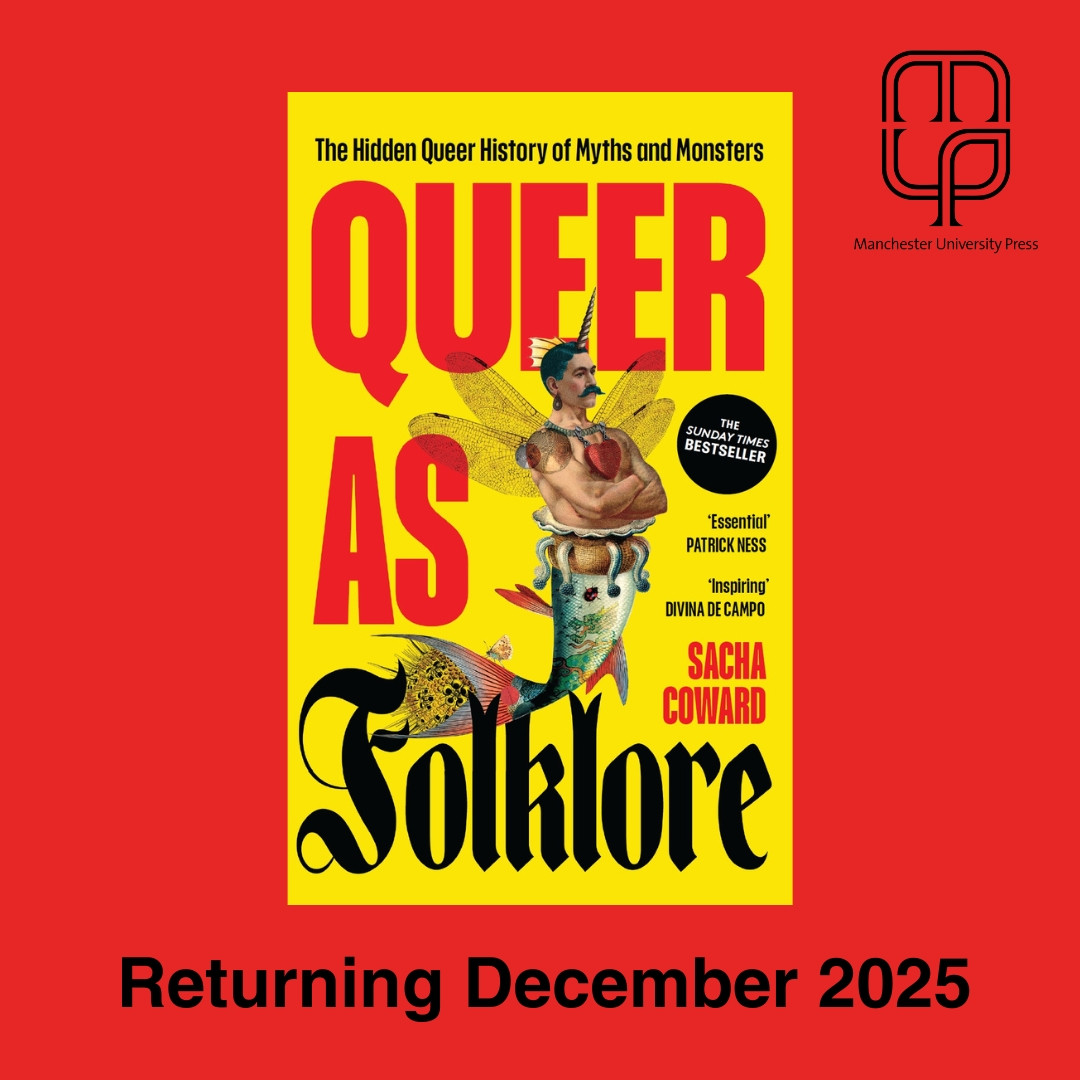
TWO: Historian Sacha Coward has a new publisher—Manchester University Press! That means Queer As Folklore: The Hidden Queer History Of Myths And Monsters is returning to shelves in December 2025.
‘Queer as Folklore’ takes readers across centuries and continents to reveal the unsung heroes and villains of storytelling, magic and fantasy. Featuring images from archives, galleries and museums around the world, each chapter investigates the queer history of different mythic and folkloric characters, both old and new. Leaving no headstone unturned, Sacha Coward will take you on a wild ride through the night from ancient Greece to the main stage of RuPaul’s Drag Race, visiting cross-dressing pirates, radical fairies and the graves of the ‘queerly departed’ along the way.
I’m going to buy another copy, because the original publisher—despite securing crowdfunding and the book becoming a Sunday Times bestseller—didn’t fully pay out the royalties owed to him. I’m also more than happy to gift a few copies!
It’s been a bit of a busy reading week
I’ve made some progress on The Listeners by Maggie Stiefvater (I’m reading the hardback, so it limits when and where I can read); I listened to more of The Devils by Joe Abercrombie, but not as much as I would like; I got a good chunk of Heartwood: A Mythago Wood Anthology read, but I did get thrown by the novella by John Langan, as I was reading the ebook and didn’t know that I’d made a longer-reaching commitment and thought it was a bit slow (it was ultimately excellent). I also started and finished a reread of Crypt of the Moon Spider, and now I’m reading In the Shadow of Their Dying by Michael R. Fletcher & Anna Smith Spark.
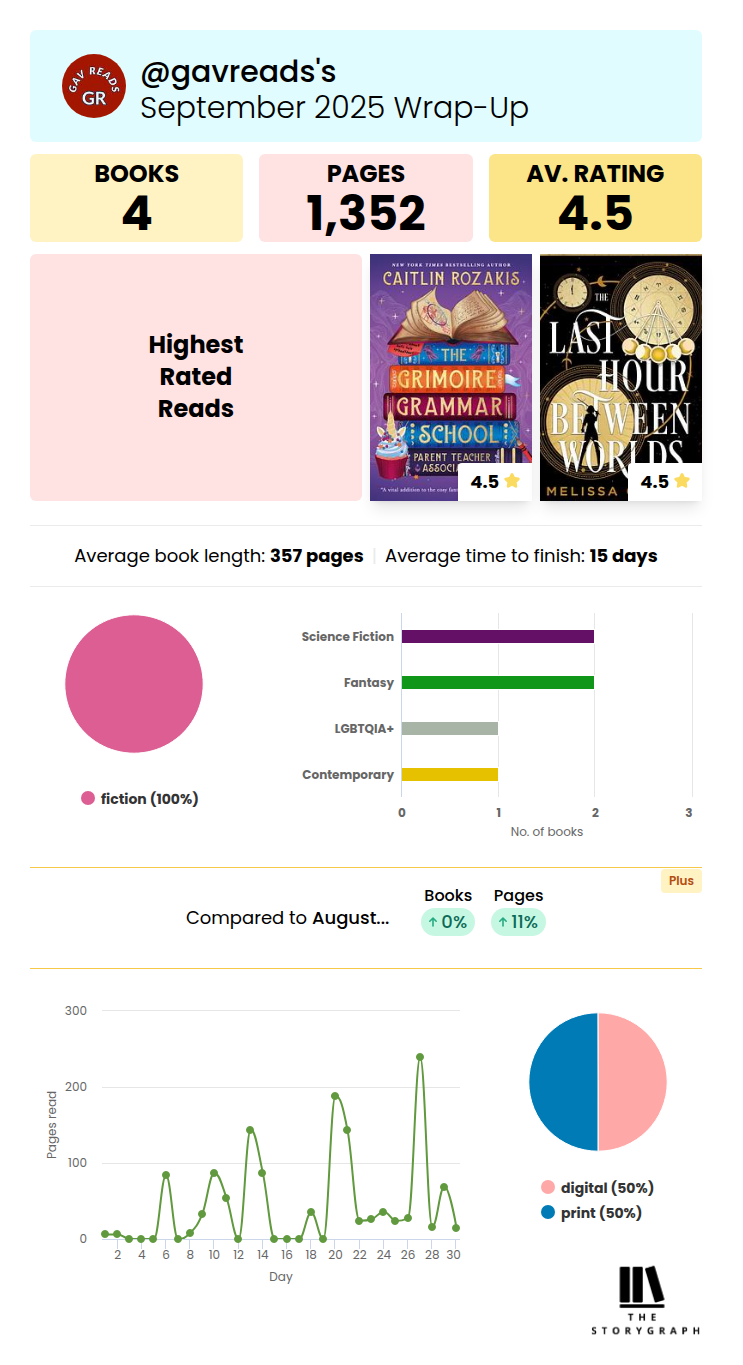
And if you’re curious this my The StoryGraph reading round-up for September.
I do need to revisit and share some of my bookmarked items—like the 116 genre books being published this month—but I’ve run out of Sunday. Maybe next week?
Womble from Runalong The Shelves has been doing a “Wombling Along” post for the last few weeks, highlighting reviews and other articles that caught their attention over the past week.
This is mostly going to be about books and book-ish things that have come to my attention — and possibly serve as my own public bookmarking system.
Let’s start with this stack of… I’m genuinely not sure what to call it… books?
It was inspired by Roseanna Pendlebury
Thinking about the things I would love to have read by the end of the year, and pulling together a few piles to drawn from as an aspirational to do list.I will not read all of these. I mean, I possibly theoretically could. But I doubt it. They're just the ones I really want to get in, if I can.
I badged mine as “the stack of books it would be nice to have read by the end of the year.” I added three caveats:
But since I’ve made the pile with the intention of prompting myself to read them, I’ve started with The Listeners by Maggie Stiefvater. One chapter in, I’m intrigued—but also wondering why I haven’t heard much about it from others.
I haven’t reviewed my recent reads:
The Last Hour Between Worlds (The Echo Archives #1) by Melissa Caruso [2024]
Artificial Condition (The Murderbot Diaries #2) by Martha Wells [2017]
The Grimoire Grammar School Parent Teacher Association by Caitlin Rozakis [2025]
If I get the time, a joint review of The Last Hour Between Worlds and The Grimoire Grammar School Parent Teacher Association might be fun. Both are excellent, and both explore parenting in a fantasy setting—though in very different ways. Each had great twists and turns, and both had me emotionally gripped. I highly recommend them.
And if you’re looking for something cosy in an SF setting, The Murderbot Diaries is turning into just that. Nice to see that Martha Wells has the adventures of Murderbot well under control.
It’s October this week. The clock is ticking to get my reading in before the World Fantasy Convention 2025 announces the various award winners. I’m seriously going to need to weave in some novellas alongside the anthologies.
The issue I’m having with Heartwood is that all the stories centre on the mythos at the heart of the wood—and speeding through them would do them a disservice.
I’m sure I’ll figure something out.
The dive into my BookTok bookmarks is going to have to wait until next week.
A review of Network Effect by Martha Wells, which I’m going to avoid until I’ve got to it myself.
A takedown of The End of the World As We Know It: New Tales of Stephen King’s The Stand. I read the last paragraph, as I still hope to finish The Stand and then read the anthology.
More praise for Uncertain Sons and Other Stories by Thomas Ha
An older, very serious discussion on the absolute canon to read
And so much more!
Next week, I may wade into “what’s a reviewer for?”—as that was today’s hot topic on Bluesky.
This is the third review from my challenge to read the 2025 British Fantasy Award Best Anthology category.
In the introduction, Charlotte Bond writes:
Whatever your taste, whatever you’re looking for, in these pages, you will learn one thing: how to fight like a girl.
And I did — though I also found a few stories that weren’t to my taste, which is a shame. With fewer stories than the other anthologies I’ve read so far, the weaker ones stand out a little more — but never mind, there are still some standout tales here.
K T Davies’s The Seamstress, the Hound, the Cook, and her Brother surprised me the most using a triptych to follow a crime through different eyes. Having seen the situation build from competing viewpoints, the shifting perspectives give the reader deeper insight into the final scene.
Shifts in perspective are definitely a theme.
One perspective I enjoyed — though I felt a little cheated by — was in A Human Response by Dolly Garland. Here a women’s body is replaced, and she finds herself trapped. Slowly, she pieces together what happens to her. The character is supposed to be without emotion, yet she has emotional reactions, which feels jarring. It also fades to black at a key moment in the ending, which I think robbed the character of the agency Garland had built up.
In In More Trouble Than She’s Worth? by Cheryl Morgan, the narrator lacks agency, but her perspective offers some great observations. For example:
I like the chrome in the sick bay, but am not convinced by the white. My crew have odd taste at times. I, by the way, am Sagaris, an Artemis Class cruiser of the Queen’s Amazon Navy, General Thomys commanding.
And
I got him though, didn’t I?, I thought proudly to myself. You can’t scrag a target without wobbling a few crew stomachs. A little non-fatal discomfort does the little ones good.
In this tale, the crew picks up some very precious cargo. Morgan uses the situation to explore how women can be both mothers and fighters — and how that differs from their enemies. This one made me cry.
The arrogance of men was explored by directly and successfully by both Gaie Sebold and Juliet E. McKenna.
In Ambition’s Engine, Sebold takes us to high society, where a newly appointed Chief Defender of the Dominion’s Transport hatches a plan to get more from a train ride than he was commissioned for. Sebold packs in commentary about war, colonialism, and the arrogance of powerful men.
With Civil War, McKenna examines the impact of a change in monarch when the King has no male heir. She explores the options available to the court and the guilds. This was a like watching a royal game of chess and I didn’t see final the move until it was too late. Very cleverly done.
In the introduction Roz Clarke and Joanne Hall suggest:
‘…perhaps now we can look beyond a direct kick back against the idea that women can’t fight, and start to reintegrate more traditionally acceptable forms of feminine power with that warrior archetype.’
And they’ve proved with this collection that fighting and feminine power take many forms — from the bloody, to the subtle, to the fearless — with motivations that defy the ‘warrior archetype’.
If you don’t need convincing that women can fight, this collection is for you. There are some excellent stories here.
And if you do need some persuasion, this collection is also for you — though you might end up a little more paranoid than before, as not all fights are direct confrontations or fairly fought.
Anthology Details
Title:Fight Like a Girl – Volume 2 Editors: Roz Clarke, Joanne Hall Publisher: Wizard’s Tower Press Publication Date: Autumn 2024 ISBN (Paperback): 9781913892845 ISBN (EPUB): 9781913892852 ISBN (MOBI): 9781913892869 Format: Paperback, EPUB, MOBI