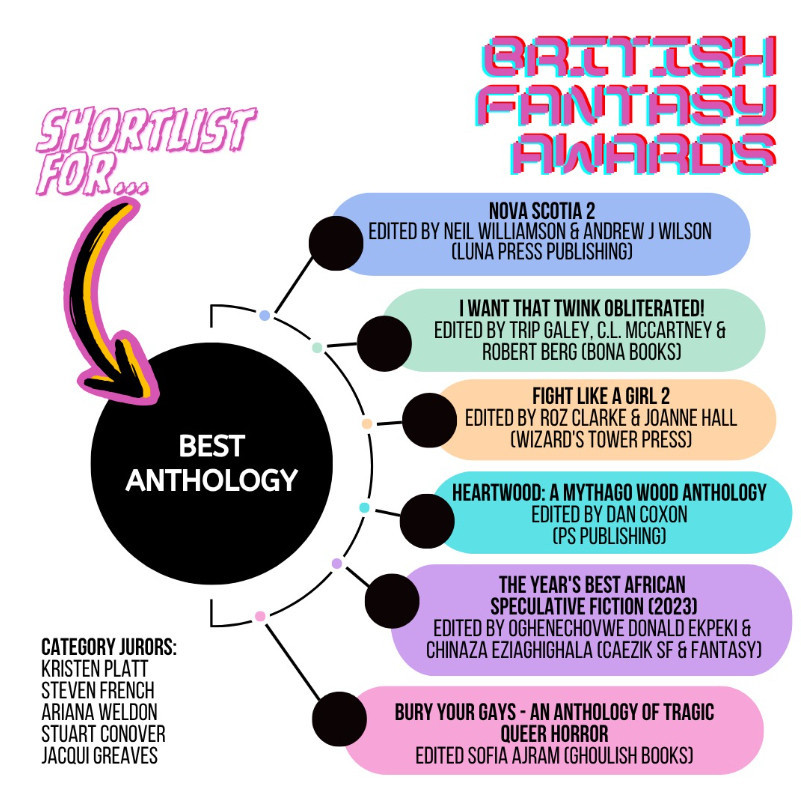
This is the third review from my challenge to read the 2025 British Fantasy Award Best Anthology category.

In the introduction, Charlotte Bond writes:
Whatever your taste, whatever you’re looking for, in these pages, you will learn one thing: how to fight like a girl.
And I did — though I also found a few stories that weren’t to my taste, which is a shame. With fewer stories than the other anthologies I’ve read so far, the weaker ones stand out a little more — but never mind, there are still some standout tales here.
K T Davies’s The Seamstress, the Hound, the Cook, and her Brother surprised me the most using a triptych to follow a crime through different eyes. Having seen the situation build from competing viewpoints, the shifting perspectives give the reader deeper insight into the final scene.
Shifts in perspective are definitely a theme.
One perspective I enjoyed — though I felt a little cheated by — was in A Human Response by Dolly Garland. Here a women’s body is replaced, and she finds herself trapped. Slowly, she pieces together what happens to her. The character is supposed to be without emotion, yet she has emotional reactions, which feels jarring. It also fades to black at a key moment in the ending, which I think robbed the character of the agency Garland had built up.
In In More Trouble Than She’s Worth? by Cheryl Morgan, the narrator lacks agency, but her perspective offers some great observations. For example:
I like the chrome in the sick bay, but am not convinced by the white. My crew have odd taste at times. I, by the way, am Sagaris, an Artemis Class cruiser of the Queen’s Amazon Navy, General Thomys commanding.
And
I got him though, didn’t I?, I thought proudly to myself. You can’t scrag a target without wobbling a few crew stomachs. A little non-fatal discomfort does the little ones good.
In this tale, the crew picks up some very precious cargo. Morgan uses the situation to explore how women can be both mothers and fighters — and how that differs from their enemies. This one made me cry.
The arrogance of men was explored by directly and successfully by both Gaie Sebold and Juliet E. McKenna.
In Ambition’s Engine, Sebold takes us to high society, where a newly appointed Chief Defender of the Dominion’s Transport hatches a plan to get more from a train ride than he was commissioned for. Sebold packs in commentary about war, colonialism, and the arrogance of powerful men.
With Civil War, McKenna examines the impact of a change in monarch when the King has no male heir. She explores the options available to the court and the guilds. This was a like watching a royal game of chess and I didn’t see final the move until it was too late. Very cleverly done.
In the introduction Roz Clarke and Joanne Hall suggest:
‘…perhaps now we can look beyond a direct kick back against the idea that women can’t fight, and start to reintegrate more traditionally acceptable forms of feminine power with that warrior archetype.’
And they’ve proved with this collection that fighting and feminine power take many forms — from the bloody, to the subtle, to the fearless — with motivations that defy the ‘warrior archetype’.
If you don’t need convincing that women can fight, this collection is for you. There are some excellent stories here.
And if you do need some persuasion, this collection is also for you — though you might end up a little more paranoid than before, as not all fights are direct confrontations or fairly fought.
Anthology Details
Title: Fight Like a Girl – Volume 2
Editors: Roz Clarke, Joanne Hall
Publisher: Wizard’s Tower Press
Publication Date: Autumn 2024
ISBN (Paperback): 9781913892845
ISBN (EPUB): 9781913892852
ISBN (MOBI): 9781913892869
Format: Paperback, EPUB, MOBI