Tag: matt-dinniman

  • Review: Dungeon Crawler Carl by Matt Dinniman [2020]

    Spoilers: Mild (premise, themes, and early plot developments)
    Genre: Science Fiction, LitRPG
    Format: Hardback
    Source: Bought
    Rating: Liked
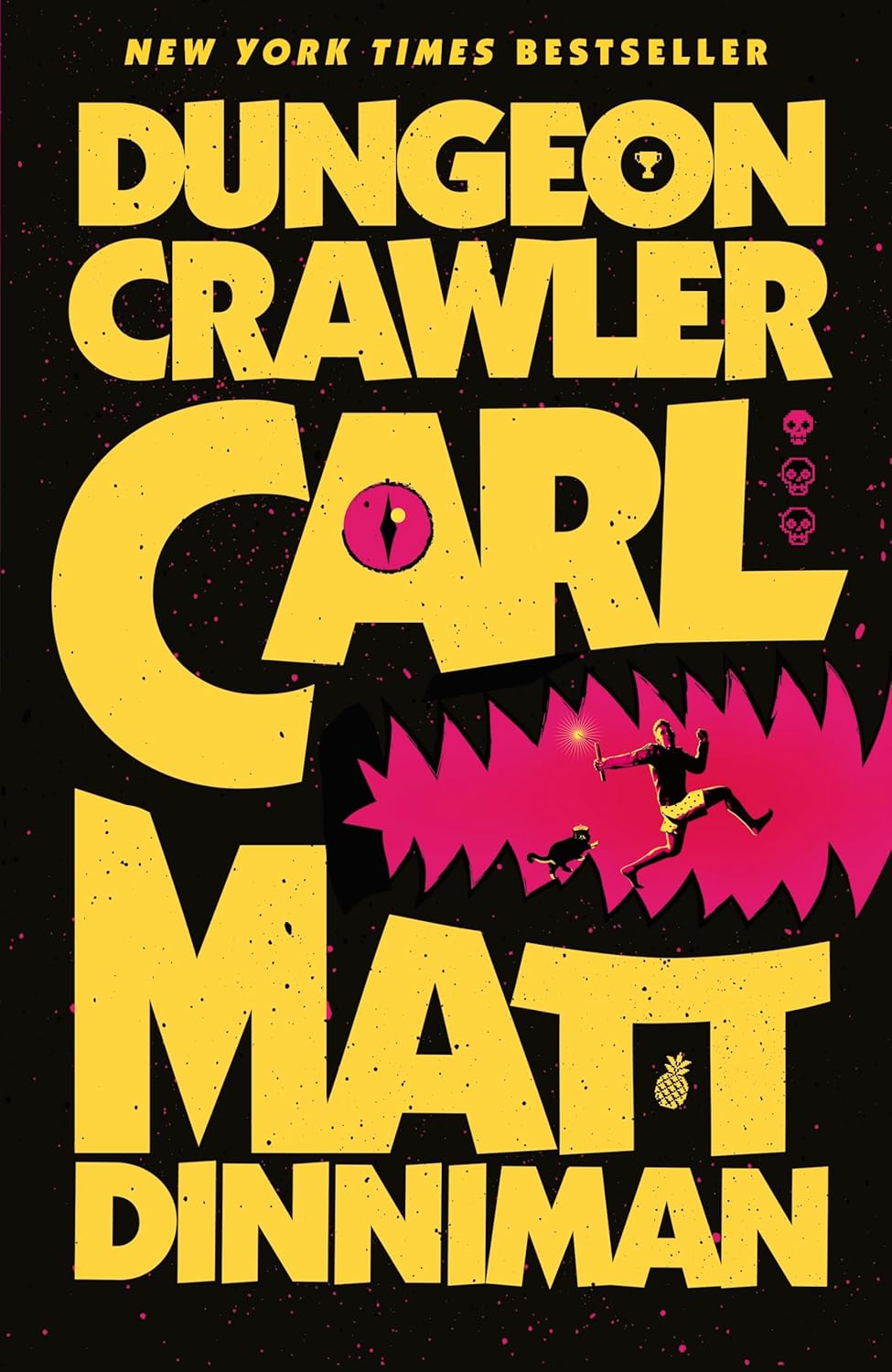
    On my copy of Dungeon Crawler Carl (DCC), under the dust jacket, it says, ‘You Will Not Break Me’. Whatever else you think of Carl, this sentiment holds true through book one and, based on what happens here, through the series as a whole.

    DCC is one of the most popular titles in the relatively new genre label of LitRPG, and it deserves that status.

    It focuses on Carl and his ex-girlfriend’s cat, Princess Donut, who just happen to be outside in the right place when the game commences and wipes out most of humanity.

    As a reward for surviving this near-extinction-level event, all new players, Crawlers, must survive a series of puzzles, skirmishes, and occasional boss battles against “things” that are solely there to kill them. Their survival mostly depends on getting stronger and killing “things”, even if those things turn out to be their fellow humans. 

    I had to pause reading DCC around 1/3 of the way in, as I grew uncomfortable with Carl’s initial portrayal.

    I am very much a ‘I care about the people more than the system’ person. Carl kills a confused, mutated woman and a crèche of goblin babies, showing little reaction to either his actions or his foes’ deaths.

    I may have prematurely concluded that ‘I understand what DCC is trying to do, and I don’t think finishing it will change that—but maybe I’ll come to like it.’

    But thinking more about the fact that it falls within the system-apocalypse microgenre, and reading around the subject, I wanted to push on and see if I was getting the full picture. 

    After picking it back up and reading more, I did. I saw Carl as stoic and practical in his response — he later reflects that they are all there to die. Given Carl’s background as a Coast Guard veteran, I wondered if that’s just how they make them. His cat does act like an arsehole. But that’s a cat for you, especially one with trophies and rosettes, though even she acknowledges that Carl is trying to do the right thing in challenging circumstances.

    Given his mantra of ‘You Will Not Break Me’, I started taking notes on when Carl was sympathetic or heroic in the face of everything he’s been pitted against. I feel the evidence shows he’s a ‘good guy’ in a bad world, and it makes you wonder what you would do. Just wait to die? Or try to survive and hope?

    The ‘cleverness’ of this work, and perhaps of the genre, is that it takes the core mechanics of an RPG and reveals the brutal reality behind them. The system is against him—he’s there to kill and, ultimately, to die, in an entertaining way.

    And that’s what video games do: they work in the abstract; they are pixels on a screen, and now there’s blood on the dungeon floor.

    This isn’t a game. It’s real life, with all the complexities and the games within games that we all experience.

    Carl gets to see that as he’s introduced to more than one of the Wizards behind the curtain. And in later scenes, Matt draws Carl into what the game represents: the politics, the promises and the control it exerts over everyone, because almost everyone is a victim. 

    As a video game-to-page adaptation, I can’t fault it. The explanations of weapons, bosses, and other baddies are good, and the AI overseer is funny, often inappropriately so. It feels like a video game experienced through all five senses.

    You have to assume that everyone is going to die, including the crawlers and the NPCs (non-playable characters), even if they themselves might not know it. It’s a story told against that injustice, focusing on a character who’s trying his best, given his upbringing and background.

    There is a lot to enjoy. The interactions, the characters, the system, the politics, and the backdrop against which it’s set. 

    Am I going to read the next one? Yes. And the one after that. I’m told that books 2 and 3 need to be read together to get the point Dinniman is trying to make. 

    I don’t think it’s a celebratory story; it’s brutal and shows the reality of RPGs while trying to satirise late-stage capitalism, which values money and entertainment over anything an individual might experience. 

    Do I expect it to soften its use of problematic gazes (see below)? Hopefully. I hear that it does as the series continues. 

    I guess we’ll see. 

    Addendum:  

    As a satire on capitalism, it’s complicated. Carl and probably the author, Matt, see the world through a white male gaze. I know more about the anatomy of his encounters with women than I wish. I’m not sure he ever mentions the guns, pecs, and thighs of any of the men he encounters.

    As other commentary has pointed out, it’s great to call out what capitalism represents, but it might still rely too heavily on the language and framing of the worldview it’s trying to satirise, which makes it hard to distinguish between commentary and ingrained bias. 
  • Dungeon Crawler Carl and the Problem of Not Caring

    I flew through the first 1/3 of the novel because I love the video game RPG genre and this was my first experience reading about how LitRPG turns them into a linear adventure. But my opinion changed when I read two scenes that came quite close together.

    Now, for the next three or four paragraphs, there are spoilers: Carl, up to this point, has been killing non-human characters to survive; it’s been very much attack-or-die. As a reader, I haven’t really expected him to have been deeply reflecting on the horror of the situation

    But there were two scenes where Carl wasn’t immediately attacked and had a chance to interact rather than react to the ‘baddies’.

    *** There are spoilers in the next two paragraphs ***

    In one, a mutated human speaks Spanish, which shows his opponent is scared and confused. Carl doesn’t understand Spanish, and a translation isn’t provided to the reader. But he still acts with violence, despite the doubts he expresses about facing an almost-human character.

    Matt doesn’t pause the action here; Carl moves on. He meets a group of goblins who don’t kill him on sight because they recognise his tattoo, which he received as a ‘bonus’ for killing another goblin group earlier. He doesn’t explain this. Instead, he uses it to gain access to their inner sanctum. They treat him with kindness, and he repays that by carrying out a mass killing.

    I thought that it would set the tone for the rest of the book – kill indiscriminately, get loot, and level up.

    But without the author exploring the emotional impact, it felt like it would be reductive and ultimately a hollow experience. I need to at least feel there is a point to the story, even if it makes me feel uncomfortable.

    And when I reached this thought earlier last week, I closed the book, fully intending to DNF it.

    I shared my disappointment on Bluesky, hoping someone would tell me I was wrong.

    Ummm, at 1/3 in, I’m not sure that I like Carl or the cat in Dungeon Crawler Carl.

    And I’m grateful to Somhairle Kelly for situating Dungeon Crawler Carl within the system-apocalypse microgenre.

    The thing that hit me from the thread was:

    Some are grimdark for the sake of grimdark. Characters often lament never getting planes, the internet, mobile phones, etc. again, but they don’t contemplate the sheer horror.

    It made me wonder if my reaction was the problem. Carl wasn’t supposed to care, and that was intentional and an expected trope because the genre as a whole focuses on the macro rather than the individual’s emotional impact.

    I’ve previously said, way back in 2023, in the context of The Poppy War Trilogy:

    I don’t plan on going back to grimdark consciously, at least not for a while, unless I read a series that is grimdark but I don’t realise it is.

    And it seemed that reading Matt or the Clarke Award had ‘fooled’ me into reading it.

    But both Somhairle’s framing and the fact that it’s up for a Clarke Award have me intrigued. I’m wondering if I can continue, knowing this will be the pattern from here on out.

    The replies in the thread imply that Carl doesn’t suddenly become empathetic as the series goes on. Growth may kick in about book 4 or 5.

    And the creator has said that it’s not what it first seems:

    Every war, every social movement has multiple battlefields, and not every battlefield has to be the front line. I want people with different points of view to enjoy these books at face value. If I then manage to drill through their thick skulls and make them think about the broader themes and maybe grow an empathetic spark, all the better.

    The above is a larger extract from a Reddit post, ‘We are not talking current event politics here, and every deliberately political post will be deleted. Repeat violators will be banned. This is why’

    So, maybe I am having the reaction that the author is expecting. I went out of my way to translate the Spanish dialogue in that first scene, and I think that’s perhaps what led me to project a negative association between Carl and his creator.

    I think the problem is that I don’t feel that I need the lesson.

    Killing anything should come with awareness.

    And I wonder if my curiosity would drive me to read through my own discomfort and dissociation, to complete my reading of the rest of the books. Given that I can’t even force myself to read the next book in the series that I LOVE, I highly doubt it.

    By the way, I love how the RPG elements are integrated; it’s just the lack of empathy for the ‘Non-Playable Characters’ even if that makes readers think about the choices that Carl is and isn’t making.

    And because of Kelly’s framing, I do want to go back to DCC with both the author’s intent and the type of genre it is.

    I now want to read The Transcendent Green by Mati Ocha (https://matiocha.com) as it was recommended by Somhairle Kelly, as they described it as ‘respectful, authentically Gaelic, and depicts the horrors without callousness or apocalypse porn. And fundamentally hopepunk

    I understand what DCC is trying to do, and I don’t think finishing it will change that—but maybe I’ll come to like it. Should I continue, or is this just not for me?