Tag: reading

  • Review: The Somewhat Wicked Witch of Brigandale by C. M. Waggoner [2026]

    Spoilers: None
    Genre: Fantasy
    Format: Hardback
    Source: Bought
    Rating: Adored (6★)

    I impulse-bought The Somewhat Wicked Witch of Brigandale after tylersshelf posted a TikTok review saying, ‘This book is so silly, so campy. It gives you all those fairy-tale vibes but with adult themes.’ Given the heavier reading I’d been doing, I bought it and bumped it right up my TBR. It’s rare that humour works for me in a novel.

    His review was spot on — I loved it for being fun, and now I’m keen to read another of his recommendations, The Lost Story by Meg Shaffer.

    It’s a 6/5 ⭐️ read that has set the bar high for the rest of my 2026 reading.

    It’s brilliant. Waggoner takes the leave-a-baby-that-is-probably-a-king-with-a-witch-to-raise trope and has fun with it. Drawing on humour and concepts that feel schooled by Pratchett’s approach to fairy tales and witches (with their practical approach to problem-solving combined with keen-eyed observations on human nature), Waggoner cranks up the narrative snark and uses it to tell the story of a mother (Gretsella) who will bring down a kingdom just to see her son (Bradley) happy. 

    The playfulness begins in the chapter subheadings and extends into the footnotes and descriptions, all of which are carried by the narrator’s voice, which reminds me of a sassy magical mirror.

    The characters have substance, the cast is varied, and Waggoner sticks with fairy-tale‑like scenarios, adds twists so they feel fresh, and it works. The key reason for picking this up was the queer love story, which is sweet, doesn’t dominate, and lets it be just two people in love. It is utterly cosy.

    The pacing, with the interludes and asides, feels like it’s always moving things forward or giving you fun snippets. It’s smart, charming, and cosy, and at 210 pages, it doesn’t outstay its welcome. The ending hints that further tales of Gretsella and Bradley may follow. I, for one, vote they do.

    As you can tell, I was charmed — maybe enchanted — by it. Regardless, I now feel compelled to enjoy it all over again, as I’ve never giggled this much at a book, and I hope you do too.

  • Review: Cosmic Love at the Multiverse Hair Salon by Annie Mare [2025]

    Spoilers: Mild (premise, themes, and early plot developments)
    Genre: Science Fiction  
    Format: Paperback 
    Source: Bought 
    Rating: Loved

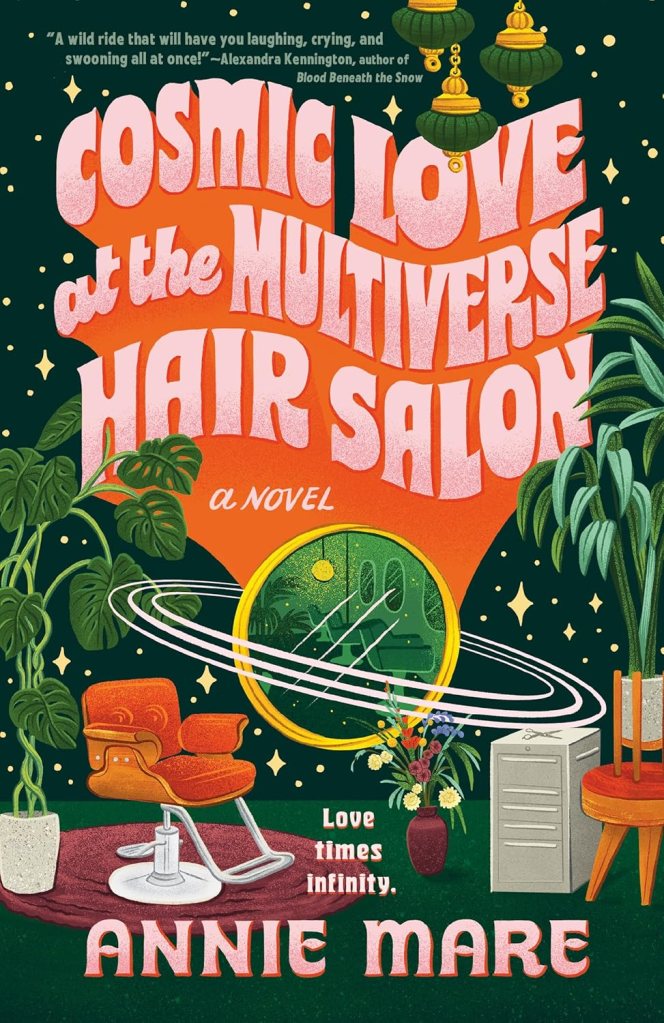
    Would you fight for a love that feels right, even if it’s for someone you’ve never met? Not because you don’t want to, but because time has separated you by 6 months? Sounds crazy, right? But that’s what happens to Tressa Fay Robeson in Cosmic Love at the Multiverse Hair Salon.

    Tressa Fay is a successful and popular hairdresser known for giving her clients life-changing hairstyles. She is still recovering from a break-up when a random text message sends her across town on a date, only to be stood up at the bar. Well, not exactly stood up. Her date tells her where she is, but they aren’t there. And they didn’t stand each other up. They were both at the bar. It’s just that Tressa Fay is in the present and her date (Meryl) was waiting for her six months ago. Tressa Fay tells her friends that she’s texting a hot woman in the past, and they believe her.

    From there, you and the characters enter a trust bubble. You have to trust that Meryl and Tressa Fay can communicate via text as the characters do, and believe that it’s really happening. We spend the opening section of the book focusing solely on Tressa Fay in the present. This shows us that, in the past, Tressa Fay hadn’t met Meryl and confirms she wasn’t supposed to. But Meryl doesn’t want to be trapped in a future where she disappears and doesn’t get to love Tressa Fay, even if it has consequences.

    I think Annie Mare does an outstanding job not only of bouncing between timelines but also of guiding the reader through complex scientific concepts. Mare navigates them expertly because she’s hyper-focused on the emotional connections shared by all the characters.

    This is Mare’s and the book’s strength. She was happy to hold my heart in her grip. I cared about all of their futures with all my heart. I teared up, held my breath, and crossed my fingers for the right things to happen.

    But the science isn’t the driver of the story; the driver is two people who are passionately in love, desperate to meet and desperate not to lose each other, but it’ll only happen if they play the science right.

    With seemingly nothing to lose but everything to gain, they start messing with time.

    All their pasts and futures become tangled; their connections are so tenuous because the present could be changed, and they could be severed from each other at any moment.

    They have the power to tell Meryl her future, and I kept wondering which upcoming past event they would choose to change and how it would manifest in the present. This tightened her fist around my heart like a vice for almost the entire time.

    It’s a hard premise to land — how much of the mystery do you explain? Do you go where the readers expect, or where you expect? I think the concept for resolving the overlapping time was masterful; I was expecting one last dramatic revelation, and it didn’t come, and what happened as a result didn’t work for me.

    Mare, I think, wanted a specific tone for the ending, but instead of leaning into the danger of their experimentation, she played it too safe. All the tension I had been holding slipped away, leaving me slightly deflated.

    Cosmic Love at the Multiverse Hair Salon, to me, is a meditation on the nature of love. The story itself feels like an instructor. I was its student. Because Meryl doesn’t want to be trapped in a future where she disappears and never gets to love Tressa Fay, every observation felt like something I needed to study and hold onto. There were so many observations I felt compelled to write down to study later. I loved watching them and taking notes as I explored, changed, loved and laughed — I just can’t promise you’ll like the last few pages.

    Recommended for anyone who enjoys (or thinks they’ll enjoy) a mix of sapphic yearning and science fiction.

    Note: I rate on a four-tier scale: Loved (4.5–5★), Liked (3.75–4.25★), Mixed (2.75–3.5★), and Not for me (1–2.5★).

  • Can I Read the Hugo and Clarke Shortlists Before the Winners Are Announced?

    Nick Hubble reminded me on Bluesky that this year’s Hugo Award nominees are out.

    Keeping a track of these write-ups for reasons. Also nice to see myself quoted if not named.

    Nick Hubble (@thehubble101.bsky.social) 2026-06-26T18:17:34.639Z

    In July last year, I gave myself two reading challenges:

    1. Read the  British Fantasy Awards 2025 shortlist for Best Anthology
    2. Read the World Fantasy Awards 2025 shortlist for Best Novella

    I managed the novellas, but burnt out on the anthologies.

    So I have form, if not an entirely successful track record, with reviewing award shortlists. It does help me focus — giving me a deadline to aim for and pushing me to read books that might otherwise sit on the ever‑growing TBR pile.

    I also did a ‘live’ reading of Annie Bot by Sierra Greer (at Dan’s request), which went on to win the Clarke Award.

    That pushed me to read it more closely and think about it more deeply — and I think I saw some of what the Clarke judges did in it. A worthy winner.

    So I’m wondering whether to set myself a new challenge: read the Hugo and Clarke shortlists before the winners are announced.

    Despite having somehow forgotten, checking the list reminded me that they are all books I’m interested in.

    Best Novel

    • A Drop of Corruption by Robert Jackson Bennett (Del Rey; Hodderscape)
    • Death of the Author by Nnedi Okorafor (William Morrow; Gollancz)
    • Shroud by Adrian Tchaikovsky (Tor UK; Orbit US)
    • The Everlasting by Alix E. Harrow (Tor US; Tor UK)
    • The Incandescent by Emily Tesh (Tor US; Orbit UK)
    • The Raven Scholar by Antonia Hodgson (Orbit US; Hodderscape)

    I’ve only read one (The Incandescent), which isn’t a great start — especially as it’s currently at the bottom of the list, sorry. In theory, I have plenty of time to catch up on the other five before the winner is announced on Sunday, 30 August 2026, at 8:00pm Pacific (4am?!).

    The good news is that I already have all of them, including special editions of Death of the Author and The Everlasting. I enjoyed Robert Jackson Bennett’s previous series, and The Raven Scholar has enough hype that it seems to be living up to it.

    If that feels ambitious, I’ve checked the other categories, and the Best Novella looks much more manageable and should give me an easy and early win.

    Best Novella

    • Automatic Noodle by Annalee Newitz (Tordotcom)
    • Cinder House by Freya Marske (Tordotcom; Tor UK)
    • Murder by Memory by Olivia Waite (Tordotcom)
    • The River Has Roots by Amal El-Mohtar (Tordotcom; Arcadia UK)
    • The Summer War by Naomi Novik (Del Rey US; Del Rey UK)
    • What Stalks the Deep by T. Kingfisher (Nightfire; Titan UK)

    I’ve read half of them — Automatic Noodle, Murder by Memory and What Stalks the Deep — all worth reading. I owe reviews of two of them. But if I had to rank them, I’d go Noodle, Deep, then Memory. I’m curious how that would change.

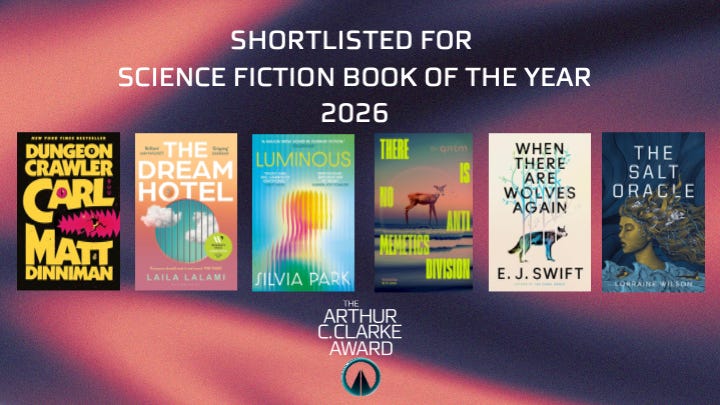
    The Arthur C. Clarke Award shortlist this year is:

    • Dungeon Crawler Carl – Matt Dinniman (Michael Joseph)
    • The Dream Hotel – Laila Lalami (Bloomsbury Circus)
    • Luminous – Silvia Park (Magpie)
    • There Is No Antimemetics Division – Qntm (Del Rey)
    • When There Are Wolves Again – E.J. Swift (Arcadia)
    • The Salt Oracle – Lorraine Wilson (Solaris)

    I bought The Dream Hotel and Dungeon Crawler Carl especially to read for this, so I’m committed in terms of TBR. The Arthur C. Clarke and Hugos always have a lot of debate, and I want to avoid FOMO and join in.

    The winner of the Arthur C. Clarke Award will be announced on 12 August 2026, putting it just over two weeks before the Hugos. In order to meet both deadlines, I’d need to read 10⅔ novels plus three novellas in just over two months.

    Should I commit to it? Would you do it? Have you read any? Who would you vote to win?

    PS

    The British Fantasy Awards 2026 Shortlists are also out, including the Best Anthology Award:

    • Lesbians In Space: Where No Man Has Gone Before, edited by J S Fields, William C Tracy, Heather Tracy (Space Wizard Science Fantasy)
    • Blood in the Bricks, edited by Neil Williamson, NewCon Press
    • This Way Lies Madness, edited Dave Jeffery, Lee Murray, Flame Tree Press
    • Silk and Sinew: A Collection of Folk Horror from the Asian Diaspora, Kristy Park Kulski (Bad Hand Books)

    And while I’m not reading the anthologies this year, I’m curious about them. Have you read any? What should I pick up?

  • Review: God’s Junk Drawer by Peter Clines [2024]

    Spoilers: None
    Genre: Portal Fantasy / Survival Fantasy
    Format Read: ebook
    Disclosure: None [this book was purchased by me]

    God’s Junk Drawer is the story of a child, Billy Gather, who, along with his sister, Beau, and father, goes missing during a rafting trip and ends up in a valley with dinosaurs, aliens, Neanderthals, and androids. It isn’t as silly as you’d expect. Clines takes it seriously, and because of that, it’s more emotionally resonant than I could have imagined.

    Rating: 4.5 / 5

    I liked it, I think. Let me explain.

    I’ve stepped back from reviewing for a while because I felt a bit of an imbalance. The analytical side of my brain — the part that holds the book in a buffer in my mind and runs analysis on it — had, I think, started to take away from the feelings that make reading enjoyable, the joy that my more emotive side gets from a book.

    This might explain why I’ve been enjoying books that give a strong emotional response, even when I can see ‘flaws’ that my more logical side would normally have focused on and criticised the book for. God’s Junk Drawer is exactly the kind of book that benefits from that shift — one that hits the emotional notes even if the logic sometimes feels like unwelcome static.

    It opens with clippings about a missing boy who is suddenly found, and he claims he’s been to a fantastical valley full of dinosaurs. In the present, the now‑adult Billy (Noah) has figured out a way to return there — but not without accidentally taking a group of graduate astronomy students and their guide with him, none of whom, unlike Noah, had prepared for the trip.

    Once that happens, it becomes clear why Clines has chosen to alternate points of view (PoV). Jumping from head to head is probably my least favourite storytelling technique. Here, though, it feels essential: a group of people experiencing the fantastical from different perspectives, with no preparation, alongside one adult who was certain the valley hadn’t changed.

    There’s a childhood naivety mixed with a teenage arrogance to Noah — he insists he knows everything there is to know about the valley — but he’s proven wrong pretty quickly. Not only about the current landscape, but about the nature of the valley itself. Clines does an exceptional job of keeping me guessing, and even as we reach the climax, he still has one or two surprises left to reveal.

    It’s a very open‑minded work, and it plays a lot with the histories of its characters. One pair in particular has an ‘aha’ moment that reframes why they hate each other so much — a reveal that lands with real emotional weight.

    It’s also a very brutal book — not just because the valley is dangerous, but because Clines is telling a story with real impact, rather than one that prioritises emotional safety.

    Now that I’ve sat with it a bit, thinking about what the valley is and its history, I do like it. I’d recommend resisting the urge to understand the valley early on; Clines reveals its nature gradually, setting things up only to pull back a curtain and show something else. Even then, I think there are still a few gaps I’d have appreciated more insight on.

    Overall, I really liked how Clines shows Noah that what his teenage self remembered was not reality, and that the sacrifices he’d made to get back had a far wider impact — both positive and negative — than he’d selfishly assumed.

    If you want to experience a valley with dinosaurs, consider your own survival odds, and have your assumptions happily eroded, I’d recommend it.

    Note: I rate on a four-tier scale: Loved (4.5–5★), Liked (3.75–4.25★), Mixed (2.75–3.5★), and Not for me (1–2.5★).

  • Sunday Summary: 25th Jan 26

    Sunday Summary mainly functions as my personal record of book-related topics that have captured my interest over the past week. It also acts as a public memory prompt and bookmarking system.

    Books Read & Reading This Week.

    Finished:

    • ???

    Nothing this week.

    Currently Reading: 

    • A Dictator Calls by Ismail Kadare (trans John Hodgson) [2023]
    • The Masquerades of Spring by Ben Aaronovitch (narrated by Kobna Holdbrook-Smith) [2024]
    • The Two Doctors Górski by Isaac Fellman [2022]

    I’ve not read a whole lot this week because I’ve been distracted by other hobbies, but also, I’ve reached a point in The Masquerades of Spring that I’m a bit nervous about. Aaronovitch has put the stakes up with threats against the gay couple, and I’ve read a few reviews to see if there is any hint at an HEA (Happy Ever After) for them. It seems there is but also I don’t think I could handle a ‘bury your gays’ trope popping up.

    The Two Doctors Górski is giving me The Incandescent by Emily Tesh vibes, I wonder how dark it’s going to go? It’s been highly recommended, so no pressure on their taste.

    DNF’d

    • ???

    Nothing this week.

    Book-ish Things

    The preorders are flowing in. This week I’ve recieved:

    • The Apple and the Pearl by Rym Kechacha
    • The Old Fire by Elisa Shua Dusapin [Translated from French by Aneesa Abbas Higgins]
    • Dominion by Addie E. Citchens
    • Nine Goblins by T. Kingfisher

    A good mix of potential reading joy I think you’d agree.

    Non-Book-ish Things

    One of my other major hobbies is video games, and last year I made a more concerted effort to put time into them, which partly helped me cope with the reading slump that dominated the first few months of 2025. At the moment, I’m playing Persona 5 Royal, a JRPG with over 100 hours of gameplay. The problem is, at 50 hours in, I’ve discovered I’ve been playing it wrong. This means I’ve started again, and this time I am paying attention to what the game is telling me and using tips that other players have shared to us.

    So if you’re wondering why I’m not reading. That does have a lot to do with it.

    I’ve also watched the first episode of Star Trek Academy, and I’m sold. Really keen to see what this young crew can do. If you liked Discovery or Voyager, I think you’ll like this.

    Cover(s) of the Week

    We Interrupt This Program by 
Randee Dawn

    Outro

    Hopefully, I’ll be able to report that I’ve finished reading something next weekend. Have a good reading week, all.