Tag: reading

  • Sunday Summary: 14th Sept 25 Edition

    Womble from Runalong The Shelves has been doing a “Wombling Along” post for the last few weeks, highlighting reviews and other articles that caught their attention over the past week.

    And I thought I’d join in.

    I’m curious about a few things:

    • Whether I’ll be able to keep it up.
    • What looking back on these posts will feel like in a year or two.

    This is mostly going to be about books and book-ish things that have come to my attention — and possibly serve as my own public bookmarking system.

    Let’s start with a recommendation from one of my favourite BookTokers, Claire Linney. She recommended Blood Debts by Terry J. Benton-Walker. To borrow and paraphrase a bit of her summary — because that’s what got me hooked:

    Two 16-year-old twins are part of a magical bloodline, but a murder has doomed their name and stripped their mother of her throne. The story is told from the perspectives of both the twins and their adversaries. It features a magic system that’s used to comment on race, and the politics and policing around it.

    Please check out Claire’s full review here.

    I have downloaded it and it’s now on my overflowing ereader ready to read.

    @claire_linney

    Blood Debts and Blood Justice by Terry J Benton Walker – young adult for ages 13+ #diversebooks #blackauthors queerbooks #youngadultbooks #fantasybooks

    ♬ original sound – Claire Linney Author

    On Bluesky two posts on criticism have been shared:

    • One by New York Magazine
    • One by Reator Magazine (formly Tor.com):

    Do reviews draw readers? Boost subscriptions? Sell ads? And if the answer is ‘no,’ what then? Charlotte Klein explores the precarious state of cultural criticism.

    New York Magazine (@nymag.com) 2025-09-08T09:10:36.872Z

    In the latest Mark As Read, @mollytempleton.com places The Death of the Critic into context. For how long has criticism has been dying, and how do we engage with discussions about art?reactormag.com/its-not-the-…

    Reactor Magazine (@reactorsff.bsky.social) 2025-09-11T15:37:43.114Z

    I’m bookmarking these to digest later, but Niall Harrison pointed out a quote from Christine Smallwood that really interests me:

    Criticism is an act of autobiography. The work of making an argu­ment, coming to a judgment, or simply choosing which books or objects to give time and attention to is inevitably, helplessly, an expression of values

    And borrowing an item from Womble:

    A Bluesky post by Zach that says:

I've been working on embracing the critic's version of this, which is "life is too short to tackle a book about which you don't have something interesting to say, good or bad"

Zach is quoting Sonora Taylor:

For anyone who needs to hear this: life is too short to finish a book you're not enjoying.
Prose is annoying you? Don't finish it.
It feels like a chore to pick up and read? Don't finish it.
Just not feeling it? Don't finish it.
We're not in class. There won't be a test. Read for *your* enjoyment.

    I need to ponder this some more. If you’re a media outlet (like Locus) or a specialist blog, you’ll likely be commenting on ‘significant’ or potentially ‘significant’ books in your area of interest. But more generally, I think we’re in the age of influencers — and influencers should be more willing to step back from the flow and share what’s important to them. Claire and Womble are both great examples of that philosophy.


    As an aside, I’m enjoying reading anthologies for my BFA challenge. However, I’ve given myself permission to skip those that don’t resonate from the start or that I fizzle out with. I’m unlikely to have anything interesting to say about them—unless the number of skips ends up reflecting something about the anthology as a whole.


    Don’t tell anyone, but I’m struggling to find time to listen to audiobooks — which is why I’ve been reading The Devils by Joe Abercrombie since the 7th of May and I’m only 46% through. It’s frustrating because I’m really enjoying Steven Pacey’s performance, and I want to listen to Let the Bad Times Roll by Alice Slatter.

    I’m going to have to just read the ebook versions of both, which will be great — but not quite the experience I was hoping for.


    Lastly, what are my plans for the rest of September? Well, I need to crack on with World Fantasy Award novellas:

    • Crypt of the Moon Spider by Nathan Ballingrud (Tor Nightfire / Titan Books)
    • In the Shadow of Their Dying by Michael F. Fletcher and Anna Smith Spark (Grimdark Magazine)
    • Yoke of Stars by R. B. Lemberg (Tachyon Publications)
    • The Woods All Black by Lee Mandelo (Tordotcom)
    • The Butcher of the Forest by Premee Mohamed (Tordotcom / Titan Books UK)

    And finsih the remaining British Fantasy Awards Best Anthology nominees:

    • Heartwood: A Mythago Wood Anthology, edited by Dan Coxon – PS Publishing
    • The Year’s Best African Speculative Fiction (2023), edited by Oghenechovwe Donald Ekpeki and Chinaza Eziaghighala – Caezik SF & Fantasy
    • Bury Your Gays – An Anthology of Tragic Queer Horror, edited by Sofia Ajram – Ghoulish Books

    I can guarantee you that I’m not looking forward to Bury Your Gays—it’s exactly the type of tales I tend to avoid—but I’ve committed myself now, so wish me luck when I get there.

    Apart from those, I’m planning to finish The Devils and The Last Hour Between Worlds by Melissa Caruso, as I keep pushing them aside for the anthologies. My last experience with The Last Hour Between Worlds had me sitting there gasping at something she had cleverly woven in. Like The DevilsThe Last Hour Between Worlds is proving to be very entertaining.

    Until next week—happy reading!

  • Thoughts: Embracing the DNF

    This week, I have DNF’d (Did Not Finish), aka started but not finished the following books:

    • The Ministry of Time by Kaliane Bradley [2024]
    • Floating Hotel by Grace Curtis [2024]
    • Extremophile by Ian Green [2024]

    And in May, I DNF’d:

    • The Employees: A Workplace Novel of the 22nd Century by Olga Ravn [2018]
    • Under the Eye of the Big Bird by Hiromi Kawakami [2016/2025]

    And before that, I was struggling with the following:

    • Red Sonja: Consumed by Gail Simone [2024]

    That one actually put me in a reading slump. 

    Are they ‘bad’ books? Definitely not. They’ve got mainly positive reviews. A Womble, for example, enjoyed The Ministry of Time and Extremophile. Most of them are award-shortlisted, so someone has definitely advocated for them. 

    Do they work for my brain? No. At least, they didn’t work for me when I picked them up. And part of my brain won’t let go of them. Why didn’t I like them? Why did other people enjoy what I did not?

    It’s those kinds of spirals that cause a short circuit.

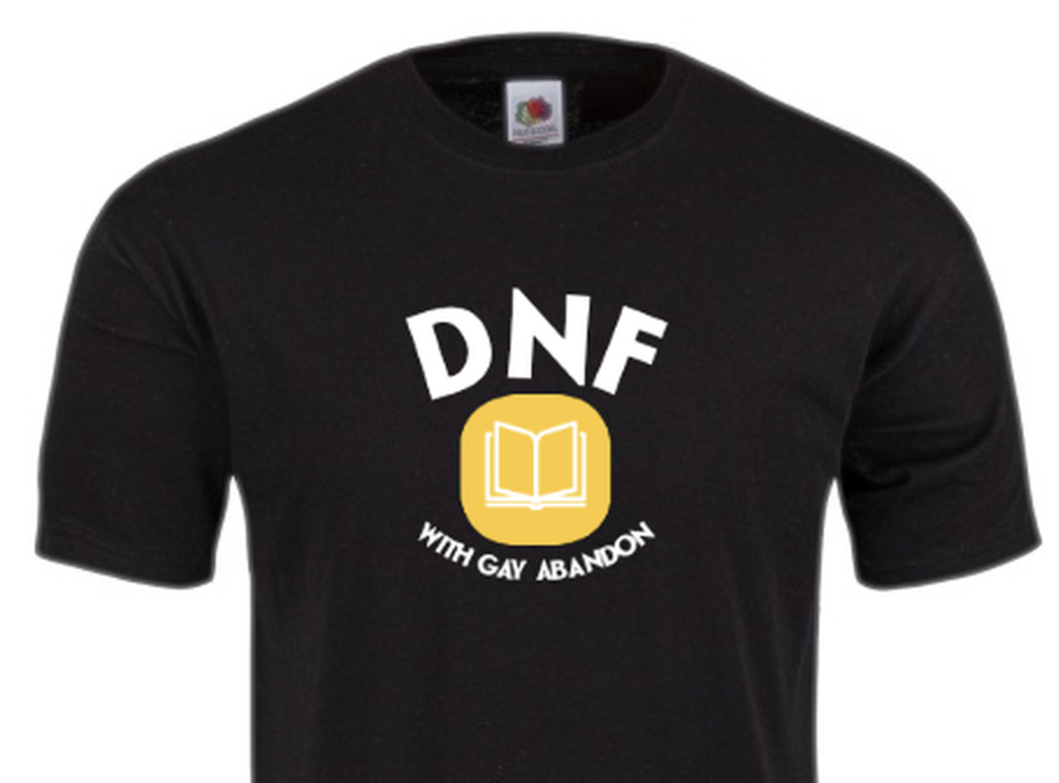
    joked on Bluesky that the theme for the rest of 2025 is: 

    DNF With Gay Abandon.

    I am considering getting it printed on a t-shirt.

    A T-Shirt with a logo of a book in the middle. Above that is 'DNF' and below is, 'With Gay Abandon'
    T-Shirt Idea

    What I don’t want to do is put myself in the position of another reading slump. They are brutal. I am giving myself permission to DNF for the silliest of reasons without guilt.

    It might be the book, or it might be me, but I’m going to try not to read too much into it if you don’t? 

    Though I don’t understand how anyone made sense of Under the Eye of the Big Bird… 

    I’m leaving this post here before I get myself in trouble.

    But before I do, I’ve avoided a slump. I’m reading Creation Lake by Rachel Kushner [2024], and the narration is doing the right things for my brain. 

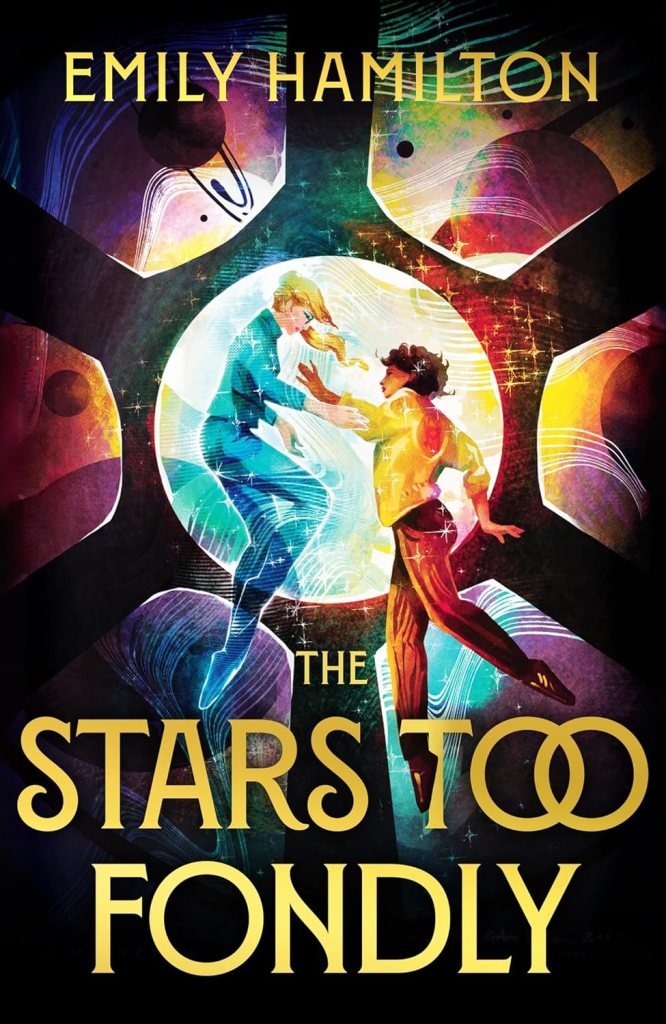
  • FR Review of The Stars Too Fondly by Emily Hamilton [2024]

    First Read Reviews (FR Reviews) are written for readers who want to know whether a book is worth picking up and what it might be about. There may be mild spoilers, but no in-depth discussion of the book’s events.

    The publishers describe The Stars Too Fondly as:

    “Part space odyssey, part Sapphic romcom, and all spaceship-stealing fun, Emily Hamilton’s breathtaking debut is a wild tale of galaxy-spanning friendship, improbable love, and wonder as vast as the universe itself.”

    After finishing it last night, I mostly agree.

    Hamilton weaves a well-constructed story of strange energy, making the best of bad circumstances, and unsustainable love.

    I can’t remember why I bought it—maybe I just needed more fun, space-based sci-fi. I read it now because June was Pride Month, and I was hoping for some queer joy. That’s exactly what Emily Hamilton delivered.

    Four friends want to know what happened to the missing crew of a spaceship, so they break into a compound to find out. In the process, they set off a series of events that lead them to examine the fabric of the universe in a completely unique way.

    At its core, The Stars Too Fondly is a slow-burn sapphic romance. It’s essential not only to understanding the main character but also to a foundational element of the plot. The story couldn’t have happened without it.

    As this is a First Read Review, I won’t overexplain the story. I found it compelling and touching—it made me cry—but it also had a strong sci-fi heart. The science drives the events until… well, you’ll see.

    Hamilton keeps it playful, especially in the interplay between the long-term friends and the not-so-subtle flirting of the wannabe lovers. The characters come to understand the impact of being on an unplanned space odyssey, and Hamilton manages the tension so it never spills over into melodrama.

    I do have a couple of notes of caution. First, in the setup, you’ll need to suspend disbelief that an advanced spacecraft could remain untouched in a hangar for twenty-one years. Second, the story is stripped back, which is part of its appeal—you, as the reader, are as trapped as the characters. Some may find this overly simplistic or frustrating. But as I said, it’s all about the romance and finding out whether they will or won’t. No spoilers, but I cried again.

    The spice level was unexpected, given the timing and circumstances in which it occurred. And the resolution to one of the plotlines felt underplayed, considering all it took to get there.

    But Hamilton clearly planned her plot. You can see the threads come together, and that makes her a writer to watch.

    Overall, I had a great time. If you’re looking for queer joy in space with solid science fiction adventure behind it, I highly recommend this book.

  • FRReview: The Undetectables by Courtney Smyth [2023]

    First Read Reviews are written for readers who want to know if a book is worth picking up and what it might be about. There may be the mildest spoilers, but no in-depth discussion of the events in the book.

    Description:

    The Undetectables, a detective agency run by three witches and a ghost in a cat costume (don’t ask), are hired to investigate another murder, several years after failing to solve their only other case. Given their track record and what’s happened over the last few years, they might not be up to the job.

    Thoughts:

    Note: If you like the sound of this book, don’t read the blurb. Just dive in.

    This is an urban fantasy murder mystery set in Wrackton, a small Occult town (I say small as I’m not entirely sure how many residents it has), home to various magical and mythological folk, and, if Diana’s ex-girlfriends are any measure, it’s very queer normative. There are some non-magical humans (Apparents) in the town, but they, the Apparents, mostly live separately in ordinary places, though magical people do live there amongst them too.

    Our focus is on Mallory, whose pain and fatigue from her fibromyalgia are explored through both the physical effects and the impact it has on her friendships with Cornelia and Diana. Her connections to them have faded by the time the story starts in the present. Throughout, it shows how those relationships have waned in Mallory’s mind since her diagnosis.

    Plenty of awkward moments happen as the trio gets back together. It feels like a mix between Scooby Doo and Buffy the Vampire Slayer’s Teen/Post-Teen detective forumas because they are excited to be working out clues, but put themselves in grave danger, while also dealing with the interpersonal dramas within their circle and from the people who enter it.

    There is a solid mystery at the heart of The Undetectables, with clues scattered throughout. It was well plotted and handled, and I didn’t feel cheated as it became clear what had happened and what led them to their suspects.

    Smyth tries to pack a lot into the first outing. A setup of local politics and the mythos that binds this and other Occult towns together, as they also explores the past and newly emerging relationships between our three main characters.

    Smyth labours some of the points they are trying to make and fails to hit all the marks they have set themselves, which can make for clunky reading. Some of the scenes don’t play out quite as smoothly as they should. I feel I’ve misread some key information (like doors and placements of characters in scenes), and I thought some interactions didn’t feel as natural as they could have been.

    But ultimately, I forgave the structural and technical issues I perceived because I wanted to see the mystery solved; I was invested in finding out what happened to our main trio and their friendly ghost: Smyth made me tear up more than once, as they also doesn’t pull their punches.

    I’d be remiss in not praising Smyth for how well they handled the impact of Mallory’s change in health on her and her friends. They also pointed out how everyone faces things that people are reluctant to discuss by getting their characters to discuss them.

    Summary:

    There is no getting away from the fact that there are some structural and technical issues. But for me, those are forgiven because of the world Smyth is attempting to build, the problems their characters explore, and the killer their characters are attempting to catch.

    If you can push past the abovementioned issues, I recommend reading it.

    Thanks to proud-geek.co.uk, I have a copy of the sequel, The Undead Complex, sitting on my desk. I can’t wait to see what our trio gets up to next.

  • [Contains Spoilers] What was the Point of The Lightspeed Trilogy? 

    Niall Harrison’s review in Locus magazine does provide answers.

    Beyond The Light Horizon

    However, I was unsatisfied with the ending. This feeling wasn’t helped by my e-reader telling me that there was 12% left. It ended on the first of what I was hoping were several post-script chapters. And I was promoted to post this on Bluesky: 

    I have just finished [Beyond the Light Horizon], and I feel like I have been cheated out of chapters at the end. Hmmmm.

    Have I forgotten that one of Science Fiction’s roles is to look at the big questions, and it uses a story wrapper to do that? 

    From my reaction to this work, it seems I have. Niall hasn’t taken much more away from the trilogy than I did.

    In a nutshell, an AI called ‘Iskander’ is a predictive AI that can anticipate your needs and set things in motion so they happen at the right time. Think of it as wanting to go out and finding you don’t have to wait for a taxi because it is already outside.  

    What it sets in motion in the trilogy is the discovery of Faster Than Light Travel, which results in a submarine/spaceship being built in Scotland. This then causes a chain reaction to open the world’s eyes to a deep conspiracy in which FTL has been a worldwide secret project.

    On reflection, this series is tackling a lot of big ideas: 

    • there are at least three versions of AI supporting/controlling the three main human geopolitical alliances 
    • the way the countries have aligned themselves
    • the socioeconomic impacts of those allegiances
    • the impact of climate change, either natural or manmade 
    • experimentation with evolution (and seeding/sharing flora and fauna) across different planets 

    After planting the seeds, MacLeod leaves it up to the reader to decide what happens next. And I think he does his story and audience a disservice here. Partly because he places his main character, Grant, back in a box and back on his original rails. And partly because there doesn’t seem to be anybody to take up the mantle. 

    Sure. Treaties are reinforced by force. New economic ties are arranged for between world trade are established but in the flashforward postscript those aren’t addressed for their impact or how integration between the Earth factions, and the other worlds they’ve colonised are working out – and more importantly for me if those other world inhabitants have been to Earth to establish themselves there.

    But overall, the grounding of Grant popped a bubble; it felt like the author didn’t want Grant to grow or change despite the extraordinary things he’d be instrumental in initiating.