Tag: romance

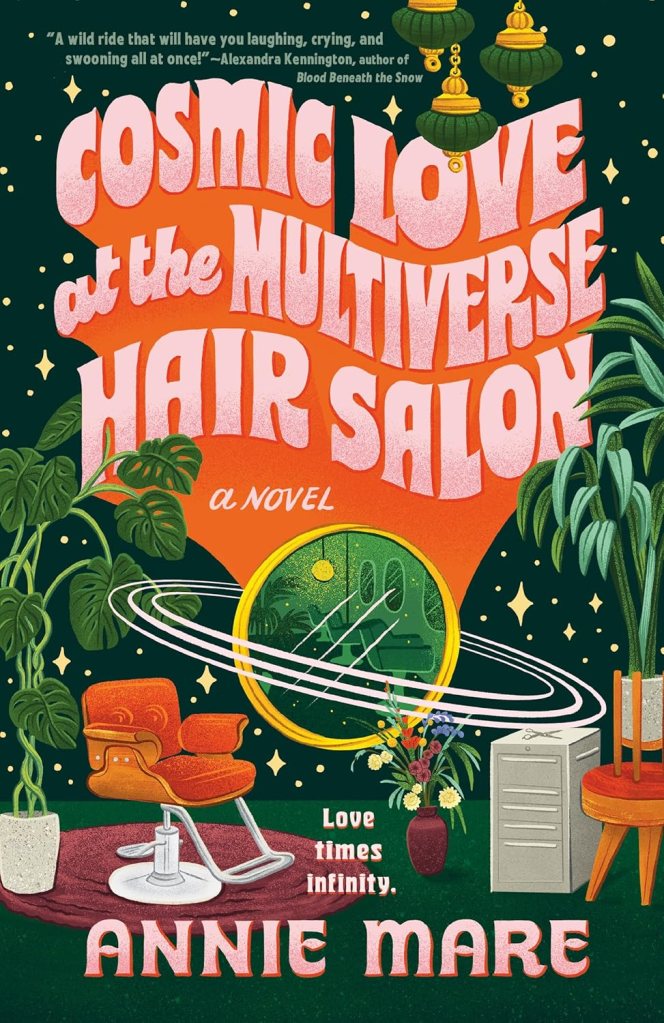
  • Review: Cosmic Love at the Multiverse Hair Salon by Annie Mare [2025]

    Spoilers: Mild (premise, themes, and early plot developments)
    Genre: Science Fiction  
    Format: Paperback 
    Source: Bought 
    Rating: Loved

    Would you fight for a love that feels right, even if it’s for someone you’ve never met? Not because you don’t want to, but because time has separated you by 6 months? Sounds crazy, right? But that’s what happens to Tressa Fay Robeson in Cosmic Love at the Multiverse Hair Salon.

    Tressa Fay is a successful and popular hairdresser known for giving her clients life-changing hairstyles. She is still recovering from a break-up when a random text message sends her across town on a date, only to be stood up at the bar. Well, not exactly stood up. Her date tells her where she is, but they aren’t there. And they didn’t stand each other up. They were both at the bar. It’s just that Tressa Fay is in the present and her date (Meryl) was waiting for her six months ago. Tressa Fay tells her friends that she’s texting a hot woman in the past, and they believe her.

    From there, you and the characters enter a trust bubble. You have to trust that Meryl and Tressa Fay can communicate via text as the characters do, and believe that it’s really happening. We spend the opening section of the book focusing solely on Tressa Fay in the present. This shows us that, in the past, Tressa Fay hadn’t met Meryl and confirms she wasn’t supposed to. But Meryl doesn’t want to be trapped in a future where she disappears and doesn’t get to love Tressa Fay, even if it has consequences.

    I think Annie Mare does an outstanding job not only of bouncing between timelines but also of guiding the reader through complex scientific concepts. Mare navigates them expertly because she’s hyper-focused on the emotional connections shared by all the characters.

    This is Mare’s and the book’s strength. She was happy to hold my heart in her grip. I cared about all of their futures with all my heart. I teared up, held my breath, and crossed my fingers for the right things to happen.

    But the science isn’t the driver of the story; the driver is two people who are passionately in love, desperate to meet and desperate not to lose each other, but it’ll only happen if they play the science right.

    With seemingly nothing to lose but everything to gain, they start messing with time.

    All their pasts and futures become tangled; their connections are so tenuous because the present could be changed, and they could be severed from each other at any moment.

    They have the power to tell Meryl her future, and I kept wondering which upcoming past event they would choose to change and how it would manifest in the present. This tightened her fist around my heart like a vice for almost the entire time.

    It’s a hard premise to land — how much of the mystery do you explain? Do you go where the readers expect, or where you expect? I think the concept for resolving the overlapping time was masterful; I was expecting one last dramatic revelation, and it didn’t come, and what happened as a result didn’t work for me.

    Mare, I think, wanted a specific tone for the ending, but instead of leaning into the danger of their experimentation, she played it too safe. All the tension I had been holding slipped away, leaving me slightly deflated.

    Cosmic Love at the Multiverse Hair Salon, to me, is a meditation on the nature of love. The story itself feels like an instructor. I was its student. Because Meryl doesn’t want to be trapped in a future where she disappears and never gets to love Tressa Fay, every observation felt like something I needed to study and hold onto. There were so many observations I felt compelled to write down to study later. I loved watching them and taking notes as I explored, changed, loved and laughed — I just can’t promise you’ll like the last few pages.

    Recommended for anyone who enjoys (or thinks they’ll enjoy) a mix of sapphic yearning and science fiction.

    Note: I rate on a four-tier scale: Loved (4.5–5★), Liked (3.75–4.25★), Mixed (2.75–3.5★), and Not for me (1–2.5★).
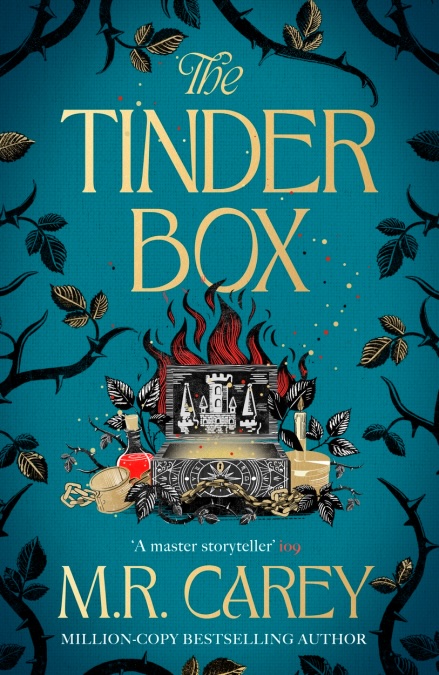
  • Review: The Tinder Box by M.R. Carey [2026]

    Spoilers: Mild (themes and setup only
    Genre: Fantasy
    Format: e-ARC
    Source: NetGalley (in exchange for an unbiased review)
    Rating: Liked

    This is Carey’s take on a short story by Hans Christian Andersen, unsurprisingly also called The Tinderbox. He tells the tale of a soldier and a witch whose existence has been put at risk by the deeds of their rulers.

    If you’re wanting an action/adventure you’re not getting that. What you do get is a slower examination of good, bad, wicked and truly evil.

    Set in a small Eastern European country of Allesheim, where there is a seemingly endless war with its neighbours, Ehrlich and Pozhka, though it’s unclear what they are truly fighting about.

    It’s implied that whoever wins this fight for control will ultimately make no difference to the lives of the citizens of each country. And while the rulers squabble, their citizens are starving and dying for the sake of a war that has no end in sight.

    The tone of the book is set by Mag Tresti, as he describes his honourable medical discharge being conducted alongside the execution of his condemned comrades, who have been branded as faithless cowards and are to be executed in batches. Both events are carried out on behalf of, and in the presence of, the king.

    The soldier notes that, despite the pending deaths and general unhappiness of the gathering soldiers being honoured, a semblance of approval has been conjured up for the king’s speech where there was none. This hints at the power of the adviser, which is both magical and political.

    Mag, the now ex-soldier, is shunned by those he comes across on his search for new employment, but eventually finds himself asking a reclusive widow, Jannae Mirchella, for work. Surprisingly but brusquely, she agrees, initially with terms acceptable to both.

    But the terms offered—payment on completion of work—are not fulfilled, as she is always finding work to be done. This doesn’t seem to matter until Mag is doing a dangerous task and comes into possession of a Tinder Box.

    This event soon coincides with him leaving the widow’s employ; formerly a man without power, he now seems to possess something powerful, though he doesn’t know at the time that it contains three devils.

    The widow, however, is a witch. One who has been waiting for some unspecified right moment to go back into the world. This is not the moment she was waiting for, but recovering the box is overwhelming.

    While travelling she starts to remember her past, and becomes haunted by a key moment, forced to look back at this and other decisions her circumstances forced her to take. She examines the most important one—taking her revenge—and why she’s been putting it off.

    We start with Mag’s narration, but the story demands we see into the heart of Jannae, so it is then told from her perspective. And we get to understand what she’s willing to sacrifice, and are challenged to believe that there might be some good in her cold heart.

    We switch between the two as one hunts the other down.

    We even get to see the world through the king’s adviser, though we see nothing redeeming through his eyes.

    The limits of choice are a theme that cuts across our three main characters, and we get to see the world from each of them, which may be a bit disappointing to those who were enjoying the ex-soldier’s narration and were happy to see the world from his point of view.

    Told from multiple points of view, this allows Carey to provide better commentary and insight. The slower nature of the story gives space for this. He examines women in this society, who are not well thought of; the role of soldiers, seen as replicable; the ambivalence of those who hold power, though it is really the people who hold it; how people can be oh so very petty, where telling tales really doesn’t have consequences; and overall the value of a life, which becomes about living in the moment.

    Ultimately, it is the story of how life doesn’t like people who want to live outside the boxes that society puts them into, making sure they toe the line, which is literal in the case of the three devils.

    The skill of Carey’s storytelling is shown in scenes where Mag tries to befriend the inhabitants of the Tinder Box – like Aladdin’s genie, they can seemingly grant any wish, but they are prisoners bound to the commands of their possessor, and unlike the genie they have no end to their sentence. Does he win them over? Are they actually wicked or have they also found themselves on the wrong side of an ambivalent ruler?

    There are reflections from both the living, the meta-living, and the dead.

    On what happens to the living after death, one of the prisoners of the box says:

    ‘That knowledge Elohim has not shared with any. I have always assumed that there is a mill where old souls are washed and made new, but if there is I’ve never seen it. Perhaps they only fade. Or perhaps there is another place somewhere in which they enjoy a different existence. In any event, their persistence on this plane is short’

    It doesn’t matter to the god of this world (Elohim); like the King, both treat the world as if there will always be more people, and more souls, to do their bidding, and that’s how they inevitably become worthless.

    Carey makes you feel that everyone is worthy, well maybe not the evil King or his court. But everyone else—yes, there is a cost, but aren’t things of real value worth the price?

    I am trying not to say too much, because it’s not packed with events; it’s more thoughtful and meditative. I think this will frustrate some readers, which would be a shame.

    But if they stick with it, it’s a story of making the best of things, with some unrequited love—or perhaps lust—woven in.

    Overall, it’s a fairytale stretched into a novel, spending that extra time exploring the meaning of life and what can be achieved if you truly live.

    Note: I rate on a four-tier scale: Loved (4.5–5★), Liked (3.75–4.25★), Mixed (2.75–3.5★), and Not for me (1–2.5★).