Tag: Science Fiction

  • Review: Dungeon Crawler Carl by Matt Dinniman [2020]

    Spoilers: Mild (premise, themes, and early plot developments)
    Genre: Science Fiction, LitRPG
    Format: Hardback
    Source: Bought
    Rating: Liked
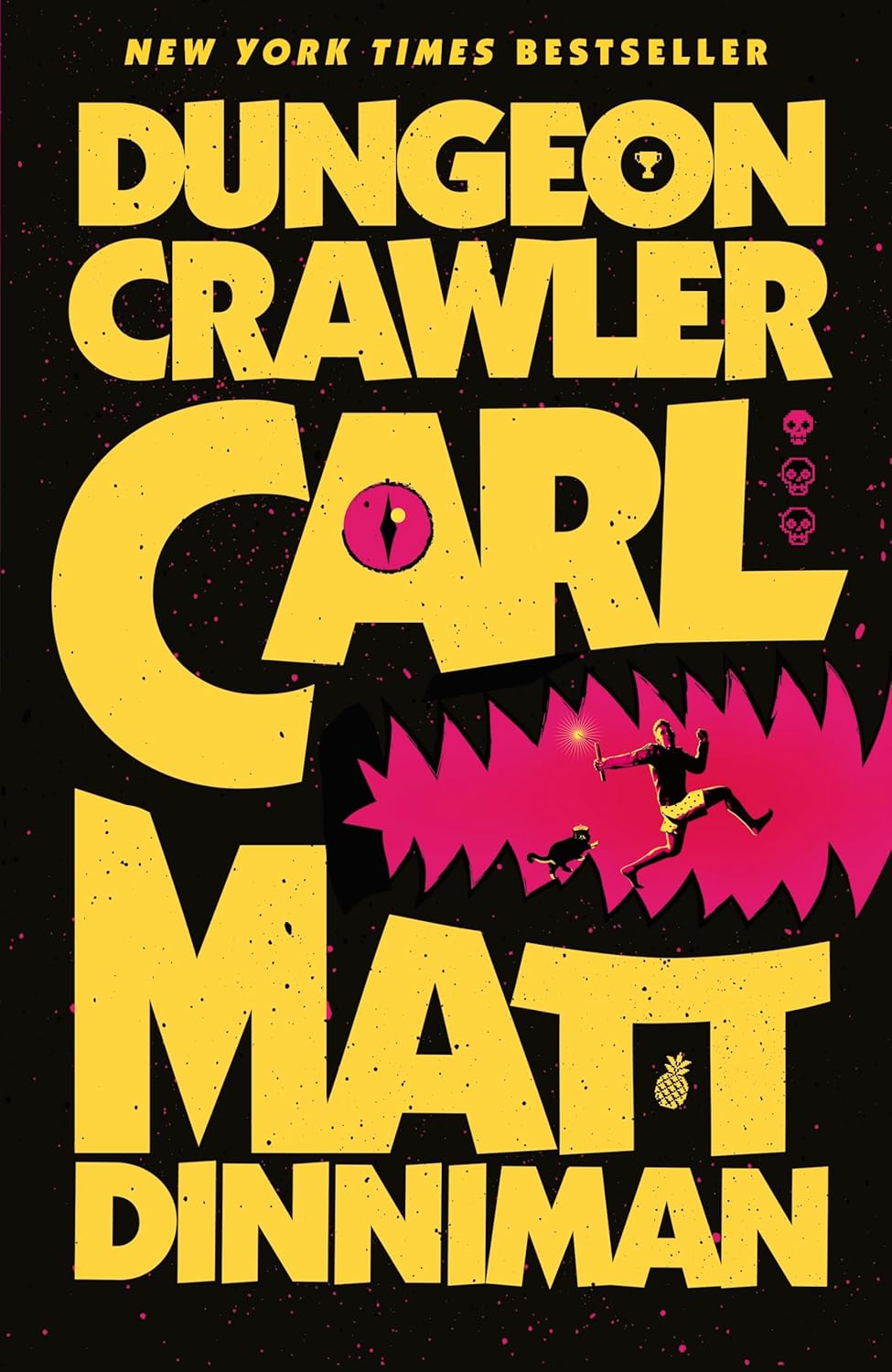
    On my copy of Dungeon Crawler Carl (DCC), under the dust jacket, it says, ‘You Will Not Break Me’. Whatever else you think of Carl, this sentiment holds true through book one and, based on what happens here, through the series as a whole.

    DCC is one of the most popular titles in the relatively new genre label of LitRPG, and it deserves that status.

    It focuses on Carl and his ex-girlfriend’s cat, Princess Donut, who just happen to be outside in the right place when the game commences and wipes out most of humanity.

    As a reward for surviving this near-extinction-level event, all new players, Crawlers, must survive a series of puzzles, skirmishes, and occasional boss battles against “things” that are solely there to kill them. Their survival mostly depends on getting stronger and killing “things”, even if those things turn out to be their fellow humans. 

    I had to pause reading DCC around 1/3 of the way in, as I grew uncomfortable with Carl’s initial portrayal.

    I am very much a ‘I care about the people more than the system’ person. Carl kills a confused, mutated woman and a crèche of goblin babies, showing little reaction to either his actions or his foes’ deaths.

    I may have prematurely concluded that ‘I understand what DCC is trying to do, and I don’t think finishing it will change that—but maybe I’ll come to like it.’

    But thinking more about the fact that it falls within the system-apocalypse microgenre, and reading around the subject, I wanted to push on and see if I was getting the full picture. 

    After picking it back up and reading more, I did. I saw Carl as stoic and practical in his response — he later reflects that they are all there to die. Given Carl’s background as a Coast Guard veteran, I wondered if that’s just how they make them. His cat does act like an arsehole. But that’s a cat for you, especially one with trophies and rosettes, though even she acknowledges that Carl is trying to do the right thing in challenging circumstances.

    Given his mantra of ‘You Will Not Break Me’, I started taking notes on when Carl was sympathetic or heroic in the face of everything he’s been pitted against. I feel the evidence shows he’s a ‘good guy’ in a bad world, and it makes you wonder what you would do. Just wait to die? Or try to survive and hope?

    The ‘cleverness’ of this work, and perhaps of the genre, is that it takes the core mechanics of an RPG and reveals the brutal reality behind them. The system is against him—he’s there to kill and, ultimately, to die, in an entertaining way.

    And that’s what video games do: they work in the abstract; they are pixels on a screen, and now there’s blood on the dungeon floor.

    This isn’t a game. It’s real life, with all the complexities and the games within games that we all experience.

    Carl gets to see that as he’s introduced to more than one of the Wizards behind the curtain. And in later scenes, Matt draws Carl into what the game represents: the politics, the promises and the control it exerts over everyone, because almost everyone is a victim. 

    As a video game-to-page adaptation, I can’t fault it. The explanations of weapons, bosses, and other baddies are good, and the AI overseer is funny, often inappropriately so. It feels like a video game experienced through all five senses.

    You have to assume that everyone is going to die, including the crawlers and the NPCs (non-playable characters), even if they themselves might not know it. It’s a story told against that injustice, focusing on a character who’s trying his best, given his upbringing and background.

    There is a lot to enjoy. The interactions, the characters, the system, the politics, and the backdrop against which it’s set. 

    Am I going to read the next one? Yes. And the one after that. I’m told that books 2 and 3 need to be read together to get the point Dinniman is trying to make. 

    I don’t think it’s a celebratory story; it’s brutal and shows the reality of RPGs while trying to satirise late-stage capitalism, which values money and entertainment over anything an individual might experience. 

    Do I expect it to soften its use of problematic gazes (see below)? Hopefully. I hear that it does as the series continues. 

    I guess we’ll see. 

    Addendum:  

    As a satire on capitalism, it’s complicated. Carl and probably the author, Matt, see the world through a white male gaze. I know more about the anatomy of his encounters with women than I wish. I’m not sure he ever mentions the guns, pecs, and thighs of any of the men he encounters.

    As other commentary has pointed out, it’s great to call out what capitalism represents, but it might still rely too heavily on the language and framing of the worldview it’s trying to satirise, which makes it hard to distinguish between commentary and ingrained bias. 
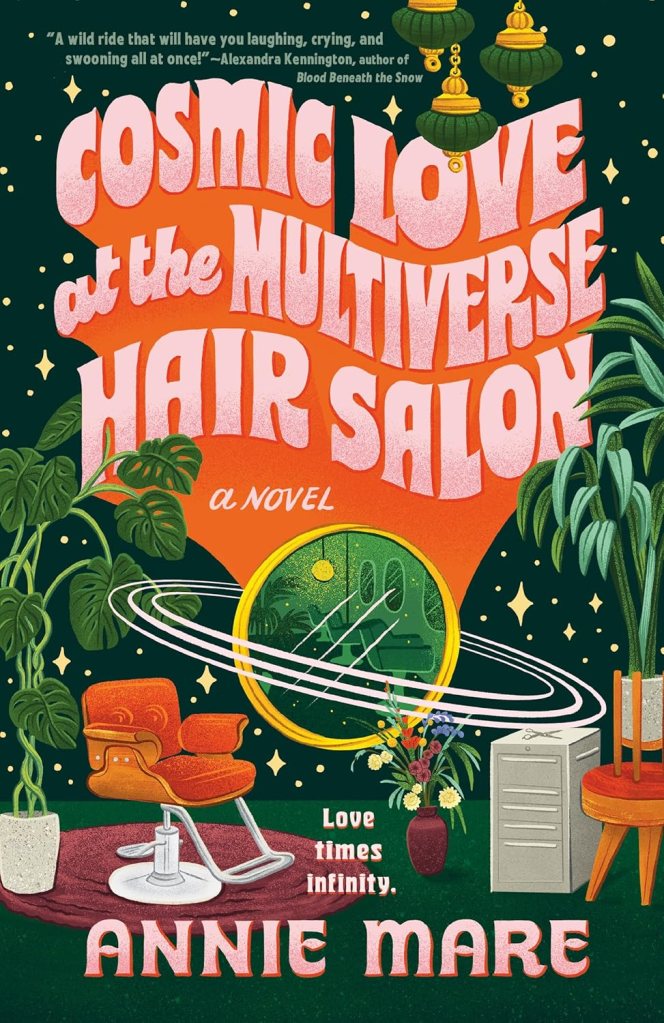
  • Review: Cosmic Love at the Multiverse Hair Salon by Annie Mare [2025]

    Spoilers: Mild (premise, themes, and early plot developments)
    Genre: Science Fiction  
    Format: Paperback 
    Source: Bought 
    Rating: Loved

    Would you fight for a love that feels right, even if it’s for someone you’ve never met? Not because you don’t want to, but because time has separated you by 6 months? Sounds crazy, right? But that’s what happens to Tressa Fay Robeson in Cosmic Love at the Multiverse Hair Salon.

    Tressa Fay is a successful and popular hairdresser known for giving her clients life-changing hairstyles. She is still recovering from a break-up when a random text message sends her across town on a date, only to be stood up at the bar. Well, not exactly stood up. Her date tells her where she is, but they aren’t there. And they didn’t stand each other up. They were both at the bar. It’s just that Tressa Fay is in the present and her date (Meryl) was waiting for her six months ago. Tressa Fay tells her friends that she’s texting a hot woman in the past, and they believe her.

    From there, you and the characters enter a trust bubble. You have to trust that Meryl and Tressa Fay can communicate via text as the characters do, and believe that it’s really happening. We spend the opening section of the book focusing solely on Tressa Fay in the present. This shows us that, in the past, Tressa Fay hadn’t met Meryl and confirms she wasn’t supposed to. But Meryl doesn’t want to be trapped in a future where she disappears and doesn’t get to love Tressa Fay, even if it has consequences.

    I think Annie Mare does an outstanding job not only of bouncing between timelines but also of guiding the reader through complex scientific concepts. Mare navigates them expertly because she’s hyper-focused on the emotional connections shared by all the characters.

    This is Mare’s and the book’s strength. She was happy to hold my heart in her grip. I cared about all of their futures with all my heart. I teared up, held my breath, and crossed my fingers for the right things to happen.

    But the science isn’t the driver of the story; the driver is two people who are passionately in love, desperate to meet and desperate not to lose each other, but it’ll only happen if they play the science right.

    With seemingly nothing to lose but everything to gain, they start messing with time.

    All their pasts and futures become tangled; their connections are so tenuous because the present could be changed, and they could be severed from each other at any moment.

    They have the power to tell Meryl her future, and I kept wondering which upcoming past event they would choose to change and how it would manifest in the present. This tightened her fist around my heart like a vice for almost the entire time.

    It’s a hard premise to land — how much of the mystery do you explain? Do you go where the readers expect, or where you expect? I think the concept for resolving the overlapping time was masterful; I was expecting one last dramatic revelation, and it didn’t come, and what happened as a result didn’t work for me.

    Mare, I think, wanted a specific tone for the ending, but instead of leaning into the danger of their experimentation, she played it too safe. All the tension I had been holding slipped away, leaving me slightly deflated.

    Cosmic Love at the Multiverse Hair Salon, to me, is a meditation on the nature of love. The story itself feels like an instructor. I was its student. Because Meryl doesn’t want to be trapped in a future where she disappears and never gets to love Tressa Fay, every observation felt like something I needed to study and hold onto. There were so many observations I felt compelled to write down to study later. I loved watching them and taking notes as I explored, changed, loved and laughed — I just can’t promise you’ll like the last few pages.

    Recommended for anyone who enjoys (or thinks they’ll enjoy) a mix of sapphic yearning and science fiction.

    Note: I rate on a four-tier scale: Loved (4.5–5★), Liked (3.75–4.25★), Mixed (2.75–3.5★), and Not for me (1–2.5★).

  • Can I Read the Hugo and Clarke Shortlists Before the Winners Are Announced?

    Nick Hubble reminded me on Bluesky that this year’s Hugo Award nominees are out.

    Keeping a track of these write-ups for reasons. Also nice to see myself quoted if not named.

    Nick Hubble (@thehubble101.bsky.social) 2026-06-26T18:17:34.639Z

    In July last year, I gave myself two reading challenges:

    1. Read the  British Fantasy Awards 2025 shortlist for Best Anthology
    2. Read the World Fantasy Awards 2025 shortlist for Best Novella

    I managed the novellas, but burnt out on the anthologies.

    So I have form, if not an entirely successful track record, with reviewing award shortlists. It does help me focus — giving me a deadline to aim for and pushing me to read books that might otherwise sit on the ever‑growing TBR pile.

    I also did a ‘live’ reading of Annie Bot by Sierra Greer (at Dan’s request), which went on to win the Clarke Award.

    That pushed me to read it more closely and think about it more deeply — and I think I saw some of what the Clarke judges did in it. A worthy winner.

    So I’m wondering whether to set myself a new challenge: read the Hugo and Clarke shortlists before the winners are announced.

    Despite having somehow forgotten, checking the list reminded me that they are all books I’m interested in.

    Best Novel

    • A Drop of Corruption by Robert Jackson Bennett (Del Rey; Hodderscape)
    • Death of the Author by Nnedi Okorafor (William Morrow; Gollancz)
    • Shroud by Adrian Tchaikovsky (Tor UK; Orbit US)
    • The Everlasting by Alix E. Harrow (Tor US; Tor UK)
    • The Incandescent by Emily Tesh (Tor US; Orbit UK)
    • The Raven Scholar by Antonia Hodgson (Orbit US; Hodderscape)

    I’ve only read one (The Incandescent), which isn’t a great start — especially as it’s currently at the bottom of the list, sorry. In theory, I have plenty of time to catch up on the other five before the winner is announced on Sunday, 30 August 2026, at 8:00pm Pacific (4am?!).

    The good news is that I already have all of them, including special editions of Death of the Author and The Everlasting. I enjoyed Robert Jackson Bennett’s previous series, and The Raven Scholar has enough hype that it seems to be living up to it.

    If that feels ambitious, I’ve checked the other categories, and the Best Novella looks much more manageable and should give me an easy and early win.

    Best Novella

    • Automatic Noodle by Annalee Newitz (Tordotcom)
    • Cinder House by Freya Marske (Tordotcom; Tor UK)
    • Murder by Memory by Olivia Waite (Tordotcom)
    • The River Has Roots by Amal El-Mohtar (Tordotcom; Arcadia UK)
    • The Summer War by Naomi Novik (Del Rey US; Del Rey UK)
    • What Stalks the Deep by T. Kingfisher (Nightfire; Titan UK)

    I’ve read half of them — Automatic Noodle, Murder by Memory and What Stalks the Deep — all worth reading. I owe reviews of two of them. But if I had to rank them, I’d go Noodle, Deep, then Memory. I’m curious how that would change.

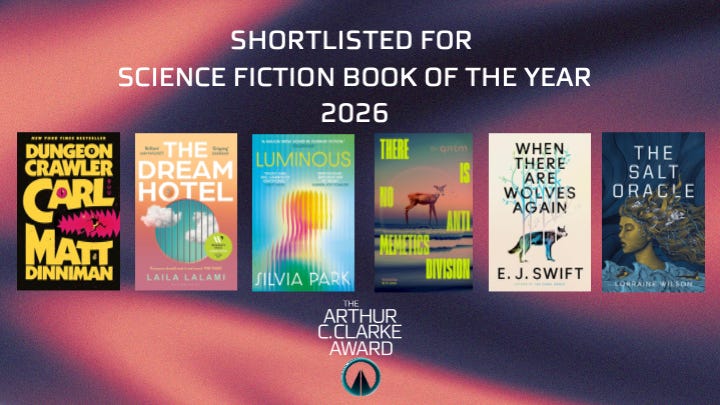
    The Arthur C. Clarke Award shortlist this year is:

    • Dungeon Crawler Carl – Matt Dinniman (Michael Joseph)
    • The Dream Hotel – Laila Lalami (Bloomsbury Circus)
    • Luminous – Silvia Park (Magpie)
    • There Is No Antimemetics Division – Qntm (Del Rey)
    • When There Are Wolves Again – E.J. Swift (Arcadia)
    • The Salt Oracle – Lorraine Wilson (Solaris)

    I bought The Dream Hotel and Dungeon Crawler Carl especially to read for this, so I’m committed in terms of TBR. The Arthur C. Clarke and Hugos always have a lot of debate, and I want to avoid FOMO and join in.

    The winner of the Arthur C. Clarke Award will be announced on 12 August 2026, putting it just over two weeks before the Hugos. In order to meet both deadlines, I’d need to read 10⅔ novels plus three novellas in just over two months.

    Should I commit to it? Would you do it? Have you read any? Who would you vote to win?

    PS

    The British Fantasy Awards 2026 Shortlists are also out, including the Best Anthology Award:

    • Lesbians In Space: Where No Man Has Gone Before, edited by J S Fields, William C Tracy, Heather Tracy (Space Wizard Science Fantasy)
    • Blood in the Bricks, edited by Neil Williamson, NewCon Press
    • This Way Lies Madness, edited Dave Jeffery, Lee Murray, Flame Tree Press
    • Silk and Sinew: A Collection of Folk Horror from the Asian Diaspora, Kristy Park Kulski (Bad Hand Books)

    And while I’m not reading the anthologies this year, I’m curious about them. Have you read any? What should I pick up?