Tag: The Arthur C. Clarke Award

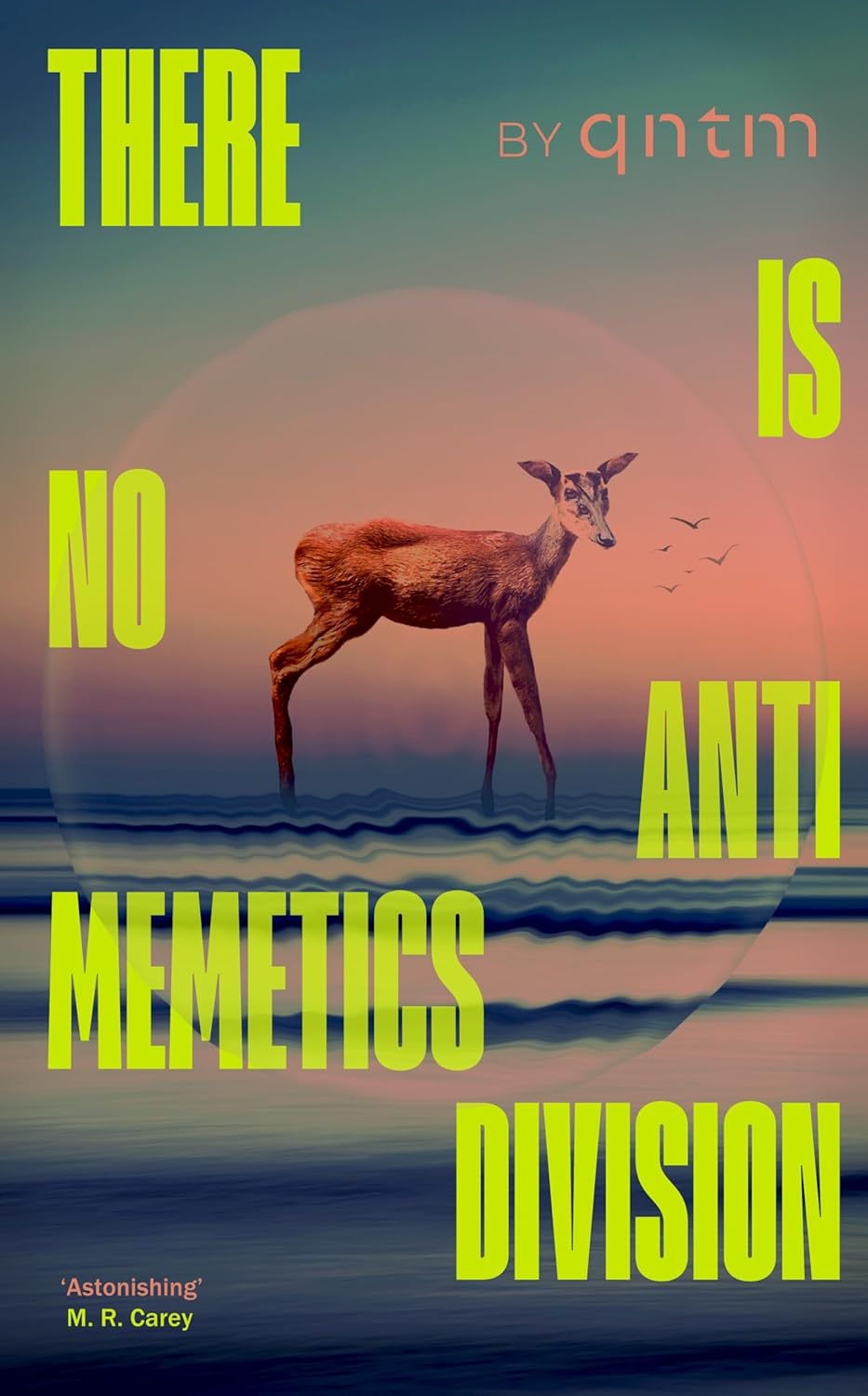
  • Novel Review: There is No Antimemetics Division by qntm [2025]

    Spoilers: None
    Genre: Weird/Cosmic Horror
    Format: Hardback
    Source: Bought
    Rating: Inducted (4.5–5★, Recommended)

    What if something was eating your memories? You were also aware that it was happening but didn’t know what it had taken, or what you were doing to stop it, because it wasn’t just your memories it was taking, but everyone else’s too? And what if it wasn’t just one thing but lots of ‘things’ that could affect people’s memories? Then what would you do?
    We are used to ideas (memes) breaking containment.

    …an internet meme is a concept or piece of media that spreads via the internet. It could be anything – a video, hashtag or image…They can come from social interactions, pop culture, or political views.

    Source: MEMES: WHAT ARE THEY?

    Memes change the world, and anti-memes do too. qntm’s There Is No Antimemetics Division explores what happens when ideas don’t spread, but instead resist being remembered and slip from the mind.

    An antimeme is an idea with self-censoring properties; an idea which, by its intrinsic nature, discourages or prevents people from spreading it.

    Source: Antimemetics Division Hub – SCP Foundation

    It opens with Marie Quinn walking into a meeting that feels wrong, and from there, everything feels out of place.

    qntm takes the weirdness of VanderMeer’s Area X novels, combines it with the government bureaucracy of Stross’s The Laundry series, and puts it in a pressure cooker, releasing the results in a series of intense, interlinked sections.

    As a novel that plays with memory, it has its own logic, but it also has jarring moments. It takes what you’ve been told from earlier scenes and twists and changes them, which doesn’t automatically mean you’ve misremembered them.

    It originated as a web serial, and I wonder if that’s why it occasionally feels fragmented. Whether the fragmentation is accidental or deliberate, they add to the uncertainty and enhances the creeping horror signposted throughout.

    As a reader, I don’t think you’re expected to ‘keep’ up with the changes, but you do need to accept that the reality you now see is the one in that moment.

    Cosmic horror is, at its heart, about the uncaring nature of the universe and the entities who are bigger than us, but qntm makes this personal for Quinn, and by extension, the reader. Quinn is perhaps cruelly given back memories she’d lost, only to have them taken away again.

    This is a clever novel; it may frustrate and infuriate, but it builds toward a moment via the mantra:

    No, this is not your first day.

    Recommended for readers interested in the 2026 Arthur C. Clarke Award shortlist and for fans of Jeff VanderMeer, Charles Stross, and creeping existential horror.

  • Review: When There Are Wolves Again by E. J. Swift [2025]

    Spoilers: None
    Genre: Speculative Climate Fiction
    Format: Paperback
    Source: Bought
    Rating: Inducted (4.5–5★)

    Is this Arthur C. Clarke Award-winning book worth your time? Yes. 100% yes.

    When There Are Wolves Again is a climate-focused speculative fiction novel that shows how our choices can nudge the world toward a different, hopefully better, place.

    I’ll let you decide whether Swift is giving us a what-if, making a prediction, or whether her words can become a manifestation?

    Decades from now, two women sit by a fire and speak. Lucy tells us directly how she has fought for nature. Hester reports on her life as if she were an outsider looking in. Lucy uses direct action to force change, while Hester records her observations and shares documentaries of those moments to shift her audience’s perspective.

    It might seem like they’re recounting a fantasy, but the story challenges the current world’s assumption that we can’t respond radically enough to climate change. Instead, it offers an alternative future in which we let nature return and be wild. Their stories empower the reader by showing how something dramatic can be achieved through the choices and sacrifices of just two people.

    I did start to worry that the time-leaping format would feel like a biographical run-through, which would leave me with an ‘oh well’ feeling at the end, but Swift doesn’t just wander aimlessly back to the fireside chat that frames this tale.

    The leaps ahead in time feel deliberately random, and they work. The reader just needs to trust that it will all make sense because it builds an emotional jigsaw that pays off when the last piece clicks into place.

    This is because Swift is willing to pause and examine who we are in those moments; that’s what makes it meaningful.

    The message is that grief, sadness, and regret are part of life, but it’s what we do afterwards that matters.

    Hester leaves home and turns that into an observation of the world, using her camera lens to give nature a voice and, unintentionally, exposing herself. But only after Lucy’s actions for wider change do we understand the cost.

    In contrast, Lucy is an outsider from the start. She takes that rejection and pain, and it fuels her as she shouts and screams for a better deal for nature.

    The author’s skill emerges best in the scenes where the characters are with their family, friends, and enemies. These moments aren’t forced; they’re where Lucy and Hester process their feelings. I got emotional more than once because of how they have to face themselves through their past decisions, present circumstances, and inevitable futures.

    And there is a realisation, followed by discomfort as a reader, that they might not have had a happy life. But their happiness has always been and will remain secondary. The question raised here is: was that worth it? Swift argues, through the changes their lives make to nature, that it is.

    It’s a novel that sticks your hand in the dirt and forces you to look at nature, free to live and die without human constraint or interference. The challenge is to go outside, stick your hand in real soil, and help change things.

    This is for anyone who cares about our future and wants to see a hopeful one made possible by the sacrifices of two remarkable people.

    My Ratings

    • Loved / Inducted (4.5–5★)
    • Passing Through (3.75–4.25★)
    • Impactful but flawed / missed swings (2.75–3.5★)
    • Not for Me / Back on the Shelf (1–2.5★ or DNF)
  • Can I Read the Hugo and Clarke Shortlists Before the Winners Are Announced?

    Nick Hubble reminded me on Bluesky that this year’s Hugo Award nominees are out.

    Keeping a track of these write-ups for reasons. Also nice to see myself quoted if not named.

    Nick Hubble (@thehubble101.bsky.social) 2026-06-26T18:17:34.639Z

    In July last year, I gave myself two reading challenges:

    1. Read the  British Fantasy Awards 2025 shortlist for Best Anthology
    2. Read the World Fantasy Awards 2025 shortlist for Best Novella

    I managed the novellas, but burnt out on the anthologies.

    So I have form, if not an entirely successful track record, with reviewing award shortlists. It does help me focus — giving me a deadline to aim for and pushing me to read books that might otherwise sit on the ever‑growing TBR pile.

    I also did a ‘live’ reading of Annie Bot by Sierra Greer (at Dan’s request), which went on to win the Clarke Award.

    That pushed me to read it more closely and think about it more deeply — and I think I saw some of what the Clarke judges did in it. A worthy winner.

    So I’m wondering whether to set myself a new challenge: read the Hugo and Clarke shortlists before the winners are announced.

    Despite having somehow forgotten, checking the list reminded me that they are all books I’m interested in.

    Best Novel

    • A Drop of Corruption by Robert Jackson Bennett (Del Rey; Hodderscape)
    • Death of the Author by Nnedi Okorafor (William Morrow; Gollancz)
    • Shroud by Adrian Tchaikovsky (Tor UK; Orbit US)
    • The Everlasting by Alix E. Harrow (Tor US; Tor UK)
    • The Incandescent by Emily Tesh (Tor US; Orbit UK)
    • The Raven Scholar by Antonia Hodgson (Orbit US; Hodderscape)

    I’ve only read one (The Incandescent), which isn’t a great start — especially as it’s currently at the bottom of the list, sorry. In theory, I have plenty of time to catch up on the other five before the winner is announced on Sunday, 30 August 2026, at 8:00pm Pacific (4am?!).

    The good news is that I already have all of them, including special editions of Death of the Author and The Everlasting. I enjoyed Robert Jackson Bennett’s previous series, and The Raven Scholar has enough hype that it seems to be living up to it.

    If that feels ambitious, I’ve checked the other categories, and the Best Novella looks much more manageable and should give me an easy and early win.

    Best Novella

    • Automatic Noodle by Annalee Newitz (Tordotcom)
    • Cinder House by Freya Marske (Tordotcom; Tor UK)
    • Murder by Memory by Olivia Waite (Tordotcom)
    • The River Has Roots by Amal El-Mohtar (Tordotcom; Arcadia UK)
    • The Summer War by Naomi Novik (Del Rey US; Del Rey UK)
    • What Stalks the Deep by T. Kingfisher (Nightfire; Titan UK)

    I’ve read half of them — Automatic Noodle, Murder by Memory and What Stalks the Deep — all worth reading. I owe reviews of two of them. But if I had to rank them, I’d go Noodle, Deep, then Memory. I’m curious how that would change.

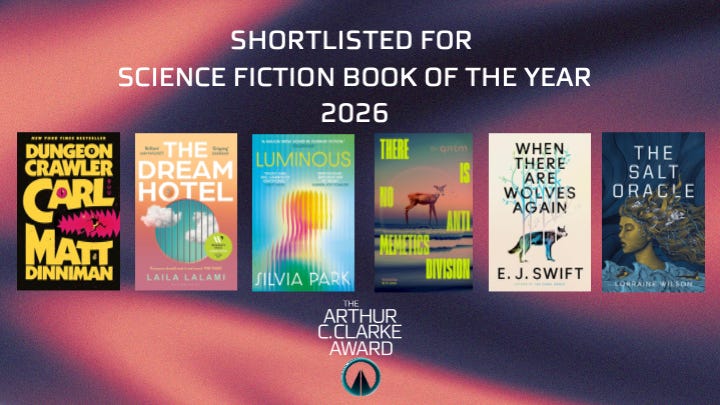
    The Arthur C. Clarke Award shortlist this year is:

    • Dungeon Crawler Carl – Matt Dinniman (Michael Joseph)
    • The Dream Hotel – Laila Lalami (Bloomsbury Circus)
    • Luminous – Silvia Park (Magpie)
    • There Is No Antimemetics Division – Qntm (Del Rey)
    • When There Are Wolves Again – E.J. Swift (Arcadia)
    • The Salt Oracle – Lorraine Wilson (Solaris)

    I bought The Dream Hotel and Dungeon Crawler Carl especially to read for this, so I’m committed in terms of TBR. The Arthur C. Clarke and Hugos always have a lot of debate, and I want to avoid FOMO and join in.

    The winner of the Arthur C. Clarke Award will be announced on 12 August 2026, putting it just over two weeks before the Hugos. In order to meet both deadlines, I’d need to read 10⅔ novels plus three novellas in just over two months.

    Should I commit to it? Would you do it? Have you read any? Who would you vote to win?

    PS

    The British Fantasy Awards 2026 Shortlists are also out, including the Best Anthology Award:

    • Lesbians In Space: Where No Man Has Gone Before, edited by J S Fields, William C Tracy, Heather Tracy (Space Wizard Science Fantasy)
    • Blood in the Bricks, edited by Neil Williamson, NewCon Press
    • This Way Lies Madness, edited Dave Jeffery, Lee Murray, Flame Tree Press
    • Silk and Sinew: A Collection of Folk Horror from the Asian Diaspora, Kristy Park Kulski (Bad Hand Books)

    And while I’m not reading the anthologies this year, I’m curious about them. Have you read any? What should I pick up?