What if something was eating your memories? You were also aware that it was happening but didn’t know what it had taken, or what you were doing to stop it, because it wasn’t just your memories it was taking, but everyone else’s too? And what if it wasn’t just one thing but lots of ‘things’ that could affect people’s memories? Then what would you do?
We are used to ideas (memes) breaking containment.
…an internet meme is a concept or piece of media that spreads via the internet. It could be anything – a video, hashtag or image…They can come from social interactions, pop culture, or political views.
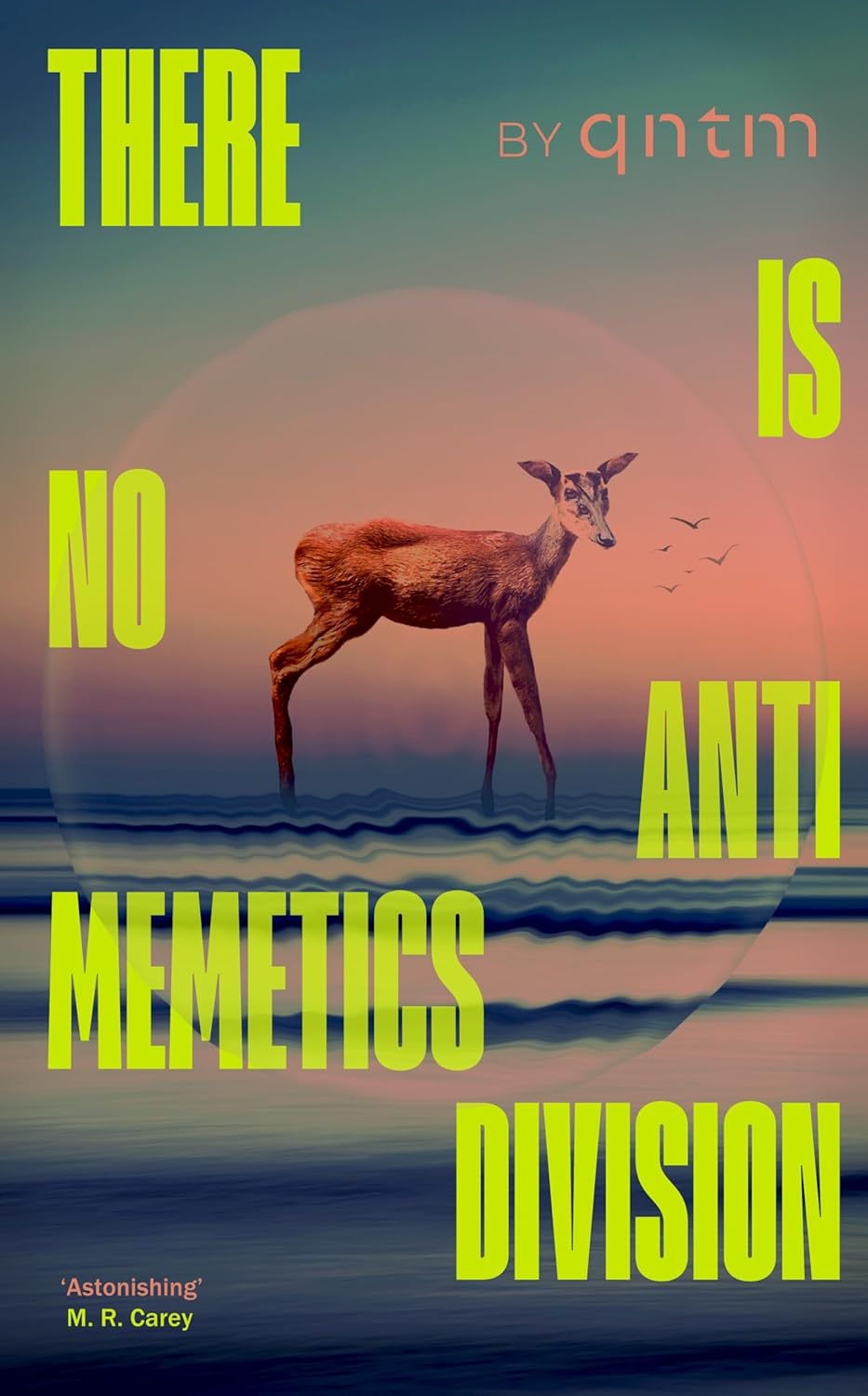
Memes change the world, and anti-memes do too. qntm’s There Is No Antimemetics Division explores what happens when ideas don’t spread, but instead resist being remembered and slip from the mind.
An antimeme is an idea with self-censoring properties; an idea which, by its intrinsic nature, discourages or prevents people from spreading it.
It opens with Marie Quinn walking into a meeting that feels wrong, and from there, everything feels out of place.
qntm takes the weirdness of VanderMeer’s Area X novels, combines it with the government bureaucracy of Stross’s The Laundry series, and puts it in a pressure cooker, releasing the results in a series of intense, interlinked sections.
As a novel that plays with memory, it has its own logic, but it also has jarring moments. It takes what you’ve been told from earlier scenes and twists and changes them, which doesn’t automatically mean you’ve misremembered them.
It originated as a web serial, and I wonder if that’s why it occasionally feels fragmented. Whether the fragmentation is accidental or deliberate, they add to the uncertainty and enhances the creeping horror signposted throughout.
As a reader, I don’t think you’re expected to ‘keep’ up with the changes, but you do need to accept that the reality you now see is the one in that moment.
Cosmic horror is, at its heart, about the uncaring nature of the universe and the entities who are bigger than us, but qntm makes this personal for Quinn, and by extension, the reader. Quinn is perhaps cruelly given back memories she’d lost, only to have them taken away again.
This is a clever novel; it may frustrate and infuriate, but it builds toward a moment via the mantra:
No, this is not your first day.
Recommended for readers interested in the 2026 Arthur C. Clarke Award shortlist and for fans of Jeff VanderMeer, Charles Stross, and creeping existential horror.
Spoilers: Mild (premise, themes, and early plot developments) Genre: Science Fiction Format: Paperback Source: Bought Rating: Loved
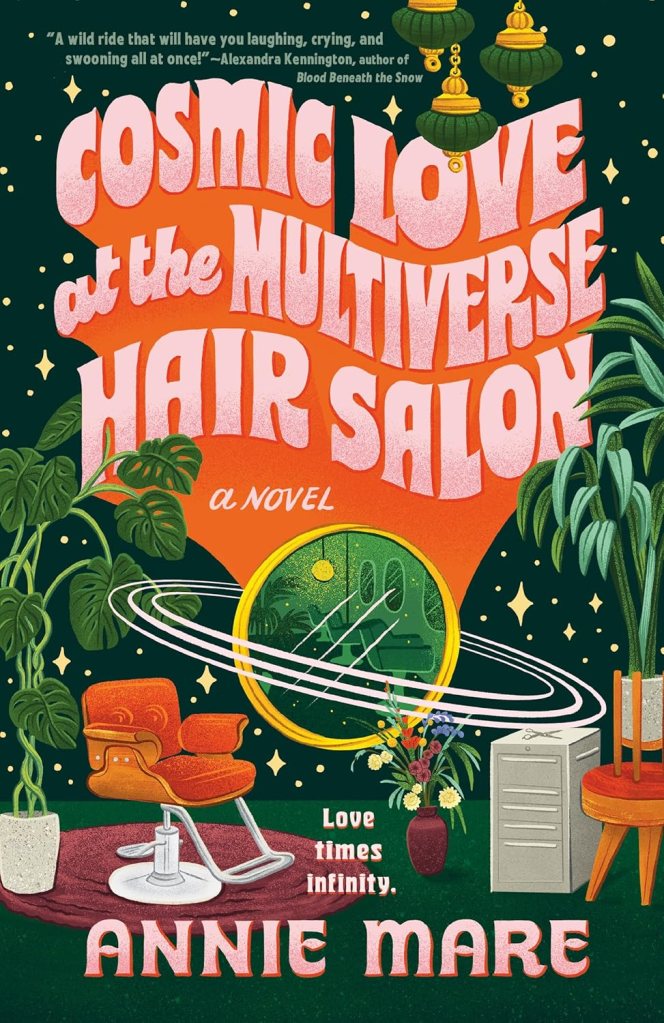
Would you fight for a love that feels right, even if it’s for someone you’ve never met? Not because you don’t want to, but because time has separated you by 6 months? Sounds crazy, right? But that’s what happens to Tressa Fay Robeson in Cosmic Love at the Multiverse Hair Salon.
Tressa Fay is a successful and popular hairdresser known for giving her clients life-changing hairstyles. She is still recovering from a break-up when a random text message sends her across town on a date, only to be stood up at the bar. Well, not exactly stood up. Her date tells her where she is, but they aren’t there. And they didn’t stand each other up. They were both at the bar. It’s just that Tressa Fay is in the present and her date (Meryl) was waiting for her six months ago. Tressa Fay tells her friends that she’s texting a hot woman in the past, and they believe her.
From there, you and the characters enter a trust bubble. You have to trust that Meryl and Tressa Fay can communicate via text as the characters do, and believe that it’s really happening. We spend the opening section of the book focusing solely on Tressa Fay in the present. This shows us that, in the past, Tressa Fay hadn’t met Meryl and confirms she wasn’t supposed to. But Meryl doesn’t want to be trapped in a future where she disappears and doesn’t get to love Tressa Fay, even if it has consequences.
I think Annie Mare does an outstanding job not only of bouncing between timelines but also of guiding the reader through complex scientific concepts. Mare navigates them expertly because she’s hyper-focused on the emotional connections shared by all the characters.
This is Mare’s and the book’s strength. She was happy to hold my heart in her grip. I cared about all of their futures with all my heart. I teared up, held my breath, and crossed my fingers for the right things to happen.
But the science isn’t the driver of the story; the driver is two people who are passionately in love, desperate to meet and desperate not to lose each other, but it’ll only happen if they play the science right.
With seemingly nothing to lose but everything to gain, they start messing with time.
All their pasts and futures become tangled; their connections are so tenuous because the present could be changed, and they could be severed from each other at any moment.
They have the power to tell Meryl her future, and I kept wondering which upcoming past event they would choose to change and how it would manifest in the present. This tightened her fist around my heart like a vice for almost the entire time.
It’s a hard premise to land — how much of the mystery do you explain? Do you go where the readers expect, or where you expect? I think the concept for resolving the overlapping time was masterful; I was expecting one last dramatic revelation, and it didn’t come, and what happened as a result didn’t work for me.
Mare, I think, wanted a specific tone for the ending, but instead of leaning into the danger of their experimentation, she played it too safe. All the tension I had been holding slipped away, leaving me slightly deflated.
Cosmic Love at the Multiverse Hair Salon, to me, is a meditation on the nature of love. The story itself feels like an instructor. I was its student. Because Meryl doesn’t want to be trapped in a future where she disappears and never gets to love Tressa Fay, every observation felt like something I needed to study and hold onto. There were so many observations I felt compelled to write down to study later. I loved watching them and taking notes as I explored, changed, loved and laughed — I just can’t promise you’ll like the last few pages.
Recommended for anyone who enjoys (or thinks they’ll enjoy) a mix of sapphic yearning and science fiction.
Note: I rate on a four-tier scale: Loved (4.5–5★), Liked (3.75–4.25★), Mixed (2.75–3.5★), and Not for me (1–2.5★).
Spoilers: None Genre: Literary Fiction Format read: Print Disclosure: None [this book was purchased by me] Loved (4.5–5★)
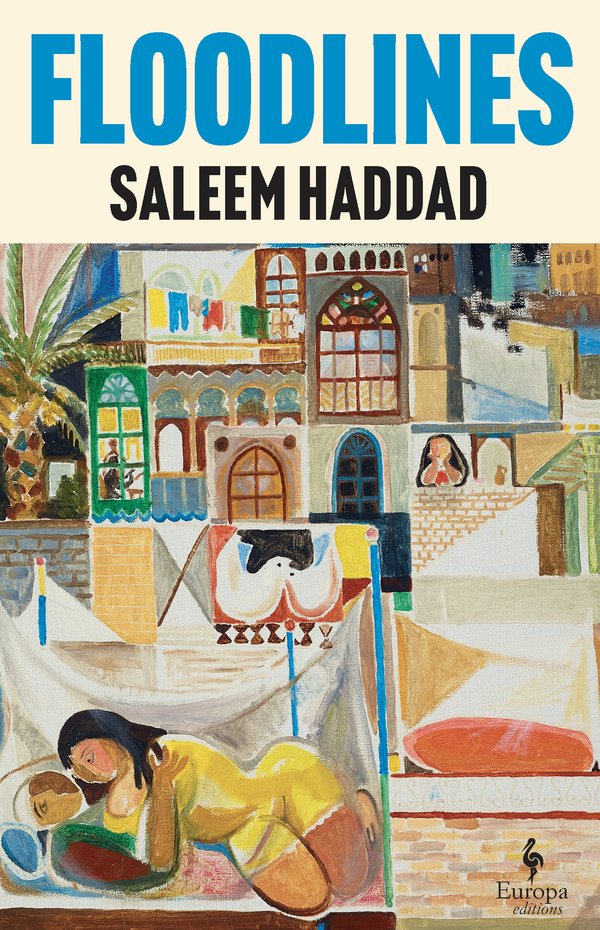
This is Haddad’s second novel. His first, Guapa, won the Polari First Book Prize and was set over 24 hours during the Arab Spring. Floodlines starts in July 2014 and ends in November 2014, but it documents events that happened decades earlier, and they ripple through its pages.
Haddad shows us that dreams play a significant role in the trajectory of our lives. He presents us with characters who are happier when the past is forgotten and buried in the sand, and contrasts them with those whose childhood nostalgia is so powerful it demands their shared past be uncovered. A past cleaned up and carried aloft with pride, like a tarnished family heirloom of uncertain value.
As the story progresses, some of the characters’ imagined pasts are shown to be untethered from reality. These conflicting memories explosively converge by the end of the novel. They often take the form of a waking dream, in which past events in Iraq intrude on the reality of their English country-cottage family home. Hopes for the future—a future where those displaced by the wars in Iraq are able to go home and re-find their identities—are harshly exposed as fantasy. But the reality is that a swept-away past has been left to fester.
On its surface, this is a story of three sisters who are arguing over how to honour or preserve their father’s artistic legacy. Their father was a hero in Iraq, still revered as a great artist, and is remembered for the impact he had. But the plan to track down his art and exhibit it unravels the past that has been tightly bound and hidden away.
There is an early email exchange in which Zainab states to Mediha, “I am copying in Ishtar because all three of us, as Hayder’s daughters, should be involved in these discussions.” However, this exchange later boils over with the reply, “Your concern for Baba’s legacy is laughable. What is driving all this sudden love and adoration?”
Haddad weaves a tapestry using the points of view of a son (Nizar, a war journalist turned sex worker), his mother (Zainab), her two sisters (Ishtar, the middle sister, and Mediha, the youngest and carer to their mother), and their mother (Bridget). Each point of view is a loose thread that the characters and the story tug on, as the lies their lives were built on unravel.
Art does not heal the trauma, and exposing the realities through factual reporting doesn’t either. The act of creation and observation does, however, expose the inner self. For example, Zainab collects objects and creates handicrafts and is seen as a lesser artist, while Ishtar has turned her art into political protest but is now beating a drum that only she can hear.
Lies sit at the heart of the novel because they are used to sweep away the truth. It is a story of dreams and quests, but also of the realities of displacement, and of how setting the past aside in favour of the present does not remove its burdens.
Though the story opens with Nizar, it is ultimately a family story. Haddad centres each of them, and some of the most powerful moments come when Bridget’s past and present merge. In these skilfully described scenes, you wonder if you are in a country home in the UK or standing in a house in Iraq. By the end, you know their mother has moulded them, but their history, and the desert heat, have fired them.
Floodlines asks: What does their father’s art reveal? And is that knowledge worth it?
The answer challenges taboos and conformity, exposing the lies we tell others and ourselves to feel safe. Ultimately, it serves as a warning that art is the heart revealed.
In yesterday’s post, I confirmed that “I’ll be back” in 2026 and promised a look at what I plan to read this year. Before that, though, I want to share some standout books from 2025. These aren’t definitive “best of” lists—just the ones that really stuck with me.
What stood out in 2025?
I’m going to caveat this selection by giving some stats:
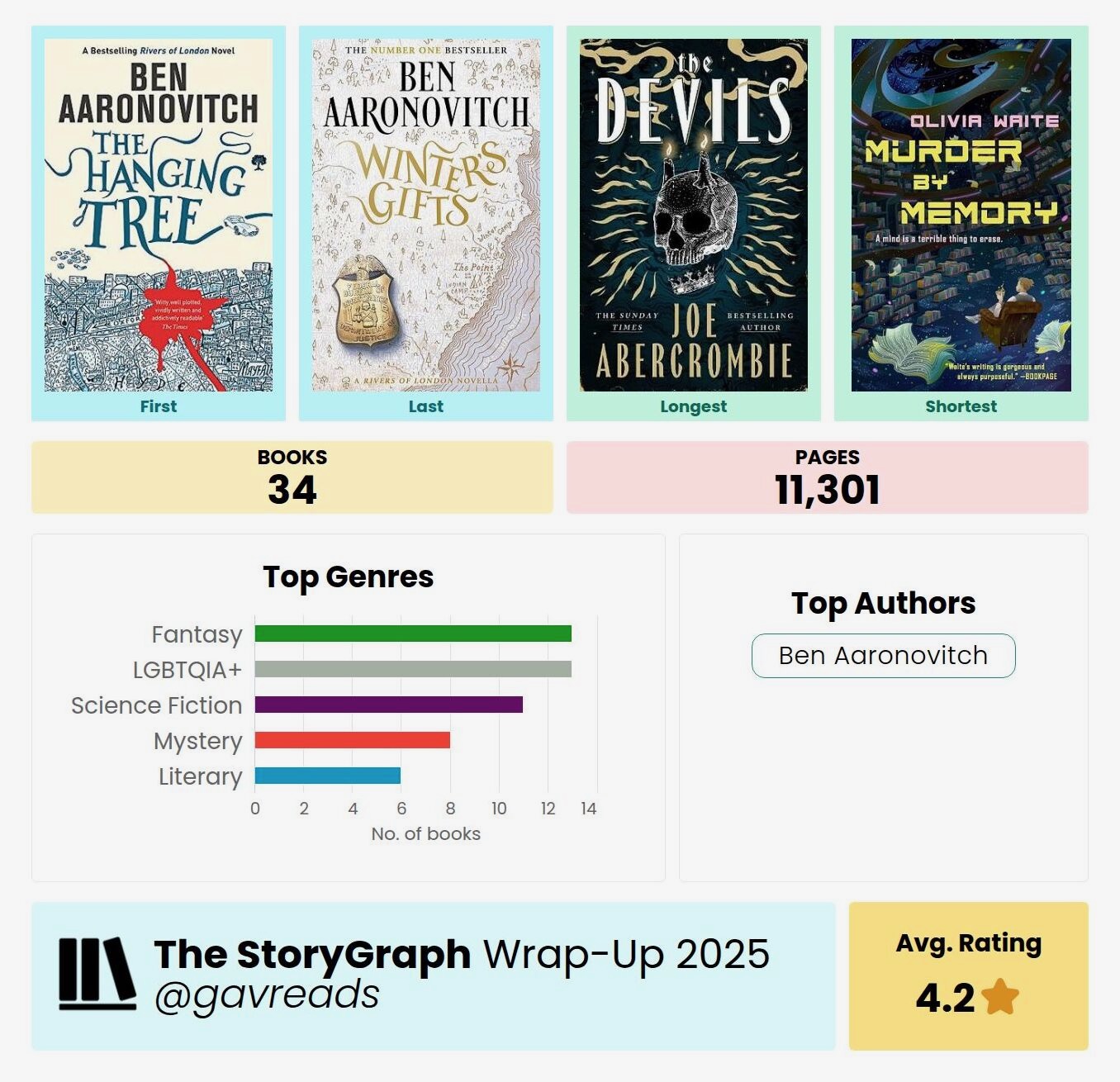
I read 34 books in total (you can see the full list here).
5 of those were Rivers of London related.
7 were published in 2025
4 were books in translation
I really like using The StoryGraph app (I’m @gavreads)to capture my reading. They also provide nice graphics:
This is my way of saying that 34 is a respectable number, but it’s not the biggest pool of work to make proclamations like this is the best book published in 2025, etc.
I also DNF’d 9 books. I want to retry three of them (Under the Eye of the Big Bird, Extremophile, & The Ministry of Time) to see if I can figure out what others liked in them that I missed.
If you’re looking for the best released in 2025, this not the blog post you are looking for.
Anyway, here are some idiosyncratic ‘best ofs’:
Best of Found Families:
August Kitko and the Mechas from Space by Alex White
The Undetectables by Courtney Smyth
Best Slow-Burn Reveal:
The Listeners by Maggie Stiefvater
Best Ensemble of ‘Monsters’:
The Devils by Joe Abercrombie
Best Parent Fighting for Their Child:
The Last Hour Between Worlds by Melissa Caruso
The Grimoire Grammar School Parent Teacher Association by Caitlin Rozakis
Best use of humour to present a horrific things:
The Trees by Percival Everett
Best use of a family holiday:
Diavola by Jennifer Marie Thorne
Best Tales of Taxi Riders
Goodnight Tokyo by Atsuhiro Yoshida
Best Questioning of ‘If AI is alive’?
The Murderbot Diaries Vol. 1 by Martha Wells
Annie Bot by Sierra Greer
The Stars Too Fondly by Emily Hamilton
Volatile Memory by Seth Haddon
The Long Way to a Small, Angry Planet by Becky Chambers
Best Long Running Series that I’ve read in 2025:
Rivers of London (#6 to #9.5)
Best Time Spent in a Freezer
When the Museum Is Closed by Emi Yagi [tr.. Yuki Tejima]
Best Example of How We’ve Not Really Moved On as a Society:
The Black Cloud by Fred Hoyle [1957]
Best Example of How We Have Gone Backwards:
Kitchen by Banana Yoshimoto [tr. Megan Backus] [1988/1993]
Do you want to give out any more awards?
I’m sure I could think of more, but let’s stop here.
What are you planning on reading in 2026?
All the books I bought in 2025? Maybe not, as that’s physically impossible at this point. Perhaps the topic of why I keep buying books should be explored in a future post. For now, though, I want to get some ‘quick reading wins’ under my belt and read some of the shorter, standalone fiction.
The thene of 2026 is:
The year of the backlog (recent and extended).
This might not be the most up-to-date content for future blog posts, but I’m planning to make it the best reading experience I can. With that in mind, here are two lists of 10 books I want to read in 2026 (and if I remember, I’ll report back)
Selected from 2025 Releases:
The Book of Jonah by Luke Kennard
The Imagined Life by Andrew Porter
Dot Slash Magic by Liz Shipton
Isabella Nagg and the Pot of Basil by Oliver Darkshire
Of Monsters and Mainframes by Barbara Truelove
Play Nice by Rachel Harrison
The Haunting of William Thorn by Ben Alderson
Once Was Willem by M.R. Carey
The Entanglement of Rival Wizards by Sara Raasch
A Song of Legends Lost by M.H. Ayinde
There are so many more… The Isle in the Silver Sea, The Everlasting,The Last Soul Among Wolves, It’s Not a Cult, Spread Me, Dead & Breakfast, Angel Down… I’d better stop.
Selected from The Backlog:
Running Close to the Wind by Alexandra Rowland
Remember You Will Die by Eden Robins
House Of Leaves by Mark Z. Danielewski
Nude Against a Rock by Robert Hamberger
Small Things Like These by Claire Keegan
Hour of the Star by Clarice Lispector
Pnin by Vladimir Nabokov
Great Granny Webster by Caroline Blackwood
There’s No Such Thing as an Easy Job. by Kikuko Tsumura [Tr. Polly Barton]
The Count of Monte Cristo by Alexandre Dumas
This is just the tip of an iceberg, but hopefully shows a selection of my backlog and the delights that I have to look forward to.
That’s my plan. What are yours? Any highlights from 2025, and what’s on your list for 2026?
If you’re reading this, we both made it to the end of 2025—well done to us! The blog did too, which feels like a small miracle.
Will I be back in 2026?
Absolutely.
Will I be posting more in 2026?
That I’m not so sure about—but I do plan on reading more.
What’s with the downbeat opening to this post?
2025 has been a funny old year for me as GavReads. It started with reader’s block and burnout, which I finally shook off in April thanks to a re-read of The Hanging Tree by Ben Aaronovitch. And my first post in 2025 didn’t appear until June, a post about The Lightspeed Trilogy, which I’d stopped myself from posting despite having started it in June 2025.
I have written a few things I’m proud of, but it’s been a trickle, not a flood:
In the post I updated as I finished sections, I tried to form thoughts and conclusions based solely on what I’d just read and on what I’d read up to that point. I enjoyed doing it, and thanks, Dan, for the challenge.
Speaking of challenges, I set myself two and was completely successful with one and partly successful with the other.
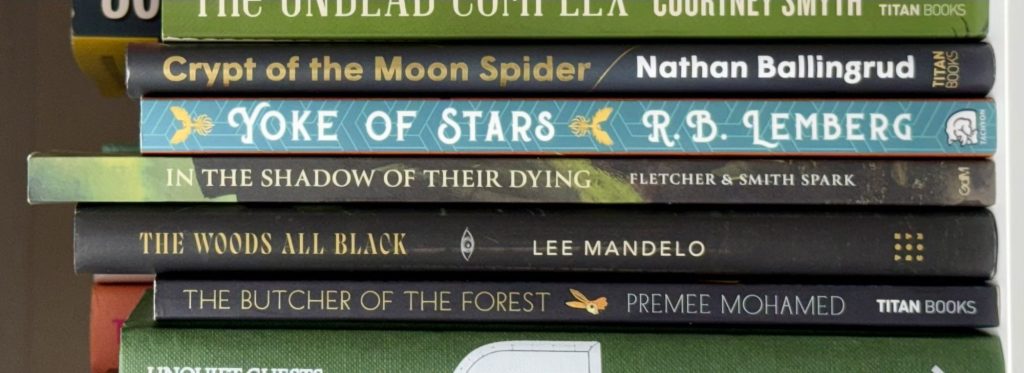
I had planned to read them all except one, In the Shadow of Their Dying, by Michael F. Fletcher and Anna Smith Spark, at some point. And I enjoyed comparing them all, and I was really surprised how much I loved Yoke of Stars by R. B. Lemberg, despite, or because of, how much it made me work.
I wasn’t so sucessful in my attempt to read all the works in the World Fantasy Awards 2025 shortlist for Best Novella. I finished and reviewed:
Heartwood: A Mythago Wood Anthology, edited by Dan Coxon- PS Publishing
The Year’s Best African Speculative Fiction (2023), edited by Oghenechovwe Donald Ekpeki and Chinaza Eziaghighala – Caezik SF & Fantasy
Or even start:
Bury Your Gays – An Anthology of Tragic Queer Horror, edited Sofia Ajram – Ghoulish Books
I burned out while reading Heartwood, mostly from the pressure of having to review it by the deadline. By its nature, it’s very samey. The stories I’ve read are excellent, but I didn’t want to read them so quickly, and I think I just froze.
I may have also realised that I am out of practice and have less physical and mental capacity for both reading and reviewing.
What’s the ‘but’? I feel there is a ‘but’ coming on.
I think I have some triggers around stress… It’s not about a lack of motivation; it’s a mental short-circuit when I force myself to do something I don’t want to do or when I worry about what the review might be like.
I can confirm that meeting ‘on-demand’ deadlines is no longer for me, if it ever was.
Which then raised the question of relevance, why I haven’t spent time reviewing things, and what I do in the future?
As I won’t be reviewing with an aim to post around the publication date, that is, unless I manage to read some of my 2025 hardbacks and schedule a post for the paperback release, what is the best time to review a book?
Reviewer friend question – when is the best time to review a book? I don't mean for the book/author/publisher, but for you as a reviewer, or other reasons if they exist?
What makes me a good reviewer is ‘building’ the book in my head; what makes me a bad reviewer, and sometimes not so speedy reader, is also ‘building’ the book in my head, which is probably where the burnout comes from. And that probably explains why I have to switch genres and can’t keep reading the same things.
Anyway, in the past, the best way to get a book out of my head was to write down my thoughts about it, which is why I posted my thoughts on The Lightspeed Trilogy a year after I first had them.
It’s also why I think about post looking at The Last Hour Between Worlds (The Echo Archives #1) by Melissa Caruso, alongside The Grimoire Grammar School Parent Teacher Association by Caitlin Rozakis, and, potentially, The Incandescent by Emily Tesh.
I’d also like to reread both Lake of Darknessby Adam Roberts and Calypso by Oliver K. Langmead as they both deal with the future of humanity in fascinating ways.
And when are you going to post your reviews?
Probably, when I’ve just finished it, and with myself as the audience in mind. This means that unless I buy and review
Are you feeling better now that’s all out of your system?
Actually, yes.
So what is the plan for 2026?
This year I’ve read thirty-four books, up from 2023’s twenty-two, but down from last year’s forty. However, if I’d read at the same pace over the other 3 months, I think I could have hit 45 this year.
The plan for 2026 is to avoid burnout, probably by continuing to embrace the philosophy of DNF’ing more when needed. Though for some stories, like The Devils and The Incandescent, that would have been the wrong thing to do, I think, even if I really did want to at certain points.
Are you setting yourself an actual measurable goal?
I am going to set 3:
Read every day—even if it’s a page. I have a 103-day streak on The StoryGraph that I really don’t want to break.
Read at least 33 books.
Read at least 15,000 pages.
Well, that’s the reading ones, what about the blog?
I have enjoyed doing the Sunday Summary posts that I started doing in September, and I did enjoy the reading with a goal in mind, so how about:
Aim to post a Sunday Summary every week.
Do at least 2 reading challenges
Oh, and what will you be reading?
Now that’s a question for the next post, but as a preview, the ratio has to be low, 2026 purchased and high, whatever I have on the shelves, which may have hit over 500 after I went a bit overboard with acquisitions this year, including 3 from Paris.
These are some of my thoughts and feelings as a ‘social media’ reader, as we leave 2025 and enter 2026.
If you’ve made it this far, thank you! What were your standout reads of 2025? And what’s on your list for 2026?
 Gav Reads