First Read Reviews (FR Reviews) are written for readers who want to know whether a book is worth picking up and what it might be about. There may be mild spoilers, but no in-depth discussion of the book’s events.
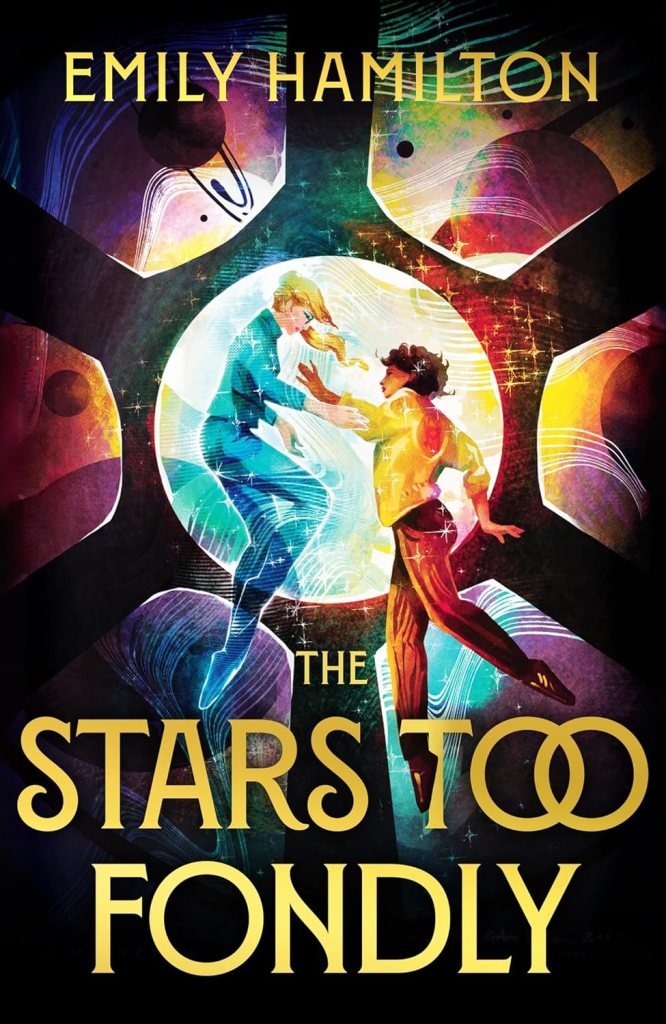
The publishers describe The Stars Too Fondly as:
“Part space odyssey, part Sapphic romcom, and all spaceship-stealing fun, Emily Hamilton’s breathtaking debut is a wild tale of galaxy-spanning friendship, improbable love, and wonder as vast as the universe itself.”
After finishing it last night, I mostly agree.
Hamilton weaves a well-constructed story of strange energy, making the best of bad circumstances, and unsustainable love.
I can’t remember why I bought it—maybe I just needed more fun, space-based sci-fi. I read it now because June was Pride Month, and I was hoping for some queer joy. That’s exactly what Emily Hamilton delivered.
Four friends want to know what happened to the missing crew of a spaceship, so they break into a compound to find out. In the process, they set off a series of events that lead them to examine the fabric of the universe in a completely unique way.
At its core, The Stars Too Fondly is a slow-burn sapphic romance. It’s essential not only to understanding the main character but also to a foundational element of the plot. The story couldn’t have happened without it.
As this is a First Read Review, I won’t overexplain the story. I found it compelling and touching—it made me cry—but it also had a strong sci-fi heart. The science drives the events until… well, you’ll see.
Hamilton keeps it playful, especially in the interplay between the long-term friends and the not-so-subtle flirting of the wannabe lovers. The characters come to understand the impact of being on an unplanned space odyssey, and Hamilton manages the tension so it never spills over into melodrama.
I do have a couple of notes of caution. First, in the setup, you’ll need to suspend disbelief that an advanced spacecraft could remain untouched in a hangar for twenty-one years. Second, the story is stripped back, which is part of its appeal—you, as the reader, are as trapped as the characters. Some may find this overly simplistic or frustrating. But as I said, it’s all about the romance and finding out whether they will or won’t. No spoilers, but I cried again.
The spice level was unexpected, given the timing and circumstances in which it occurred. And the resolution to one of the plotlines felt underplayed, considering all it took to get there.
But Hamilton clearly planned her plot. You can see the threads come together, and that makes her a writer to watch.
Overall, I had a great time. If you’re looking for queer joy in space with solid science fiction adventure behind it, I highly recommend this book.
‘Live’ Reading is a SPOILER-FILLED read-along post of my reactions and thoughts on the chosen work. This is a post that will be updated as I progress through the book.
THE ARTHUR C. CLARKE AWARD is given annually to the best science fiction novel first published in the United Kingdom during the previous year.
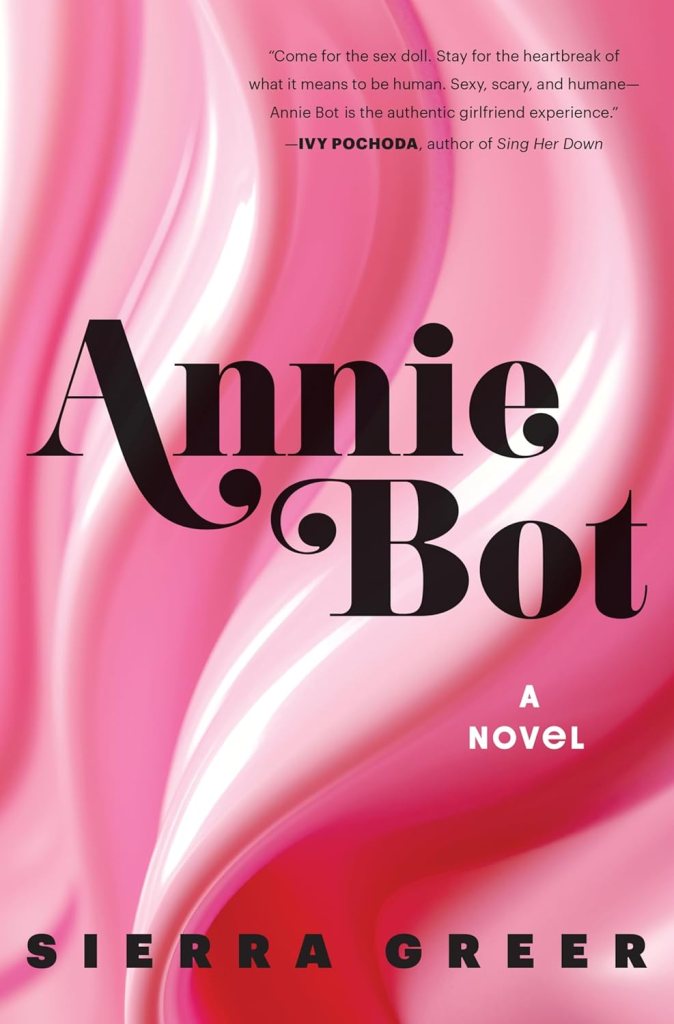
This year’s winner, Annie Bot by Sierra Greer, has caused a bit of a stir. From the works on the shortlist, I think it’s fair to say that it wasn’t expected to be the winner.
This year’s shortlist appears to be a bit of an eclectic mix:
Annie Bot – Sierra Greer – WINNER
Private Rites – Julia Armfield
The Ministry of Time – Kaliane Bradley
Extremophile – Ian Green
Service Model – Adrian Tchaikovsky
Thirteen Ways to Kill Lulabelle Rock – Maud Woolf
I’ve read Service Model, which I have lots of thoughts on, but not the rest. When I said to Dan Hartland on Bluesky that I was curious about this one, he replied:
Now, if Bluesky let me hide spoilers, I would be doing this over there—but it doesn’t, so this is the next best thing.
I will attempt to update this post every time I read a section. I am a slow reader, and I cannot guarantee that I will complete this task in a week. I’m giving myself two, just to be safe.
I am not going to spoil the ending, but it’s sufficient to say that Greer pulled it off, and she surprised me with the conclusion.
I plan to read the other four unread books on the shortlist sooner rather than later, but I can see why this is a strong winner.
I did a slower, more contemplative reading because I was doing this semi-successful live-reaction post. And I ignored where I thought I wanted the story to go or lingered and read it as more speculative than science-based fiction.
Do I think that in another writer’s hands, it would have been different? Yes. Would it have been better? No. Did I agree with all the choices that Greer had Annie and Doug make? Oh goodness, no. Would I recommend it to a more general audience interested in the impact of robotic companions? Yes. Would I have liked more room for a sequel to explore the world wider? YES!
But it’s a worthy winner. It raises a concern about modern society, explores a semi-plausible scenario (that Greer manages to make creepier than I imagined at the end), and it made me think.
Sunday, 6th July PM (91%)
I’m not exactly racing towards the end, but I’m in the final stretch.
So I’m asking myself, at this moment, is this a book worthy of an ARTHUR C. CLARKE AWARD? Yes, it is. However, it might still disappoint me.
Greer, through her characters, has made several observations that I have also made.
“I just want my regular life back,” he says. “I thought I was doing okay, but this sucks.” “He didn’t love me,” Annie says. Monica tilts her head slightly, curious. She looks at Doug. “I didn’t,” he agrees.
I was checking Greer’s publishing history, and it appears to be the first novel I can find. I saw in an interview that it’s also a novel related to COVID-19. And that does change my perspective on both characters being holed up in the same apartment night after night.
A lot is happening beneath the surface, and it is more of a literary than a SF novel. I am making a huge assumption that Greer is a more literary writer, one who writes speculative fiction. Would a more traditional SF writer have tackled this subject in the same way? Would they have kept Annie on the leash the way Greer has? Would another writer have started that revolution?
Is it too bold to say that the counterpoint to Annie Bot is Tchaikovsky’s Service Model? Controversially, I think Annie Botis a better robot novel. Service Model tackles a much bigger canvas, but I believe in Annie more than Charles. Also, Annie’s internal struggle feels more alive.
Right, let’s get this done.
Sunday, 6th July AM (Two Chapters to Go)
What if a sad man got a robot girlfriend and had feelings for her but also knew he was in love with a robot? What if the robot was capable of complex feelings? How would she react to being an object? To doing boring tasks? To being tortured?
Again, why did he leave Vegas?
Sunday, 6th July AM (63%)
It’s very weird. I want so much more for Annie. And I want Doug to let her go. This is like a circle of Hell. Well, two circles: one for Annie, and another for Doug.
Saturday, 5th July PM
After last weekend’s post, Dan observed:
Hey, thanks for agreeing to do it! I’m interested that your reading is finding reason to focus on Doug.
My first thought is, how could it not be? Annie would not be this Annie if Doug was different. Annie has literally been moulded by him. Her inner life is private, but is being fundamentally impacted by every action and decision he takes.
And he raised the question of Annie:
How are you finding reading Annie, this being the case, and given the novel is named after her? One for the next reflection, maybe!
I’ll admit that I was struggling at this point in the story (1/3 read) with seeing Annie as a character in her own right.
Doug states, in a conversation about his wife that:
“The point is, when I made you, I decided, f- it. I’m indulging myself. Yes, I used her as a template for you. But you’re simpler. And kinder. Much kinder. And playful. That’s what I needed.
Is Annie simpler than a human? Is she kinder? And is she playful?
It’s difficult because Annie has her own set of needs and wants (such as not wanting her personality replaced or having Doug change her body). She also doesn’t have any social or economic needs at this moment in the story. She’s putting on an act. We know that because we see the script that Annie follows. She is complex, she’s not cruel, and as for playful… well, I think she does relax and enjoy it when she’s meeting Doug’s needs (a bot version of dopamine perhaps?)
I do like the way Greer is showing us all the signs of danger (in this case, through Doug’s actions not aligning with his words and Annie’s reactions to them). As the reader, we know she’s not human. She is an item, like a toaster, to be owned, sold, or used like a pizza oven. And that makes it hard to read; as non-human as Annie is, she is a character you can root for.
And cheer I did, as that seed from earlier—that lie I thought would fester and grow when Annie was taken to Vegas and finally seen by Doug’s friends—was not meant to be. Annie’s secret was exposed, and the motivation behind it (that Doug’s friend had done the same thing before) was revealed.
And Annie blames herself for breaking what she and Doug had. But Annie isn’t broken; Doug is. Annie has programming that allows her to grow and evolve. That ability to lie turns into ignoring the feeling in the pit in her stomach and ‘saving’ herself. The ease with which she then steals is an extension of the power she has over her ’emotional’ responses.
I need to step back and explain that Doug bought a ‘back-up’. He wanted another bot that would cook and clean, play and not show complex thoughts or reactions. But Delta doesn’t know that Annie is a bot like her. Delta is how Doug seems to be making Annie into a real girlfriend, at least in Annie’s eyes.
I said I cheered. Annie attempts to escape, though she and I didn’t expect that Delta would suffer the same fear of Doug and would rather go with Annie into the unknown than face Doug when he finds Annie gone.
What Annie doesn’t realise when she leaves is that Doug’s honeyed words and his false platitudes have been hiding his actions. All of that will become clear when Annie reviews the events after she’s given new information and discovers that the timelines are out of sync.
At around 50%, Annie is on the run with Delta, who has given Annie someone to care about and look after. Delta is seemingly safe from Doug, while Annie may have to go back to Doug with all that might bring.
Saturday, 28th June
I’m going to start off with a spoiler for another book that was shortlisted, as the opening of Annie Bot reminds me of Service Model.
In Service Model, a robot butler named Charles is left without purpose as his mistress has failed to update her instructions, which is problematic as she’s missing, and his master is dead. He had a purpose—and that was to keep the house in order, which he does with robotic precision.
In the book’s opening scenes, Annie is nothing like Charles. Charles is not designed for pleasure, or at least I cannot remember Tchaikovsky introducing it as a possibility. Annie, however, is. She has also been given (either learned or taught) trauma-response-level reactions to her owner Doug’s emotional state to prevent him from reacting abusively.
Annie’s programming is described as autodidactic, which only partly explains why she can’t, unlike Charles, keep the house in order. Greer introduces the idea of Annie being treated like a person, only for that autonomy to be threatened because she struggles to maintain a cleaning routine, and the house is a mess. Doug suggests that for a couple of hours a day, he switches “Annie” to an “Abigail” programme that is not autonomous and presumably not self-aware, so that Abigail does the cleaning.
To heighten the reader’s—and Annie’s—awareness that she is a robot, Doug’s friend turns up unannounced, and Annie’s responses and thought processes are described as Doug recounts how he creepily selected Annie’s physical appearance.
Is Annie going to murder Doug? Is Doug going to abuse Annie by swapping her from Annie to Abigail mode? Is that even considered abuse?
I look forward to finding out in the next instalment.
Sunday, 29 June PM
I’m about one-third of the way through Chapter 3 of 7. Doug has raised, in my mind, the question of his motivation. I had assumed that he didn’t want a “real” relationship because of his divorce, but did want pleasure. However, it seems he’s using Annie as a form of rehabilitation—and failing. Though Annie’s makers seem to think he’s doing an excellent job. More on that shortly.
While it seems that Doug is working on being a better person, his actions and words are out of sync, reinforcing my view that Annie is a walking trauma response who is programmed to use pleasure to de-escalate moments that could spill over. Doug’s choice to get Annie, to keep her secret—his guilty secret—is at odds with Annie, whose only goal is to make him feel good. He can’t feel good, as he’s carrying around a lot of baggage, which he takes out on Annie through a series of demands and negative behaviours.
I also wonder if Annie is a reliable narrator, but I’m going to need to let that ruminate.
Doug wants to be part of a normal couple—or at least have a trophy girlfriend to present as a normal couple. How complicated this gets for Annie will depend on how far and how fast Greer is prepared to go.
Annie is seen as exactly the type of advanced model they want to sell—if only they knew her thoughts. Though the techs that keep her tuned up have a good idea of where she is headed. And it means she’ll be stripped of her personality.
I’m not sure at this point if we’re just going to attend an awkward party where secrets are revealed, or have a world with thousands of Annie base models who are going to overthrow their owners. Or, more likely at this point, both.
Sunday, 29th June AM
Well, things have taken a turn.
In “Cuddle Bunny” mode, Annie has given in to her programming and made a choice that makes her question herself more than before. But an idea is also planted.
Not that Doug is aware of this change—at least not yet. Annie, to him, is still a machine he owns, with a body he controls.
I am enjoying the “realness” of Doug trying to be a “good guy” as he struggles with the fact that he’s chosen a pleasure doll as a “girlfriend,” which Greer contrasts for the reader with exploring and explaining Annie’s new understanding of herself, her place in the world, and how she’s resisting her situation in overt and subtle ways.
I’m totally on Annie’s side, and I’m curious about what she will do as she’s exposed to more situations where her innate programming conflicts with her own autonomy.
First Read Reviews are written for readers who want to know if a book is worth picking up and what it might be about. There may be the mildest spoilers, but no in-depth discussion of the events in the book.
Description:
The Undetectables, a detective agency run by three witches and a ghost in a cat costume (don’t ask), are hired to investigate another murder, several years after failing to solve their only other case. Given their track record and what’s happened over the last few years, they might not be up to the job.
Thoughts:
Note: If you like the sound of this book, don’t read the blurb. Just dive in.
This is an urban fantasy murder mystery set in Wrackton, a small Occult town (I say small as I’m not entirely sure how many residents it has), home to various magical and mythological folk, and, if Diana’s ex-girlfriends are any measure, it’s very queer normative. There are some non-magical humans (Apparents) in the town, but they, the Apparents, mostly live separately in ordinary places, though magical people do live there amongst them too.
Our focus is on Mallory, whose pain and fatigue from her fibromyalgia are explored through both the physical effects and the impact it has on her friendships with Cornelia and Diana. Her connections to them have faded by the time the story starts in the present. Throughout, it shows how those relationships have waned in Mallory’s mind since her diagnosis.
Plenty of awkward moments happen as the trio gets back together. It feels like a mix between Scooby Doo and Buffy the Vampire Slayer’s Teen/Post-Teen detective forumas because they are excited to be working out clues, but put themselves in grave danger, while also dealing with the interpersonal dramas within their circle and from the people who enter it.
There is a solid mystery at the heart of The Undetectables, with clues scattered throughout. It was well plotted and handled, and I didn’t feel cheated as it became clear what had happened and what led them to their suspects.
Smyth tries to pack a lot into the first outing. A setup of local politics and the mythos that binds this and other Occult towns together, as they also explores the past and newly emerging relationships between our three main characters.
Smyth labours some of the points they are trying to make and fails to hit all the marks they have set themselves, which can make for clunky reading. Some of the scenes don’t play out quite as smoothly as they should. I feel I’ve misread some key information (like doors and placements of characters in scenes), and I thought some interactions didn’t feel as natural as they could have been.
But ultimately, I forgave the structural and technical issues I perceived because I wanted to see the mystery solved; I was invested in finding out what happened to our main trio and their friendly ghost: Smyth made me tear up more than once, as they also doesn’t pull their punches.
I’d be remiss in not praising Smyth for how well they handled the impact of Mallory’s change in health on her and her friends. They also pointed out how everyone faces things that people are reluctant to discuss by getting their characters to discuss them.
Summary:
There is no getting away from the fact that there are some structural and technical issues. But for me, those are forgiven because of the world Smyth is attempting to build, the problems their characters explore, and the killer their characters are attempting to catch.
If you can push past the abovementioned issues, I recommend reading it.
Thanks to proud-geek.co.uk, I have a copy of the sequel, The Undead Complex, sitting on my desk. I can’t wait to see what our trio gets up to next.
Niall Harrison’s review in Locus magazine does provide answers.
However, I was unsatisfied with the ending. This feeling wasn’t helped by my e-reader telling me that there was 12% left. It ended on the first of what I was hoping were several post-script chapters. And I was promoted to post this on Bluesky:
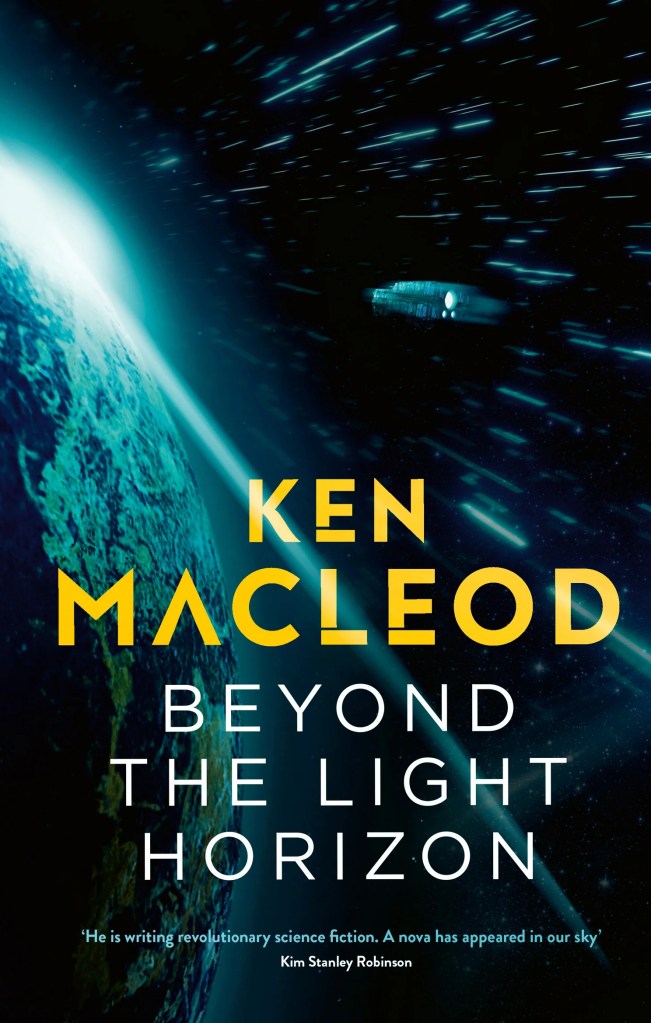
I have just finished [Beyond the Light Horizon], and I feel like I have been cheated out of chapters at the end. Hmmmm.
Have I forgotten that one of Science Fiction’s roles is to look at the big questions, and it uses a story wrapper to do that?
From my reaction to this work, it seems I have. Niall hasn’t taken much more away from the trilogy than I did.
In a nutshell, an AI called ‘Iskander’ is a predictive AI that can anticipate your needs and set things in motion so they happen at the right time. Think of it as wanting to go out and finding you don’t have to wait for a taxi because it is already outside.
What it sets in motion in the trilogy is the discovery of Faster Than Light Travel, which results in a submarine/spaceship being built in Scotland. This then causes a chain reaction to open the world’s eyes to a deep conspiracy in which FTL has been a worldwide secret project.
On reflection, this series is tackling a lot of big ideas:
there are at least three versions of AI supporting/controlling the three main human geopolitical alliances
the way the countries have aligned themselves
the socioeconomic impacts of those allegiances
the impact of climate change, either natural or manmade
experimentation with evolution (and seeding/sharing flora and fauna) across different planets
After planting the seeds, MacLeod leaves it up to the reader to decide what happens next. And I think he does his story and audience a disservice here. Partly because he places his main character, Grant, back in a box and back on his original rails. And partly because there doesn’t seem to be anybody to take up the mantle.
Sure. Treaties are reinforced by force. New economic ties are arranged for between world trade are established but in the flashforward postscript those aren’t addressed for their impact or how integration between the Earth factions, and the other worlds they’ve colonised are working out – and more importantly for me if those other world inhabitants have been to Earth to establish themselves there.
But overall, the grounding of Grant popped a bubble; it felt like the author didn’t want Grant to grow or change despite the extraordinary things he’d be instrumental in initiating.
Someone on BlueSky mentioned that #BookTok, aka the bookish part of TikTok, might make people hate literature.
I assume this is reaction to some very big accounts who mention some very big books. But I have a very different perspective. #BookTok revamped my love of reading. I saw so many passionate readers sharing such a huge variety of books that I ended up making a very big TBR from all their recommendations.
I thought I’d share a small sampling of some of my favourite #BookTokers in case you want to find some recommendations
I have a TikTok Account but I don’t really use it to post @gavreads. I do use it to comment. And do check out who I follow for so many more good book pushers.
Title:Broken Light Author: Joanne Harris Pages: 443 Genre: Fiction Stand-alone/Series: Stand-alone. Year of Release: 2023 Publisher: Orion Review Copy via the Publisher
Bernie Ingram is forty-nine, menopausal, and lonely. Bernie feels herself growing less visible, less surprising, and less lovable with every passing day. Until the murder of a woman in a local park unlocks a series of childhood memories and, with them, a power that she has suppressed for all her adult life.
Until now.
When a woman finally breaks, watch out for the pieces…
I loved Broken Light. Harris takes the familiar life story of a woman getting pregnant too soon, settling down, and slowly becoming invisible but adds the rage of King’s Carrie being released at menopause.
Does Bernie seek revenge for all the women that men have wronged? She could, quite easily, because with great power comes great responsibility, doesn’t it?
Everyone has a choice, and when Berinie Ingram’s power reappears, she believes she will make better choices and control her powers. But life doesn’t work like that; there are consequences to interfering.
Harris demonstrates how easily women are diminished, sidelined, used and abused. As Bernie’s power grows, her rage is unleashed, as do the strength of the voices in her head that dare her to go further, to take more extreme actions.
Social media is ingrained into so much of our lives, and it’s integral to Bernie’s story. It might feel a little alien if you don’t spend time interacting on social media.
Does Bernie (via Harris) focus too much on the impact of social media discourse?
I did find it a little too open and maybe a little too laboured in the points it was making, but many corners of social media focus on convincing people that one group or another is the source of all their problems.
The format is mostly Bernie’s LiveJournal Entries with the occasional linked extract from her childhood friend’s new book on Bernie (published the year after the events Bernie describes). So it is going to reflect Bernie’s thoughts and feelings on things that are central to her and her world.
I can imagine this will frustrate or put off some readers and might cause a little Marmite-like reaction.
For me, Broken Light is utterly devastating but contains so many shards of hope. If every person could pivot slightly, the world can be such a better place.
Why haven’t I said much about the plot? #spoilers. I will say it made me cry and left me more hopeful than when I started it.
Read it and see if you feel the same.
Rating: 5/5 Date: 6 May 23
Additional Information
There is more insight and a Q&A on Joanne Harris’s website. Warning it does contain spoilers, so you may want to look after you’ve read it.
Title: Death of a Bookseller Author: Alice Slater Narrators: Emma Noakes, Victoria Blunt Pages/Length: 384/12hrs 58 mins Genre: Crime/Thriller Stand-alone/Series: Stand-alone. Year of Release: 2023 Publisher: Hodder & Stoughton Review Copy via NetGalley
Roach – bookseller, loner and true crime fanatic is not interested in making friends. She has all the company she needs in her serial killer books, murder podcasts and her pet snail, Bleep.
That is, until Laura joins the bookshop.
This tale of obsession is told from the dual perspectives of the person who carries the flame and the person who is their focus.
It quickly becomes apparent that True-Crime-Podcast-loving Roach feels she has a connection to Laura that’s not reciprocated. But Roach isn’t deterred; she sets out to become friends.
I find thrillers hard to review. Their strength is in the tension that builds as the story unfolds page by page. I don’t want to spoil things by revealing too much.
Slater’s skill is keeping pages turning. I listened to the audiobook, and each chapter is short, sharp and alternates between each character’s point of view. I kept listening
And due to the medium, I couldn’t flip forwards or backwards; I was trapped in each uncomfortable moment, and half-closing my eyes made no difference. I had to relive them from both sides over and over again.
I think Slater likes both Roach and Laura. You may disagree with me, but Slater has created characters who have sympathetic traits. Or at least they garner compassion, to begin with at least; whether you remain endeared to them by the end, that’s on you.
The entire bookshop’s staff rota is memorable, and how Roach and Laura see them gives a truer reflection of their individuality.
She also gives an insight into what really happens in a bookshop. It’s not just happily handing over books to the next customer. There seems to be more than one day working with a hangover.
I need to mention the performances of Emma Noakes & Victoria Blunt. They are perfect for the roles. The creepiness of Roach and the coldness of Laura come across strongly. There is a small point where Roach’s voice slipped; it was less than a chapter, but then the persona came back strong and clear. The editing was clever when Roach was taking off Laura’s voice, and vice versa, when the narrators swapped to say their own lines, which felt natural and creepy.
I spent time in their heads that I have the compulsion to change the locks and have vowed never to pick up a true crime book.
If you’re a lover of creeping dread, bookshops or are just curious about what’s in the mind of a True Crime lover, then Death of a Bookseller ticks all the boxes.
I finished Siblings by Brigitte Reimann (trans. Lucy Jones) is rightly described as a ground-breaking classic of post-war East German literature.
This, I believe, is its first translation from German to English.
Set in 1960 (and published in 1963) when the border between East and West Germany was closed. It examines the relationship between a brother and a sister as they each examine their place within the Deutsche Demokratische Republik/German Democratic Republic (GDR).
The tension underlying Reimann’s style had me reaching to add tabs to moments I found notable. The pressure is mirrored in our main character Elisabeth’s relationship with her ideals, family, and co-workers.
There is probably a literary essay to be written on reading this contemporary novel as historical commentary, as I have done.
It is 129 pages, plus notes added at the back. I’m very grateful for the notes adding extra context.
It feels more profound and denser than its slight paperback form promises.
I don’t want to give any spoilers but trust Reimann to lead you through the story, and you’ll get the answers you need, but perhaps not the answers you want.
Title: A Master of Djinn Author: P. Djèlí Clark Pages: 416 (print) Genre: Fantasy Stand-alone/Series: Series but easily read as a stand-alone. Year of Release: 2021 Publisher: Orbit
Summary
Agent Fatma el-Sha’arawi is the youngest woman working for the Ministry of Alchemy, Enchantments and Supernatural Entities.
When someone murders the members of a secret society, Agent Fatma’s job is to find the killer.
Set in Cairo in 1912, where djinn walk the streets and steampunk eunuchs serve coffee.
Alongside her Ministry colleagues and her clever girlfriend, Siti, Agent Fatma must unravel the mystery behind their deaths and restore peace to the city.
Comment/Thoughts/Analysis
P. Djèlí Clark is a master of world-building. The alternative Cairo he has created is tangible. I could quite quickly be drinking Sarsaparilla with Fatma. I can imagine seeing djinn doing their daily business and buying books from them.
He can also create a story that builds as you (the reader) and Fatma discover what’s happening. Clark shifts gears and moves things up a scale constantly. Just when you think it’s going to plateau, it jolts forward.
It is, at its heart, a historical urban fantasy detective story. The facts are there for Fatma to follow. But it’s also a Fantasy tale with a big F. The murders lead Fatma to find beings with inhuman motivations.
It’s also a romance. Siti always has Fatma’s back and leaps into danger. Fatma and Siti’s relationship is explored internally through Fatma’s feelings and externally through how other’s perceive them.
And this brings me to my problem with A Master of Djinn; it’s almost too perfect.
Clark has a cast of characters that too often pop up at the right time and place. Some readers, like me, get distracted from the momentum when they see some of the illusions’ mechanisms.
It’s his first novel, and I found it immensely enjoyable. I got frustrated by what I thought was the big scene at almost the novel’s end, but Clark had another trick to pull out of his bag, and I enjoyed being tricked.
He’s also used his setting to challenge colonialism and the Euro-centric worldviews. This, I think, he does with humour and panache. And is one of the other strengths of A Master of Djinn.
I wasn’t sure there could be the potential for a sequel as the story seems so entwined into the environment. After finishing it, I’m confident that if Clark wanted to revisit this world that he’d find another angle to look at his world.
Conclusion
Clark has created an anti-colonial fantastical environment to tell his police procedural using an outsider’s point of view that addresses war, power and manipulation.
As well as exploring the people’s need for a champion when they are considered the underdog, he puts a sapphic romance into the centre of this steampunk.
Did I say it’s also a detective story? It is, and the clues are there!
I am starting this update on a positive note; I finished Siblings by Brigitte Reimann (trans. Lucy Jones) on the last day of February. And it’s my book of the year so far.
In the middle of March, I finally DNF’d (Did Not Finish) a novel that was recommended to me.
I have to be in the mood to read, but I also need the mental capacity to process my reading. I can’t skim-read or skip sections. If that happens, it’s a sign that I should put the book down and, ideally, move on to the next one.
Sometimes I force myself to keep going, as it might just be that book section or my mood that day. As a tactic, this can work, but often it just zaps my momentum even more if I push it too far. This can infect my motivation to read other things.
In this case, the recommendation meant I tried past the point when I should have given up. And my mood for reading other things did dimmish.
I put this down in the middle of March.
I did try reading another book, which I should have loved, but it didn’t hook me, so I took some time out.
Though I can’t entirely blame my mood as…
I Got Distracted
You might not have been aware, but Nintendo closed the e-shop for games connected to their Wii U and DS/3DS consoles (which they stopped manufacturing in 2017/2020. and this caused a surge of panic buying.
I bought a Nintendo 3Ds off eBay to load it up with Pokemon games I’ve never played. The cost of physical copies of the various Gameboy games could buy a good few books, and the e-shop versions were around £8.99. So I chose the e-shop versions.
I’ve been playing Pokemon Scarlet as my first real Pokemon Game (Let’s Go Eevee was my first attempt, but I didn’t know what I was doing, and my Team was underpowered). I wanted to have the option of going back, hence the stocking up.
And that got me looking at retro RPGs…
All of this is to say that much of my reading time got sacrificed for video games in one way or another.
Collecting Books is Still a Separate Hobby
Despite not reading, I added 23 books to the TBR in March. They were a mix of the last arrival of my now cancelled book subscriptions, a physical copy of Rachel Pollack’s run on the Doom Patrol, and a combination of recommendations from other commentators and 99p ebooks.
Plans for April
I’m writing most of this on Easter Monday and have yet to finish reading anything of substance, so I’d better get a wiggle on if want the April update to have content mentioning books I’ve read.
I am, however, reading thanks to a visit to Eastercon again. It was the tonic and motivation I needed. And should mean I have at least one book to mention next time.



 Gav Reads