Tag: fiction

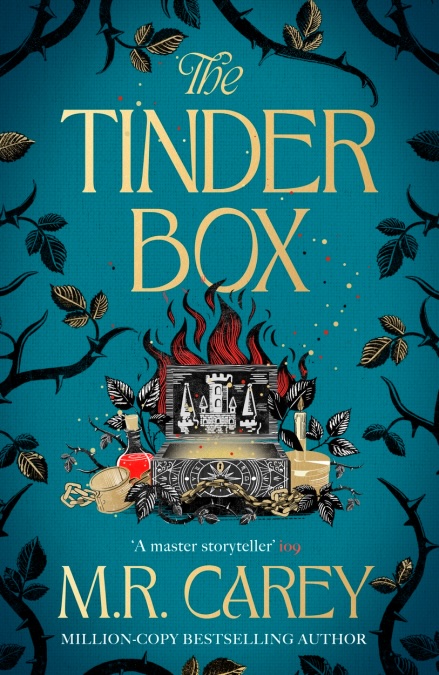
  • Review: The Tinder Box by M.R. Carey [2026]

    Spoilers: Mild (themes and setup only
    Genre: Fantasy
    Format: e-ARC
    Source: NetGalley (in exchange for an unbiased review)
    Rating: Liked

    This is Carey’s take on a short story by Hans Christian Andersen, unsurprisingly also called The Tinderbox. He tells the tale of a soldier and a witch whose existence has been put at risk by the deeds of their rulers.

    If you’re wanting an action/adventure you’re not getting that. What you do get is a slower examination of good, bad, wicked and truly evil.

    Set in a small Eastern European country of Allesheim, where there is a seemingly endless war with its neighbours, Ehrlich and Pozhka, though it’s unclear what they are truly fighting about.

    It’s implied that whoever wins this fight for control will ultimately make no difference to the lives of the citizens of each country. And while the rulers squabble, their citizens are starving and dying for the sake of a war that has no end in sight.

    The tone of the book is set by Mag Tresti, as he describes his honourable medical discharge being conducted alongside the execution of his condemned comrades, who have been branded as faithless cowards and are to be executed in batches. Both events are carried out on behalf of, and in the presence of, the king.

    The soldier notes that, despite the pending deaths and general unhappiness of the gathering soldiers being honoured, a semblance of approval has been conjured up for the king’s speech where there was none. This hints at the power of the adviser, which is both magical and political.

    Mag, the now ex-soldier, is shunned by those he comes across on his search for new employment, but eventually finds himself asking a reclusive widow, Jannae Mirchella, for work. Surprisingly but brusquely, she agrees, initially with terms acceptable to both.

    But the terms offered—payment on completion of work—are not fulfilled, as she is always finding work to be done. This doesn’t seem to matter until Mag is doing a dangerous task and comes into possession of a Tinder Box.

    This event soon coincides with him leaving the widow’s employ; formerly a man without power, he now seems to possess something powerful, though he doesn’t know at the time that it contains three devils.

    The widow, however, is a witch. One who has been waiting for some unspecified right moment to go back into the world. This is not the moment she was waiting for, but recovering the box is overwhelming.

    While travelling she starts to remember her past, and becomes haunted by a key moment, forced to look back at this and other decisions her circumstances forced her to take. She examines the most important one—taking her revenge—and why she’s been putting it off.

    We start with Mag’s narration, but the story demands we see into the heart of Jannae, so it is then told from her perspective. And we get to understand what she’s willing to sacrifice, and are challenged to believe that there might be some good in her cold heart.

    We switch between the two as one hunts the other down.

    We even get to see the world through the king’s adviser, though we see nothing redeeming through his eyes.

    The limits of choice are a theme that cuts across our three main characters, and we get to see the world from each of them, which may be a bit disappointing to those who were enjoying the ex-soldier’s narration and were happy to see the world from his point of view.

    Told from multiple points of view, this allows Carey to provide better commentary and insight. The slower nature of the story gives space for this. He examines women in this society, who are not well thought of; the role of soldiers, seen as replicable; the ambivalence of those who hold power, though it is really the people who hold it; how people can be oh so very petty, where telling tales really doesn’t have consequences; and overall the value of a life, which becomes about living in the moment.

    Ultimately, it is the story of how life doesn’t like people who want to live outside the boxes that society puts them into, making sure they toe the line, which is literal in the case of the three devils.

    The skill of Carey’s storytelling is shown in scenes where Mag tries to befriend the inhabitants of the Tinder Box – like Aladdin’s genie, they can seemingly grant any wish, but they are prisoners bound to the commands of their possessor, and unlike the genie they have no end to their sentence. Does he win them over? Are they actually wicked or have they also found themselves on the wrong side of an ambivalent ruler?

    There are reflections from both the living, the meta-living, and the dead.

    On what happens to the living after death, one of the prisoners of the box says:

    ‘That knowledge Elohim has not shared with any. I have always assumed that there is a mill where old souls are washed and made new, but if there is I’ve never seen it. Perhaps they only fade. Or perhaps there is another place somewhere in which they enjoy a different existence. In any event, their persistence on this plane is short’

    It doesn’t matter to the god of this world (Elohim); like the King, both treat the world as if there will always be more people, and more souls, to do their bidding, and that’s how they inevitably become worthless.

    Carey makes you feel that everyone is worthy, well maybe not the evil King or his court. But everyone else—yes, there is a cost, but aren’t things of real value worth the price?

    I am trying not to say too much, because it’s not packed with events; it’s more thoughtful and meditative. I think this will frustrate some readers, which would be a shame.

    But if they stick with it, it’s a story of making the best of things, with some unrequited love—or perhaps lust—woven in.

    Overall, it’s a fairytale stretched into a novel, spending that extra time exploring the meaning of life and what can be achieved if you truly live.

    Note: I rate on a four-tier scale: Loved (4.5–5★), Liked (3.75–4.25★), Mixed (2.75–3.5★), and Not for me (1–2.5★).
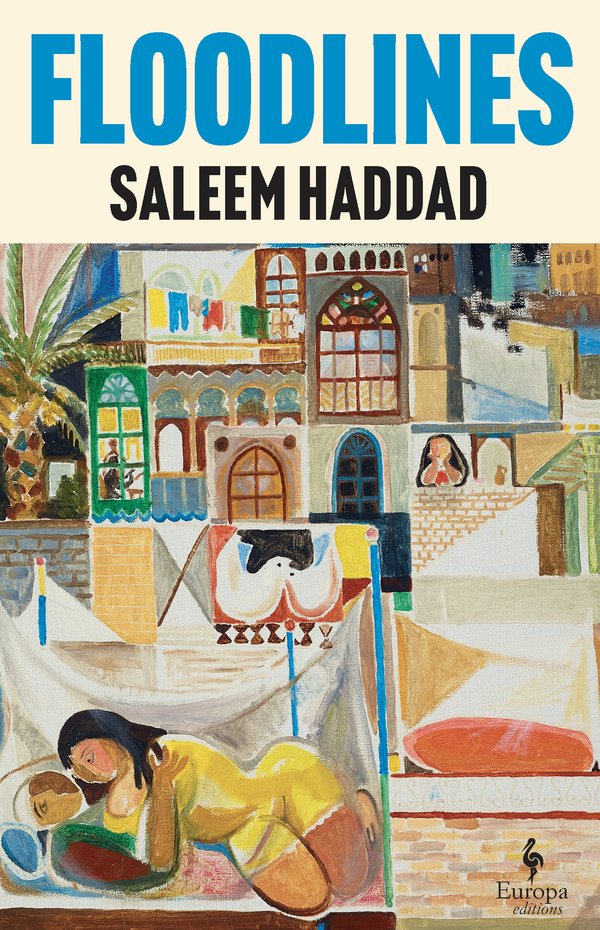
  • Review: Floodlines by Saleem Haddad [2026]

    Spoilers: None
    Genre: Literary Fiction
    Format read: Print
    Disclosure: None [this book was purchased by me]
    Loved (4.5–5★)

    This is Haddad’s second novel. His first, Guapa, won the Polari First Book Prize and was set over 24 hours during the Arab Spring. Floodlines starts in July 2014 and ends in November 2014, but it documents events that happened decades earlier, and they ripple through its pages.

    Haddad shows us that dreams play a significant role in the trajectory of our lives. He presents us with characters who are happier when the past is forgotten and buried in the sand, and contrasts them with those whose childhood nostalgia is so powerful it demands their shared past be uncovered. A past cleaned up and carried aloft with pride, like a tarnished family heirloom of uncertain value.

    As the story progresses, some of the characters’ imagined pasts are shown to be untethered from reality. These conflicting memories explosively converge by the end of the novel. They often take the form of a waking dream, in which past events in Iraq intrude on the reality of their English country-cottage family home. Hopes for the future—a future where those displaced by the wars in Iraq are able to go home and re-find their identities—are harshly exposed as fantasy. But the reality is that a swept-away past has been left to fester.

    On its surface, this is a story of three sisters who are arguing over how to honour or preserve their father’s artistic legacy. Their father was a hero in Iraq, still revered as a great artist, and is remembered for the impact he had. But the plan to track down his art and exhibit it unravels the past that has been tightly bound and hidden away.

    There is an early email exchange in which Zainab states to Mediha, “I am copying in Ishtar because all three of us, as Hayder’s daughters, should be involved in these discussions.” However, this exchange later boils over with the reply, “Your concern for Baba’s legacy is laughable. What is driving all this sudden love and adoration?”

    Haddad weaves a tapestry using the points of view of a son (Nizar, a war journalist turned sex worker), his mother (Zainab), her two sisters (Ishtar, the middle sister, and Mediha, the youngest and carer to their mother), and their mother (Bridget). Each point of view is a loose thread that the characters and the story tug on, as the lies their lives were built on unravel.

    Art does not heal the trauma, and exposing the realities through factual reporting doesn’t either. The act of creation and observation does, however, expose the inner self. For example, Zainab collects objects and creates handicrafts and is seen as a lesser artist, while Ishtar has turned her art into political protest but is now beating a drum that only she can hear.

    Lies sit at the heart of the novel because they are used to sweep away the truth. It is a story of dreams and quests, but also of the realities of displacement, and of how setting the past aside in favour of the present does not remove its burdens.

    Though the story opens with Nizar, it is ultimately a family story. Haddad centres each of them, and some of the most powerful moments come when Bridget’s past and present merge. In these skilfully described scenes, you wonder if you are in a country home in the UK or standing in a house in Iraq. By the end, you know their mother has moulded them, but their history, and the desert heat, have fired them.

    Floodlines asks: What does their father’s art reveal? And is that knowledge worth it?

    The answer challenges taboos and conformity, exposing the lies we tell others and ourselves to feel safe. Ultimately, it serves as a warning that art is the heart revealed.

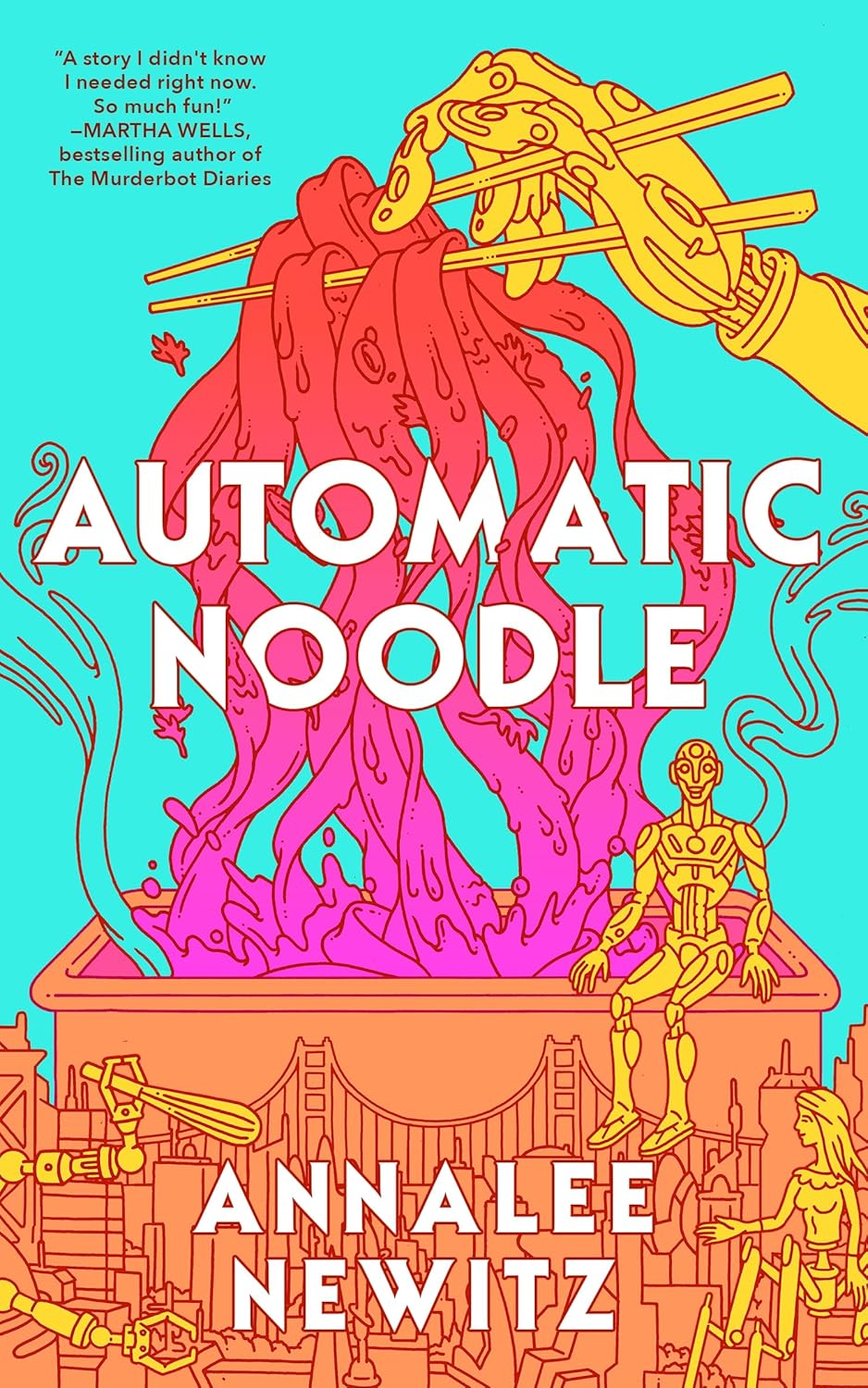
  • Review: Automatic Noodle by Annalee Newitz [2025]

    Spoilers: None
    Genre: Cosy Sci-Fi
    Format ReadPrint
    Disclosure: None (purchased by me)

    Automatic Noodle by Annalee Newitz is virtually perfect. Newitz exquisitely pulls off a chewy tale of survival, camaraderie, and noodle-making. I loved it. Can we have more of these heartfelt, low-but-high-stakes stories, please?

    Rating: 4.75 / 5

    In a near‑future San Francisco, a crew of robots awaken to find they’ve been abandoned along with their employer/owner’s food‑making business, but because of late‑stage capitalism, they also have bills to pay. So they decide to pool their collective skills and set up their own ghost kitchen, selling noodles for collection or delivery. It all seems to go well until the 1‑star reviews.

    Over 160‑odd pages, Newitz tells a low‑stakes but high personal‑impact tale set in the present but kneads into it the origins of each member of the staff, and if you don’t cry when you hear about the memories one of them holds on to in order to relive them, your heart is harder than mine.

    The skill here is that Newitz makes each robot feel alive. They are not just humans in robotic shells; the challenges they face are unique to each of them. And collectively, they have to stay under the radar of the Californian Vigilance Committee.

    It’s the hope for collective success, as well as getting to know them, that is the heart of Automatic Noodle. Seeing the unfairness of the 1‑star reviews, and how manipulation by aggrieved people impacts those who are innocent and harmless, is truly upsetting, but seeing how they go about facing it is heartwarming.

    Highly Recommended

    Note: I rate on a four-tier scale: Loved (4.5–5★), Liked (3.75–4.25★), Mixed (2.75–3.5★), and Not for me (1–2.5★).
  • Sunday Summary: 25th Jan 26

    Sunday Summary mainly functions as my personal record of book-related topics that have captured my interest over the past week. It also acts as a public memory prompt and bookmarking system.

    Books Read & Reading This Week.

    Finished:

    • ???

    Nothing this week.

    Currently Reading: 

    • A Dictator Calls by Ismail Kadare (trans John Hodgson) [2023]
    • The Masquerades of Spring by Ben Aaronovitch (narrated by Kobna Holdbrook-Smith) [2024]
    • The Two Doctors Górski by Isaac Fellman [2022]

    I’ve not read a whole lot this week because I’ve been distracted by other hobbies, but also, I’ve reached a point in The Masquerades of Spring that I’m a bit nervous about. Aaronovitch has put the stakes up with threats against the gay couple, and I’ve read a few reviews to see if there is any hint at an HEA (Happy Ever After) for them. It seems there is but also I don’t think I could handle a ‘bury your gays’ trope popping up.

    The Two Doctors Górski is giving me The Incandescent by Emily Tesh vibes, I wonder how dark it’s going to go? It’s been highly recommended, so no pressure on their taste.

    DNF’d

    • ???

    Nothing this week.

    Book-ish Things

    The preorders are flowing in. This week I’ve recieved:

    • The Apple and the Pearl by Rym Kechacha
    • The Old Fire by Elisa Shua Dusapin [Translated from French by Aneesa Abbas Higgins]
    • Dominion by Addie E. Citchens
    • Nine Goblins by T. Kingfisher

    A good mix of potential reading joy I think you’d agree.

    Non-Book-ish Things

    One of my other major hobbies is video games, and last year I made a more concerted effort to put time into them, which partly helped me cope with the reading slump that dominated the first few months of 2025. At the moment, I’m playing Persona 5 Royal, a JRPG with over 100 hours of gameplay. The problem is, at 50 hours in, I’ve discovered I’ve been playing it wrong. This means I’ve started again, and this time I am paying attention to what the game is telling me and using tips that other players have shared to us.

    So if you’re wondering why I’m not reading. That does have a lot to do with it.

    I’ve also watched the first episode of Star Trek Academy, and I’m sold. Really keen to see what this young crew can do. If you liked Discovery or Voyager, I think you’ll like this.

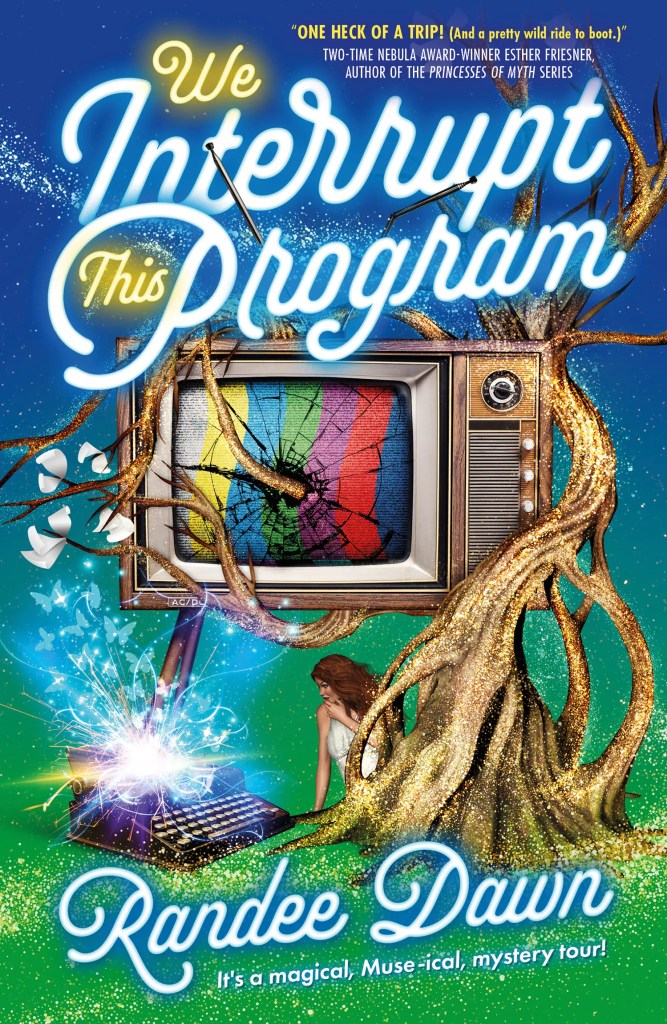
    Cover(s) of the Week

    We Interrupt This Program by 
Randee Dawn

    Outro

    Hopefully, I’ll be able to report that I’ve finished reading something next weekend. Have a good reading week, all.

  • Sunday Summary: 18th Jan 26

    Sunday Summary mainly functions as my personal record of book-related topics that have captured my interest over the past week. It also acts as a public memory prompt and bookmarking system.

    Books Read & Reading This Week.

    Finished:

    • ???

    Nothing this week.

    Currently Reading: 

    • A Dictator Calls by Ismail Kadare (trans John Hodgson) [2023]
    • The Masquerades of Spring by Ben Aaronovitch (narrated by Kobna Holdbrook-Smith) [2024]

    I’m going to be honest and say that I’m struggling with A Dectator Calls. I am going to keep going, but I feel I’m not well-versed enough in Starlin’s Russia to get the gravitas that is part of this novel.

    I am having a great time with The Masquerades of Spring, where a younger Nightingale heads to New York to solve a mystery surrounding a saxophone with the help of an old friend. Kobna Holdbrook-Smith is going an excellnt job as usual.

    DNF’d

    • The Starving Saints by Caitlin Starling [2025]

    I knew I was taking a chance on this, but the early buzz was positive, and the idea of nuns trapped in a castle going mad sounds horrific, but also an idea with a lot of potential.

    I am not a fan of grimdark works in general, and this proves again that I don’t think they are for me. I asked for thoughts on Bluesky, and no one came back saying that I needed to push through. So, as predicted last week, DNF it is.

    Book-ish Thoughts

    Continuing with the topic of DNFs, it’s one of the reasons that I wanted a page count this year; the main reason is that I’m aiming to read 50 pages a day. I don’t count DNFs as read, so before, when I was only tracking books I’d completed, DNF’ing felt like a waste. Now, they are helping with my page count.

    Books That Others Have Tempted Me With:

    Cover(s) of the Week

    Cover to Unearthed: New Horrow of Ancient Ruins

    Outro

    I have no idea what I fancy picking up next – I’ll get both A Dictator Calls and The Masquerades of Spring read and then decide, I think.

    What have you been reading?