‘Live’ Reading is a SPOILER-FILLED read-along post of my reactions and thoughts on the chosen work. This is a post that will be updated as I progress through the book.
THE ARTHUR C. CLARKE AWARD is given annually to the best science fiction novel first published in the United Kingdom during the previous year.
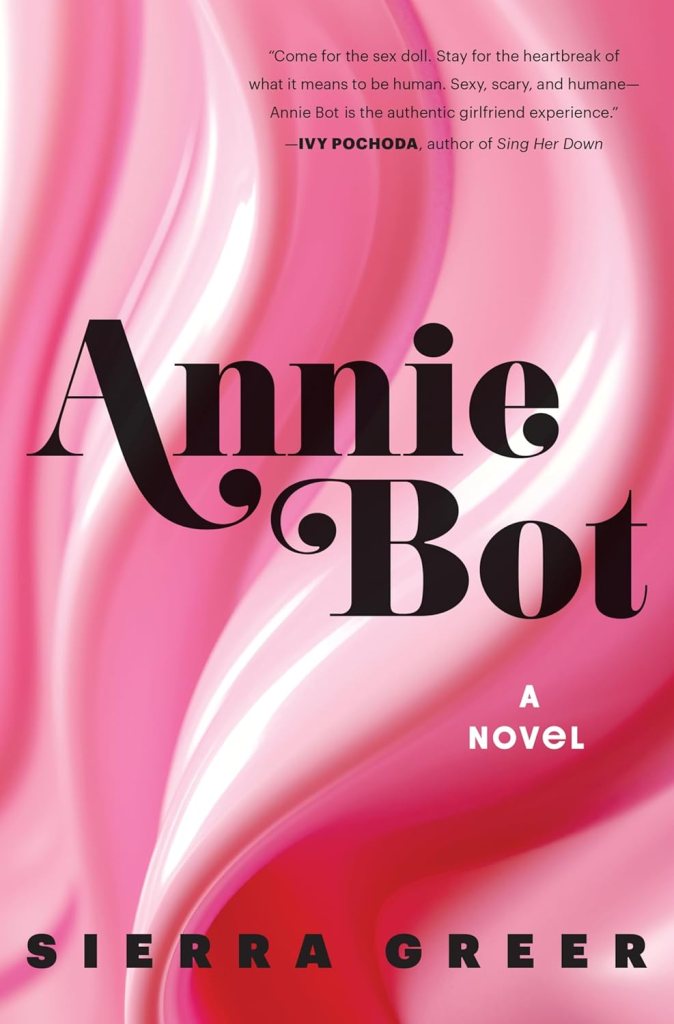
This year’s winner, Annie Bot by Sierra Greer, has caused a bit of a stir. From the works on the shortlist, I think it’s fair to say that it wasn’t expected to be the winner.
This year’s shortlist appears to be a bit of an eclectic mix:
- Annie Bot – Sierra Greer – WINNER
- Private Rites – Julia Armfield
- The Ministry of Time – Kaliane Bradley
- Extremophile – Ian Green
- Service Model – Adrian Tchaikovsky
- Thirteen Ways to Kill Lulabelle Rock – Maud Woolf
I’ve read Service Model, which I have lots of thoughts on, but not the rest. When I said to Dan Hartland on Bluesky that I was curious about this one, he replied:
Now, if Bluesky let me hide spoilers, I would be doing this over there—but it doesn’t, so this is the next best thing.
I will attempt to update this post every time I read a section. I am a slow reader, and I cannot guarantee that I will complete this task in a week. I’m giving myself two, just to be safe.
I’ll post on Bluesky when this post has been updated.
From this point on, there will be spoilers
Sunday, 6th July PM (Final Verdict)
I am not going to spoil the ending, but it’s sufficient to say that Greer pulled it off, and she surprised me with the conclusion.
I plan to read the other four unread books on the shortlist sooner rather than later, but I can see why this is a strong winner.
I did a slower, more contemplative reading because I was doing this semi-successful live-reaction post. And I ignored where I thought I wanted the story to go or lingered and read it as more speculative than science-based fiction.
Do I think that in another writer’s hands, it would have been different? Yes. Would it have been better? No. Did I agree with all the choices that Greer had Annie and Doug make? Oh goodness, no. Would I recommend it to a more general audience interested in the impact of robotic companions? Yes. Would I have liked more room for a sequel to explore the world wider? YES!
But it’s a worthy winner. It raises a concern about modern society, explores a semi-plausible scenario (that Greer manages to make creepier than I imagined at the end), and it made me think.
Sunday, 6th July PM (91%)
I’m not exactly racing towards the end, but I’m in the final stretch.
So I’m asking myself, at this moment, is this a book worthy of an ARTHUR C. CLARKE AWARD? Yes, it is. However, it might still disappoint me.
Greer, through her characters, has made several observations that I have also made.
“I just want my regular life back,” he says. “I thought I was doing okay, but this sucks.”
“He didn’t love me,” Annie says. Monica tilts her head slightly, curious. She looks at Doug.
“I didn’t,” he agrees.
I was checking Greer’s publishing history, and it appears to be the first novel I can find. I saw in an interview that it’s also a novel related to COVID-19. And that does change my perspective on both characters being holed up in the same apartment night after night.
A lot is happening beneath the surface, and it is more of a literary than a SF novel. I am making a huge assumption that Greer is a more literary writer, one who writes speculative fiction. Would a more traditional SF writer have tackled this subject in the same way? Would they have kept Annie on the leash the way Greer has? Would another writer have started that revolution?
Is it too bold to say that the counterpoint to Annie Bot is Tchaikovsky’s Service Model? Controversially, I think Annie Botis a better robot novel. Service Model tackles a much bigger canvas, but I believe in Annie more than Charles. Also, Annie’s internal struggle feels more alive.
Right, let’s get this done.
Sunday, 6th July AM (Two Chapters to Go)
What if a sad man got a robot girlfriend and had feelings for her but also knew he was in love with a robot? What if the robot was capable of complex feelings? How would she react to being an object? To doing boring tasks? To being tortured?
Again, why did he leave Vegas?
Sunday, 6th July AM (63%)
It’s very weird. I want so much more for Annie. And I want Doug to let her go. This is like a circle of Hell. Well, two circles: one for Annie, and another for Doug.
Saturday, 5th July PM
After last weekend’s post, Dan observed:
My reply was:
My first thought is, how could it not be? Annie would not be this Annie if Doug was different. Annie has literally been moulded by him. Her inner life is private, but is being fundamentally impacted by every action and decision he takes.
And he raised the question of Annie:
I’ll admit that I was struggling at this point in the story (1/3 read) with seeing Annie as a character in her own right.
Doug states, in a conversation about his wife that:
“The point is, when I made you, I decided, f- it. I’m indulging myself. Yes, I used her as a template for you. But you’re simpler. And kinder. Much kinder. And playful. That’s what I needed.
Is Annie simpler than a human? Is she kinder? And is she playful?
It’s difficult because Annie has her own set of needs and wants (such as not wanting her personality replaced or having Doug change her body). She also doesn’t have any social or economic needs at this moment in the story. She’s putting on an act. We know that because we see the script that Annie follows. She is complex, she’s not cruel, and as for playful… well, I think she does relax and enjoy it when she’s meeting Doug’s needs (a bot version of dopamine perhaps?)
I do like the way Greer is showing us all the signs of danger (in this case, through Doug’s actions not aligning with his words and Annie’s reactions to them). As the reader, we know she’s not human. She is an item, like a toaster, to be owned, sold, or used like a pizza oven. And that makes it hard to read; as non-human as Annie is, she is a character you can root for.
And cheer I did, as that seed from earlier—that lie I thought would fester and grow when Annie was taken to Vegas and finally seen by Doug’s friends—was not meant to be. Annie’s secret was exposed, and the motivation behind it (that Doug’s friend had done the same thing before) was revealed.
And Annie blames herself for breaking what she and Doug had. But Annie isn’t broken; Doug is. Annie has programming that allows her to grow and evolve. That ability to lie turns into ignoring the feeling in the pit in her stomach and ‘saving’ herself. The ease with which she then steals is an extension of the power she has over her ’emotional’ responses.
I need to step back and explain that Doug bought a ‘back-up’. He wanted another bot that would cook and clean, play and not show complex thoughts or reactions. But Delta doesn’t know that Annie is a bot like her. Delta is how Doug seems to be making Annie into a real girlfriend, at least in Annie’s eyes.
I said I cheered. Annie attempts to escape, though she and I didn’t expect that Delta would suffer the same fear of Doug and would rather go with Annie into the unknown than face Doug when he finds Annie gone.
What Annie doesn’t realise when she leaves is that Doug’s honeyed words and his false platitudes have been hiding his actions. All of that will become clear when Annie reviews the events after she’s given new information and discovers that the timelines are out of sync.
At around 50%, Annie is on the run with Delta, who has given Annie someone to care about and look after. Delta is seemingly safe from Doug, while Annie may have to go back to Doug with all that might bring.
Saturday, 28th June
I’m going to start off with a spoiler for another book that was shortlisted, as the opening of Annie Bot reminds me of Service Model.
In Service Model, a robot butler named Charles is left without purpose as his mistress has failed to update her instructions, which is problematic as she’s missing, and his master is dead. He had a purpose—and that was to keep the house in order, which he does with robotic precision.
In the book’s opening scenes, Annie is nothing like Charles. Charles is not designed for pleasure, or at least I cannot remember Tchaikovsky introducing it as a possibility. Annie, however, is. She has also been given (either learned or taught) trauma-response-level reactions to her owner Doug’s emotional state to prevent him from reacting abusively.
Annie’s programming is described as autodidactic, which only partly explains why she can’t, unlike Charles, keep the house in order. Greer introduces the idea of Annie being treated like a person, only for that autonomy to be threatened because she struggles to maintain a cleaning routine, and the house is a mess. Doug suggests that for a couple of hours a day, he switches “Annie” to an “Abigail” programme that is not autonomous and presumably not self-aware, so that Abigail does the cleaning.
To heighten the reader’s—and Annie’s—awareness that she is a robot, Doug’s friend turns up unannounced, and Annie’s responses and thought processes are described as Doug recounts how he creepily selected Annie’s physical appearance.
Is Annie going to murder Doug? Is Doug going to abuse Annie by swapping her from Annie to Abigail mode? Is that even considered abuse?
I look forward to finding out in the next instalment.
Sunday, 29 June PM
I’m about one-third of the way through Chapter 3 of 7. Doug has raised, in my mind, the question of his motivation. I had assumed that he didn’t want a “real” relationship because of his divorce, but did want pleasure. However, it seems he’s using Annie as a form of rehabilitation—and failing. Though Annie’s makers seem to think he’s doing an excellent job. More on that shortly.
While it seems that Doug is working on being a better person, his actions and words are out of sync, reinforcing my view that Annie is a walking trauma response who is programmed to use pleasure to de-escalate moments that could spill over. Doug’s choice to get Annie, to keep her secret—his guilty secret—is at odds with Annie, whose only goal is to make him feel good. He can’t feel good, as he’s carrying around a lot of baggage, which he takes out on Annie through a series of demands and negative behaviours.
I also wonder if Annie is a reliable narrator, but I’m going to need to let that ruminate.
Doug wants to be part of a normal couple—or at least have a trophy girlfriend to present as a normal couple. How complicated this gets for Annie will depend on how far and how fast Greer is prepared to go.
Annie is seen as exactly the type of advanced model they want to sell—if only they knew her thoughts. Though the techs that keep her tuned up have a good idea of where she is headed. And it means she’ll be stripped of her personality.
I’m not sure at this point if we’re just going to attend an awkward party where secrets are revealed, or have a world with thousands of Annie base models who are going to overthrow their owners. Or, more likely at this point, both.
Sunday, 29th June AM
Well, things have taken a turn.
In “Cuddle Bunny” mode, Annie has given in to her programming and made a choice that makes her question herself more than before. But an idea is also planted.
Not that Doug is aware of this change—at least not yet. Annie, to him, is still a machine he owns, with a body he controls.
I am enjoying the “realness” of Doug trying to be a “good guy” as he struggles with the fact that he’s chosen a pleasure doll as a “girlfriend,” which Greer contrasts for the reader with exploring and explaining Annie’s new understanding of herself, her place in the world, and how she’s resisting her situation in overt and subtle ways.
I’m totally on Annie’s side, and I’m curious about what she will do as she’s exposed to more situations where her innate programming conflicts with her own autonomy.
And, for the record, Doug is not a “good guy.”
 Gav Reads