
Niall Harrison’s review in Locus magazine does provide answers.
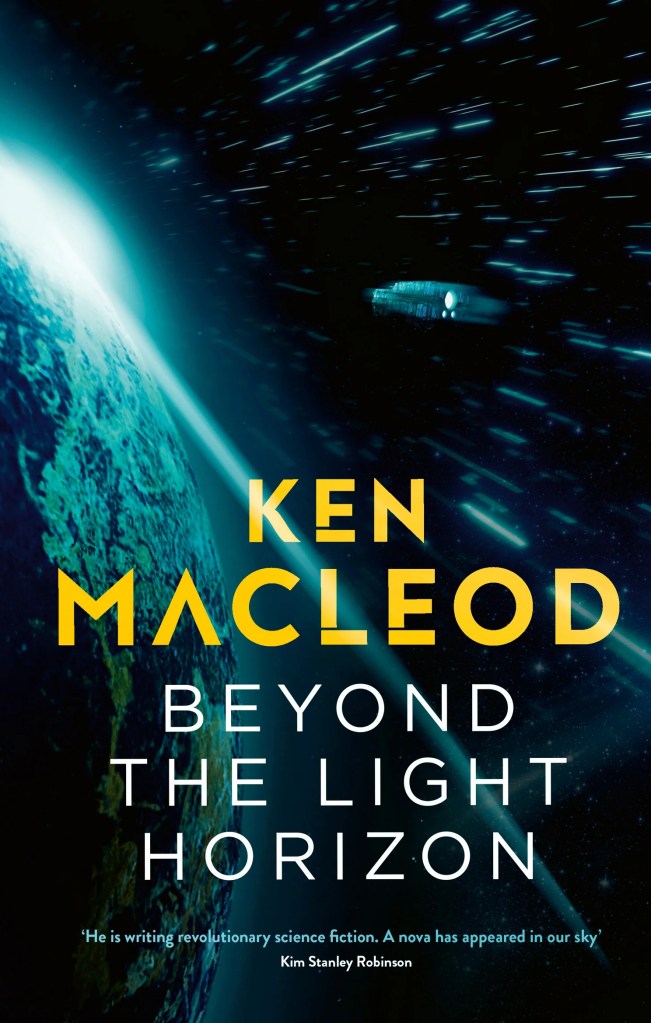
However, I was unsatisfied with the ending. This feeling wasn’t helped by my e-reader telling me that there was 12% left. It ended on the first of what I was hoping were several post-script chapters. And I was promoted to post this on Bluesky:
I have just finished [Beyond the Light Horizon], and I feel like I have been cheated out of chapters at the end. Hmmmm.
Have I forgotten that one of Science Fiction’s roles is to look at the big questions, and it uses a story wrapper to do that?
From my reaction to this work, it seems I have. Niall hasn’t taken much more away from the trilogy than I did.
In a nutshell, an AI called ‘Iskander’ is a predictive AI that can anticipate your needs and set things in motion so they happen at the right time. Think of it as wanting to go out and finding you don’t have to wait for a taxi because it is already outside.
What it sets in motion in the trilogy is the discovery of Faster Than Light Travel, which results in a submarine/spaceship being built in Scotland. This then causes a chain reaction to open the world’s eyes to a deep conspiracy in which FTL has been a worldwide secret project.
On reflection, this series is tackling a lot of big ideas:
- there are at least three versions of AI supporting/controlling the three main human geopolitical alliances
- the way the countries have aligned themselves
- the socioeconomic impacts of those allegiances
- the impact of climate change, either natural or manmade
- experimentation with evolution (and seeding/sharing flora and fauna) across different planets
After planting the seeds, MacLeod leaves it up to the reader to decide what happens next. And I think he does his story and audience a disservice here. Partly because he places his main character, Grant, back in a box and back on his original rails. And partly because there doesn’t seem to be anybody to take up the mantle.
Sure. Treaties are reinforced by force. New economic ties are arranged for between world trade are established but in the flashforward postscript those aren’t addressed for their impact or how integration between the Earth factions, and the other worlds they’ve colonised are working out – and more importantly for me if those other world inhabitants have been to Earth to establish themselves there.
But overall, the grounding of Grant popped a bubble; it felt like the author didn’t want Grant to grow or change despite the extraordinary things he’d be instrumental in initiating.
 Gav Reads
Leave a reply to EoY 2025: Will I be back in 2026? – Gav Reads Cancel reply